Recombinant Human Growth/differentiation factor 6 (GDF6) (Active)

Recombinant Human Growth/differentiation factor 6 (GDF6) (Active) — Growth factor that controls proliferation and cellular differentiation in the retina and bone formation. Purity > 95 %.

SKU: BCACP-000014 Category:
Product SKUBCACP-000014
Product DescriptionRecombinant Human Growth/differentiation factor 6 (GDF6) protein is expressed from E.Coli with Tag-Free. It contains 336-455aa. [Accession | Q6KF10].
Uniprot No.Q6KF10
Gene NamesGDF6
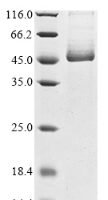
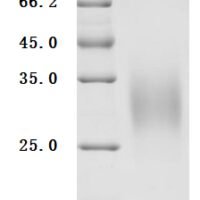
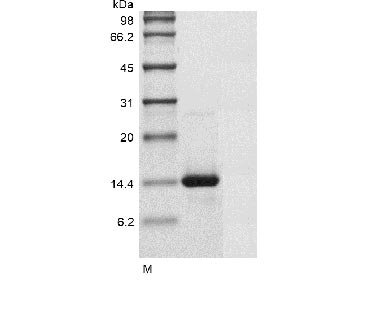
Purity> 95 % as determined by SDS-PAGE
Expression SystemE.Coli
Expression Region336-455aa
SpeciesHomo sapiens (Human)
Tag InfoTag-Free
Molecular weight13.6 kDa
ActivityFully biologically active when compared to standard. The ED50 as determined by inducing alkaline phosphatase production of murine ATDC5 cells is less than 2.0 μg/ml, corresponding to a specific activity of > 500 IU/mg.
BufferLyophilized from a 0.2 μm filtered 20 mM Tris-HCl, 0.5 M NaCl, 6% Trehalose, pH 8.0
StorageStore at -20°C/-80°C upon receipt, aliquoting is necessary for mutiple use. Avoid repeated freeze-thaw cycles.
Alternative NamesGDF6; BMP13; GDF16Growth/differentiation factor 6; GDF-6; Bone morphogenetic protein 13; BMP-13; Growth/differentiation factor 16

Function

Growth factor that controls proliferation and cellular differentiation in the retina and bone formation. Plays a key role in regulating apoptosis during retinal development. Establishes dorsal-ventral positional information in the retina and controls the formation of the retinotectal map.

Biological Context

Subcellular Location: Secreted
Disease Association: Klippel-Feil syndrome 1, autosomal dominant (KFS1) : A skeletal disorder characterized by congenital fusion of cervical vertebrae. It is due to a failure in the normal segmentation of vertebrae during the early weeks of fetal development. The clinical triad consists of short neck, low posterior hairline, and limited neck movement. Deafness is a feature in some cases and may be of sensorineural, conductive, or mixed type. [The disease is caused by variants affecting the gene represented in this entry] | [A chromosomal aberration involving GDF6 has been found in a patient with Klippel-Feil syndrome (KFS). Paracentric inv(8)(q22;2q23.3)] | Microphthalmia, isolated, 4 (MCOP4) : A disorder of eye formation, ranging from small size of a single eye to complete bilateral absence of ocular tissues. Ocular abnormalities like opacities of the cornea and lens, scaring of the retina and choroid, and other abnormalities may also be present. [The disease is caused by variants affecting the gene represented in this entry] | Leber congenital amaurosis 17 (LCA17) : A severe dystrophy of the retina, typically becoming evident in the first years of life. Visual function is usually poor and often accompanied by nystagmus, sluggish or almost absent pupillary responses, photophobia, high hyperopia and keratoconus. [The disease is caused by variants affecting the gene represented in this entry] | Multiple synostoses syndrome 4 (SYNS4) : A bone disease characterized by multiple progressive joint fusions that commonly involve proximal interphalangeal, tarsal-carpal, humeroradial and cervical spine joints. Additional features can include progressive conductive deafness and facial dysmorphism. SYNS4 inheritance is autosomal dominant. [The disease is caused by variants affecting the gene represented in this entry] | Deafness, autosomal recessive, 118, with cochlear aplasia (DFNB118) : A form of non-syndromic deafness characterized by congenital profound sensorineural hearing loss and cochlear aplasia. Sensorineural hearing loss results from damage to the neural receptors of the inner ear, the nerve pathways to the brain, or the area of the brain that receives sound information. [The gene represented in this entry is involved in disease pathogenesis. Homozygous deletions on chromosome 8 removing putative enhancers of GDF6, segregate with the disease in families with congenital deafness and cochlear aplasia]

Product Specifications

Recombinant Human Growth/differentiation factor 6 (GDF6) (Active) is a recombinant protein from Homo sapiens (Human), expressed in E.Coli, covering amino acids 336-455aa, with Tag-Free tag, molecular weight 13.6 kDa, purity > 95 % as determined by SDS-PAGE. Suitable for ELISA and Western Blot applications.

SDS-PAGE: Single band at expected molecular weight confirming purity.

ELISA: Suitable as coating antigen or detection standard.

Western Blot: Compatible with standard Western Blot protocols.

Protein Interaction: Validated for SPR (Surface Plasmon Resonance) and BLI (Bio-Layer Interferometry) studies.

Shipping: Shipped at ambient temperature. Lyophilized protein is stable during transit.

Storage: Store lyophilized protein at -20°C to -80°C. Reconstituted protein should be aliquoted and stored at -80°C. Avoid repeated freeze-thaw cycles.

Shelf Life: 12 months from date of receipt when stored as recommended.

Shipping Time: Orders placed before 2 PM EST ship same day. International orders typically deliver within 5-10 business days.

Protein Biology

Function

Growth factor that controls proliferation and cellular differentiation in the retina and bone formation. Plays a key role in regulating apoptosis during retinal development. Establishes dorsal-ventral positional information in the retina and controls the formation of the retinotectal map (PubMed:23307924). Required for normal formation of bones and joints in the limbs, skull, digits and axial skeleton. Plays a key role in establishing boundaries between skeletal elements during development. Regulation of GDF6 expression seems to be a mechanism for evolving species-specific changes in skeletal structures. Seems to positively regulate differentiation of chondrogenic tissue through the growth factor receptors subunits BMPR1A, BMPR1B, BMPR2 and ACVR2A, leading to the activation of SMAD1-SMAD5-SMAD8 complex. The regulation of chondrogenic differentiation is inhibited by NOG (PubMed:26643732). Also involved in the induction of adipogenesis from mesenchymal stem cells. This mechanism acts through the growth factor receptors subunits BMPR1A, BMPR2 and ACVR2A and the activation of SMAD1-SMAD5-SMAD8 complex and MAPK14/p38 (By similarity)

Subcellular Location

Secreted

Disease Association

Klippel-Feil syndrome 1, autosomal dominant (KFS1) : A skeletal disorder characterized by congenital fusion of cervical vertebrae. It is due to a failure in the normal segmentation of vertebrae during the early weeks of fetal development. The clinical triad consists of short neck, low posterior hairline, and limited neck movement. Deafness is a feature in some cases and may be of sensorineural, conductive, or mixed type. [The disease is caused by variants affecting the gene represented in this entry] | [A chromosomal aberration involving GDF6 has been found in a patient with Klippel-Feil syndrome (KFS). Paracentric inv(8)(q22;2q23.3)] | Microphthalmia, isolated, 4 (MCOP4) : A disorder of eye formation, ranging from small size of a single eye to complete bilateral absence of ocular tissues. Ocular abnormalities like opacities of the cornea and lens, scaring of the retina and choroid, and other abnormalities may also be present. [The disease is caused by variants affecting the gene represented in this entry] | Leber congenital amaurosis 17 (LCA17) : A severe dystrophy of the retina, typically becoming evident in the first years of life. Visual function is usually poor and often accompanied by nystagmus, sluggish or almost absent pupillary responses, photophobia, high hyperopia and keratoconus. [The disease is caused by variants affecting the gene represented in this entry] | Multiple synostoses syndrome 4 (SYNS4) : A bone disease characterized by multiple progressive joint fusions that commonly involve proximal interphalangeal, tarsal-carpal, humeroradial and cervical spine joints. Additional features can include progressive conductive deafness and facial dysmorphism. SYNS4 inheritance is autosomal dominant. [The disease is caused by variants affecting the gene represented in this entry] | Deafness, autosomal recessive, 118, with cochlear aplasia (DFNB118) : A form of non-syndromic deafness characterized by congenital profound sensorineural hearing loss and cochlear aplasia. Sensorineural hearing loss results from damage to the neural receptors of the inner ear, the nerve pathways to the brain, or the area of the brain that receives sound information. [The gene represented in this entry is involved in disease pathogenesis. Homozygous deletions on chromosome 8 removing putative enhancers of GDF6, segregate with the disease in families with congenital deafness and cochlear aplasia]

Subunit

Homodimer; disulfide-linked

Gene: GDF6  |  Organism: Homo sapiens  |  Synonyms: Bone morphogenetic protein 13; Growth/differentiation factor 16
Key Publications

Frequently Asked Questions

How do I order or inquire about this product?

Fill out the Online Inquiry form with your required quantity and specifications. You can also email sales@biocrestsci.com. Our team typically responds within 4 business hours with a quote and availability confirmation.

What is the shipping and delivery time?

Orders placed before 2 PM EST ship the same day. Domestic (US) delivery typically takes 2-3 business days. International orders deliver within 5-10 business days. All products are shipped at ambient temperature with appropriate packaging to ensure stability.

How should I store this recombinant protein?

Lyophilized proteins should be stored at -20°C to -80°C upon receipt. After reconstitution, aliquot and store at -80°C. Avoid repeated freeze-thaw cycles. Shelf life is 12 months from date of receipt when stored as recommended.

What quality controls are performed on your products?

Each product undergoes SDS-PAGE purity analysis (typically >85-95%), endotoxin testing, and bioactivity validation. Products are validated for ELISA, Western Blot, and SPR/BLI applications as specified on this product page. A Certificate of Analysis (CoA) is available upon request.

Shopping Cart
Scroll to Top