, ,

Recombinant Human Transmembrane protease serine 2 (TMPRSS2), partial (Active)

Recombinant Human Transmembrane protease serine 2 (TMPRSS2), partial (Active) — (Microbial infection) Receptor for human coronavirus HKU1-CoV, acts synergistically with disialoside glycans to facilitate the entry of the virus. Purity >85%.

SKU: BCACP-000019 Categories: , ,
Product SKUBCACP-000019
Product DescriptionRecombinant Human Transmembrane protease serine 2 (TMPRSS2) protein is expressed from Yeast with N-terminal 6xHis-tagged. It contains 106-492 aa. [Accession | O15393].
Uniprot No.O15393
Gene NamesTMPRSS2
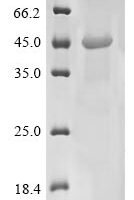
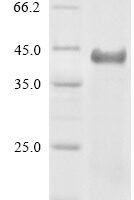
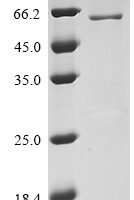
PurityGreater than 85% as determined by SDS-PAGE.
Expression SystemYeast
Expression Region106-492 aa
SpeciesHomo sapiens (Human)
Tag InfoN-terminal 6xHis-tagged
Molecular weight44.8kDa
ActivityRecombinant Human TMPRSS2 His tag protein enzyme activity is measured by its ability to cleave fluorogenic peptide substrate(Boc-Gln-Ala-Arg-AMC), The Km is 21.93μM.;Measured by Camostat Mesylate inhibit ratio on TMPRSS2 , which can cleave fluorogenic peptide substrate (Boc-Gln-Ala-Arg-AMC). The Camostat Mesylate inhibit EC50 is 0.03347-0.07945μM.
BufferLyophilized from a 0.2 μm filtered 20 mM Tris-HCl, 0.5 M NaCl, 6% Trehalose, pH 8.0
StorageStore at -20°C/-80°C upon receipt, aliquoting is necessary for mutiple use. Avoid repeated freeze-thaw cycles.
Alternative NamesTMPRSS2; PRSS10; Transmembrane protease serine 2; Serine protease 10

Function

(Microbial infection) Receptor for human coronavirus HKU1-CoV, acts synergistically with disialoside glycans to facilitate the entry of the virus. After binding to cell-surface disialoside glycans, the viral S protein interacts with the inactive form of TMPRSS2 and inhibits its protease activity.

Biological Context

Subcellular Location: Secreted
Tissue Specificity: Expressed in several tissues that comprise large populations of epithelial cells with the highest level of transcripts measured in the prostate gland. Expressed in type II pneumocytes in the lung (at protein level). Expressed strongly in small intestine. Also expressed in colon, stomach and salivary gland. Coexpressed with ACE2 within lung type II pneumocytes, ileal absorptive enterocytes, intestinal epithelial cells, cornea, gallbladder and nasal goblet secretory cells (Ref.21)

Product Specifications

Recombinant Human Transmembrane protease serine 2 (TMPRSS2), partial (Active) is a recombinant protein from Homo sapiens (Human), expressed in Yeast, covering amino acids 106-492 aa, with N-terminal 6xHis-tagged tag, molecular weight 44.8kDa, purity Greater than 85% as determined by SDS-PAGE.. Suitable for ELISA and Western Blot applications.

Recommended applications depend on the target, product format, and product-specific validation data. Refer to the product datasheet or Certificate of Analysis (CoA), or contact BioCrest Sci for application guidance.

Biological Activity: Recombinant Human TMPRSS2 His tag protein enzyme activity is measured by its ability to cleave fluorogenic peptide substrate(Boc-Gln-Ala-Arg-AMC), The Km is 21.93μM.;Measured by Camostat Mesylate inhibit ratio on TMPRSS2 , which can cleave fluorogenic peptide substrate (Boc-Gln-Ala-Arg-AMC). The Camostat Mesylate inhibit EC50 is 0.03347-0.07945μM.

Storage: Store at -20°C/-80°C upon receipt, aliquoting is necessary for mutiple use. Avoid repeated freeze-thaw cycles.

Shipping & Lead Time: Availability, shipping conditions, and estimated lead time are confirmed in the formal quotation or order confirmation based on the product format, destination, and order requirements.

Protein Biology

Function

(Microbial infection) Receptor for human coronavirus HKU1-CoV, acts synergistically with disialoside glycans to facilitate the entry of the virus. After binding to cell-surface disialoside glycans, the viral S protein interacts with the inactive form of TMPRSS2 and inhibits its protease activity

Subcellular Location

Secreted

Tissue Specificity

Expressed in several tissues that comprise large populations of epithelial cells with the highest level of transcripts measured in the prostate gland. Expressed in type II pneumocytes in the lung (at protein level). Expressed strongly in small intestine. Also expressed in colon, stomach and salivary gland. Coexpressed with ACE2 within lung type II pneumocytes, ileal absorptive enterocytes, intestinal epithelial cells, cornea, gallbladder and nasal goblet secretory cells (Ref.21)

Subunit

The catalytically active form interacts with ACE2

Gene: TMPRSS2  |  Organism: Homo sapiens  |  Synonyms: Serine protease 10
Key Publications

Frequently Asked Questions

How do I order or inquire about this product?

Submit the Online Inquiry form with your required quantity and specifications, or email sales@biocrestsci.com. Available sizes, pricing, stock status, documentation, and estimated lead time are confirmed in the formal quotation.

What is the shipping and delivery time?

Availability, dispatch timing, shipping conditions, and delivery estimates depend on the product format, destination, and order requirements. These details are confirmed in the formal quotation or order confirmation.

How should this product be stored?

Follow the storage and handling instructions in the product-specific datasheet and Certificate of Analysis (CoA). Requirements may vary by product form and formulation; contact BioCrest Sci if product-specific guidance is needed.

What quality controls are performed on your products?

Quality-control data such as identity, purity, endotoxin level, or biological activity are provided only when specified on this product page, the datasheet, or Certificate of Analysis (CoA). Biological activity is not implied unless explicitly stated.

Shopping Cart
Scroll to Top