Recombinant Mouse Microtubule-associated protein tau (Mapt) (Active)

Recombinant Mouse Microtubule-associated protein tau (Mapt) (Active) — Promotes microtubule assembly and stability, and might be involved in the establishment and maintenance of neuronal polarity. Purity >90%.

SKU: BCACP-000173 Category:
Product SKUBCACP-000173
Product DescriptionRecombinant Mouse Microtubule-associated protein tau (Mapt) protein is expressed from Mammalian cell with N-terminal 10xHis-tagged. It contains 2-733aa. [Accession | P10637].
Uniprot No.P10637
Gene NamesMapt
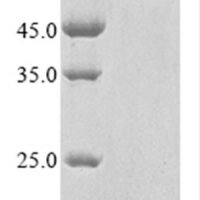
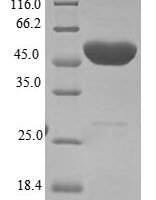
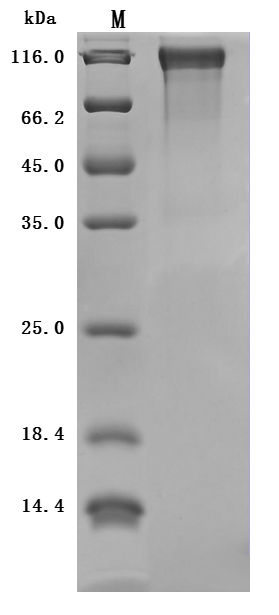
PurityGreater than 90% as determined by SDS-PAGE.
Expression SystemMammalian cell
Expression Region2-733aa
SpeciesMus musculus (Mouse)
Tag InfoN-terminal 10xHis-tagged
Molecular weight78.9 kDa
ActivityMeasured by its binding ability in a functional ELISA. Immobilized Human TFPI at 1 μg/mL can bind Anti-TFPI recombinant antibody , the EC50 is 1.242-1.788 ng/mL.
BufferLyophilized from a 0.2 μm filtered 20 mM Tris-HCl, 0.5 M NaCl, 6% Trehalose, pH 8.0
StorageStore at -20°C/-80°C upon receipt, aliquoting is necessary for mutiple use. Avoid repeated freeze-thaw cycles.
Alternative Names(Neurofibrillary tangle protein) (Paired helical filament-tau) (PHF-tau)

Function

Promotes microtubule assembly and stability, and might be involved in the establishment and maintenance of neuronal polarity. The C-terminus binds axonal microtubules while the N-terminus binds neural plasma membrane components, suggesting that tau functions as a linker protein between both. Axonal polarity is predetermined by tau localization (in the neuronal cell) in the domain of the cell body defined by the centrosome.

Biological Context

Subcellular Location: Cytoplasm, cytosol; Cell membrane (Peripheral membrane protein); Cytoplasm, cytoskeleton; Cell projection, axon; Cell projection, dendrite; Secreted
Tissue Specificity: Expressed in neurons and at a lower level in the liver and kidney. Isoform PNS-tau is expressed in the peripheral nervous system while the others are expressed in the central nervous system
Disease Association: [May be involved in the pathogenesis of cytoplasmic inclusions (as Mallory bodies) in livers of mice chronically intoxicated with Griseofulvin or DDC (3,5-diethoxycarbonyl-2,4-dihydrocollidine), a model for human alcoholic hepatitis. Alteration of Tau (abnormal phosphorylation and cross-linking) could contribute to Mallory bodies formation and disturbance of microtubule function in alcoholic liver disease]

Product Specifications

Recombinant Mouse Microtubule-associated protein tau (Mapt) (Active) is a recombinant protein from Mus musculus (Mouse), expressed in Mammalian cell, covering amino acids 2-733aa, with N-terminal 10xHis-tagged tag, molecular weight 78.9 kDa, purity Greater than 90% as determined by SDS-PAGE.. Suitable for ELISA and Western Blot applications.
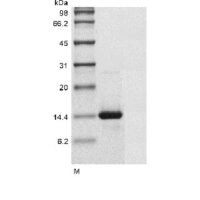
SDS-PAGE: Single band at expected molecular weight confirming purity.

ELISA: Suitable as coating antigen or detection standard.

Western Blot: Compatible with standard Western Blot protocols.

Protein Interaction: Validated for SPR (Surface Plasmon Resonance) and BLI (Bio-Layer Interferometry) studies.

Shipping: Shipped at ambient temperature. Lyophilized protein is stable during transit.

Storage: Store lyophilized protein at -20°C to -80°C. Reconstituted protein should be aliquoted and stored at -80°C. Avoid repeated freeze-thaw cycles.

Shelf Life: 12 months from date of receipt when stored as recommended.

Shipping Time: Orders placed before 2 PM EST ship same day. International orders typically deliver within 5-10 business days.

Protein Biology

Function

Promotes microtubule assembly and stability, and might be involved in the establishment and maintenance of neuronal polarity. The C-terminus binds axonal microtubules while the N-terminus binds neural plasma membrane components, suggesting that tau functions as a linker protein between both. Axonal polarity is predetermined by tau localization (in the neuronal cell) in the domain of the cell body defined by the centrosome. The short isoforms allow plasticity of the cytoskeleton whereas the longer isoforms may preferentially play a role in its stabilization

Subcellular Location

Cytoplasm, cytosol; Cell membrane (Peripheral membrane protein); Cytoplasm, cytoskeleton; Cell projection, axon; Cell projection, dendrite; Secreted

Disease Association

[May be involved in the pathogenesis of cytoplasmic inclusions (as Mallory bodies) in livers of mice chronically intoxicated with Griseofulvin or DDC (3,5-diethoxycarbonyl-2,4-dihydrocollidine), a model for human alcoholic hepatitis. Alteration of Tau (abnormal phosphorylation and cross-linking) could contribute to Mallory bodies formation and disturbance of microtubule function in alcoholic liver disease]

Tissue Specificity

Expressed in neurons and at a lower level in the liver and kidney. Isoform PNS-tau is expressed in the peripheral nervous system while the others are expressed in the central nervous system

Subunit

Interacts with MARK1, MARK2, MARK3 and MARK4 (By similarity). Interacts with SQSTM1 when polyubiquitinated (PubMed:15953362). Interacts with PSMC2 through SQSTM1 (PubMed:15953362). Interacts with FKBP4 (By similarity). Binds to CSNK1D (By similarity). Interacts with SGK1 (By similarity). Interacts with EPM2A; the interaction dephosphorylates MAPT at Ser-369 (By similarity). Interacts with PIN1 (By similarity). Interacts with LRRK2 (By similarity). Interacts with LRP1, leading to endocytosis; this interaction is reduced in the presence of LRPAP1/RAP (By similarity)

Gene: Mapt  |  Organism: Mus musculus  |  Synonyms: Neurofibrillary tangle protein; Paired helical filament-tau
Key Publications

Frequently Asked Questions

How do I order or inquire about this product?

Fill out the Online Inquiry form with your required quantity and specifications. You can also email sales@biocrestsci.com. Our team typically responds within 4 business hours with a quote and availability confirmation.

What is the shipping and delivery time?

Orders placed before 2 PM EST ship the same day. Domestic (US) delivery typically takes 2-3 business days. International orders deliver within 5-10 business days. All products are shipped at ambient temperature with appropriate packaging to ensure stability.

How should I store this recombinant protein?

Lyophilized proteins should be stored at -20°C to -80°C upon receipt. After reconstitution, aliquot and store at -80°C. Avoid repeated freeze-thaw cycles. Shelf life is 12 months from date of receipt when stored as recommended.

What quality controls are performed on your products?

Each product undergoes SDS-PAGE purity analysis (typically >85-95%), endotoxin testing, and bioactivity validation. Products are validated for ELISA, Western Blot, and SPR/BLI applications as specified on this product page. A Certificate of Analysis (CoA) is available upon request.

Shopping Cart
Scroll to Top