Function
Endoplasmic reticulum (ER) calcium-selective channel preventing intracellular Ca2(+) stores from overfilling and maintaining calcium homeostasis in the ER. In response to endoplasmic reticulum (ER) Ca2(+) overloading, assembles into a homotetramer, forming a functional calcium-selective channel facilitating Ca2(+) release. Mediates ER Ca2(+) homeostasis in osteoblasts and plays a key role in bone formation, via the CaMKII-HDAC4-RUNX2 signaling axis.
Biological Context
Subcellular Location: Endoplasmic reticulum membrane (Multi-pass membrane protein); Golgi apparatus membrane (Multi-pass membrane protein); Mitochondrion membrane (Multi-pass membrane protein)
Tissue Specificity: Widely expressed in adult and fetal tissues, with higher levels in thymus, prostate, testis and small intestine and lower levels in brain, placenta, lung and kidney. Present in most tissues in the eye, including the trabecular meshwork and retina (at protein level)
Disease Association: Craniofacial dysmorphism, skeletal anomalies and impaired intellectual development syndrome 1 (CFSMR1) : An autosomal recessive disorder characterized by craniofacial and skeletal anomalies, associated with intellectual disability. Typical craniofacial dysmorphism include brachycephaly, highly arched bushy eyebrows, synophrys, long eyelashes, low-set ears, microdontism of primary teeth, and generalized gingival hyperplasia, whereas Sprengel deformity of scapula, fusion of spine, rib abnormities, pectus excavatum, and pes planus represent skeletal anomalies. [The disease is caused by variants affecting the gene represented in this entry] | Glaucoma, primary open angle (POAG) : A complex and genetically heterogeneous ocular disorder characterized by a specific pattern of optic nerve and visual field defects. The angle of the anterior chamber of the eye is open, and usually the intraocular pressure is increased. However, glaucoma can occur at any intraocular pressure. The disease is generally asymptomatic until the late stages, by which time significant and irreversible optic nerve damage has already taken place. In some cases, POAG shows digenic inheritance involving mutations in CYP1B1 and MYOC genes. [Disease susceptibility is associated with variants affecting the gene represented in this entry]
Product Specifications
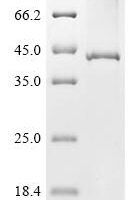
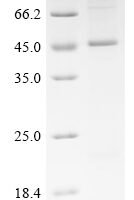
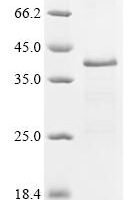
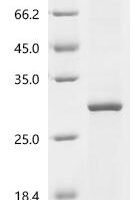
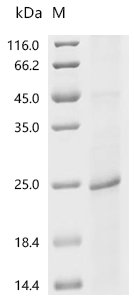
Recombinant Human Calcium load-activated calcium channel (TMCO1) Protein is a recombinant protein from Homo sapiens (Human), expressed in in vitro E.coli expression system, covering amino acids 1-188aa, with N-terminal 10xHis-tagged tag, molecular weight 22.7kDa, purity Greater than 85% as determined by SDS-PAGE.. Suitable for ELISA and Western Blot applications.