Recombinant Human Caveolin-1 (CAV1) Protein

Recombinant Human Caveolin-1 (CAV1) Protein — May act as a scaffolding protein within caveolar membranes. Purity >90%.

SKU: BCRECP-00375TM Category:

Product Specifications

Uniprot No.Q03135
Gene NamesCAV1
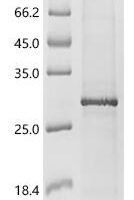
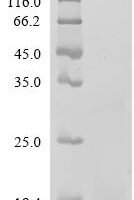
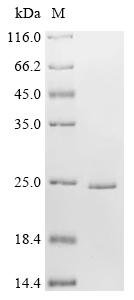
PurityGreater than 90% as determined by SDS-PAGE.
Expression Systemin vitro E.coli expression system
Expression Region1-178aa
SpeciesHomo sapiens (Human)
Tag InfoN-terminal 10xHis-tagged
Molecular weight22kDa
ActivityNot Test
BufferIf the delivery form is liquid, the default storage buffer is Tris/PBS-based buffer, 5%-50% glycerol.If the delivery form is lyophilized powder, the buffer before lyophilization is Tris/PBS-based buffer, 6% Trehalose.
StorageStore at -20°C/-80°C upon receipt, aliquoting is necessary for mutiple use. Avoid repeated freeze-thaw cycles.

Function

May act as a scaffolding protein within caveolar membranes. Forms a stable heterooligomeric complex with CAV2 that targets to lipid rafts and drives caveolae formation. Mediates the recruitment of CAVIN proteins (CAVIN1/2/3/4) to the caveolae.

Biological Context

Subcellular Location: Golgi apparatus membrane (Peripheral membrane protein); Cell membrane (Peripheral membrane protein); Membrane, caveola (Peripheral membrane protein); Membrane raft; Golgi apparatus, trans-Golgi network; Cytoplasm
Tissue Specificity: Skeletal muscle, liver, stomach, lung, kidney and heart (at protein level). Expressed in the brain
Disease Association: Lipodystrophy, congenital generalized, 3 (CGL3) : A form of congenital generalized lipodystrophy, a metabolic disorder characterized by a near complete absence of adipose tissue, extreme insulin resistance, hypertriglyceridemia, hepatic steatosis and diabetes mellitus. CGL3 inheritance is autosomal recessive. [The disease is caused by variants affecting the gene represented in this entry] | Pulmonary hypertension, primary, 3 (PPH3) : A rare disorder characterized by plexiform lesions of proliferating endothelial cells in pulmonary arterioles. The lesions lead to elevated pulmonary arterial pression, right ventricular failure, and death. The disease can occur from infancy throughout life and it has a mean age at onset of 36 years. Penetrance is reduced. Although familial pulmonary hypertension is rare, cases secondary to known etiologies are more common and include those associated with the appetite-suppressant drugs. [The disease is caused by variants affecting the gene represented in this entry] | Lipodystrophy, familial partial, 7 (FPLD7) : A form of partial lipodystrophy, a disorder characterized by abnormal subcutaneous fat distribution. Affected individuals manifest a gradual loss of subcutaneous adipose tissue in various parts of the body, accompanied by an accumulation of adipose tissue in the face and neck in some cases causing a double chin, fat neck, or cushingoid appearance. FPLD7 is an autosomal dominant form with a variable phenotype. Some patients manifest congenital cataracts and neurodegeneration leading to cerebellar and spinal cord dysfunction. [The disease is caused by variants affecting the gene represented in this entry]

Product Specifications

Recombinant Human Caveolin-1 (CAV1) Protein is a recombinant protein from Homo sapiens (Human), expressed in in vitro E.coli expression system, covering amino acids 1-178aa, with N-terminal 10xHis-tagged tag, molecular weight 22kDa, purity Greater than 90% as determined by SDS-PAGE.. Suitable for ELISA and Western Blot applications.
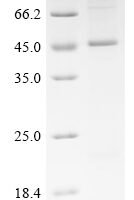
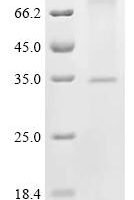
SDS-PAGE: Single band at expected molecular weight confirming purity.

ELISA: Suitable as coating antigen or detection standard.

Western Blot: Compatible with standard Western Blot protocols.

Protein Interaction: Validated for SPR (Surface Plasmon Resonance) and BLI (Bio-Layer Interferometry) studies.

Shipping: Shipped at ambient temperature. Lyophilized protein is stable during transit.

Storage: Store lyophilized protein at -20°C to -80°C. Reconstituted protein should be aliquoted and stored at -80°C. Avoid repeated freeze-thaw cycles.

Shelf Life: 12 months from date of receipt when stored as recommended.

Shipping Time: Orders placed before 2 PM EST ship same day. International orders typically deliver within 5-10 business days.

Protein Biology

Function

May act as a scaffolding protein within caveolar membranes (PubMed:11751885). Forms a stable heterooligomeric complex with CAV2 that targets to lipid rafts and drives caveolae formation. Mediates the recruitment of CAVIN proteins (CAVIN1/2/3/4) to the caveolae (PubMed:19262564). Interacts directly with G protein alpha subunits and can functionally regulate their activity (By similarity). Involved in the costimulatory signal essential for T-cell receptor (TCR)-mediated T-cell activation. Its binding to DPP4 induces T-cell proliferation and NF-kappa-B activation in a T-cell receptor/CD3-dependent manner (PubMed:17287217). Recruits CTNNB1 to caveolar membranes and may regulate CTNNB1-mediated signaling through the Wnt pathway (By similarity). Negatively regulates TGFB1-mediated activation of SMAD2/3 by mediating the internalization of TGFBR1 from membrane rafts leading to its subsequent degradation (PubMed:25893292). Binds 20(S)-hydroxycholesterol (20(S)-OHC) (By similarity)

Subcellular Location

Golgi apparatus membrane (Peripheral membrane protein); Cell membrane (Peripheral membrane protein); Membrane, caveola (Peripheral membrane protein); Membrane raft; Golgi apparatus, trans-Golgi network; Cytoplasm

Disease Association

Lipodystrophy, congenital generalized, 3 (CGL3) : A form of congenital generalized lipodystrophy, a metabolic disorder characterized by a near complete absence of adipose tissue, extreme insulin resistance, hypertriglyceridemia, hepatic steatosis and diabetes mellitus. CGL3 inheritance is autosomal recessive. [The disease is caused by variants affecting the gene represented in this entry] | Pulmonary hypertension, primary, 3 (PPH3) : A rare disorder characterized by plexiform lesions of proliferating endothelial cells in pulmonary arterioles. The lesions lead to elevated pulmonary arterial pression, right ventricular failure, and death. The disease can occur from infancy throughout life and it has a mean age at onset of 36 years. Penetrance is reduced. Although familial pulmonary hypertension is rare, cases secondary to known etiologies are more common and include those associated with the appetite-suppressant drugs. [The disease is caused by variants affecting the gene represented in this entry] | Lipodystrophy, familial partial, 7 (FPLD7) : A form of partial lipodystrophy, a disorder characterized by abnormal subcutaneous fat distribution. Affected individuals manifest a gradual loss of subcutaneous adipose tissue in various parts of the body, accompanied by an accumulation of adipose tissue in the face and neck in some cases causing a double chin, fat neck, or cushingoid appearance. FPLD7 is an autosomal dominant form with a variable phenotype. Some patients manifest congenital cataracts and neurodegeneration leading to cerebellar and spinal cord dysfunction. [The disease is caused by variants affecting the gene represented in this entry]

Tissue Specificity

Skeletal muscle, liver, stomach, lung, kidney and heart (at protein level). Expressed in the brain

Subunit

(Microbial infection) Interacts with human respiratory syncytial virus (HRSV) matrix protein; this interaction probably facilitates viral budding

Gene: CAV1  |  Organism: Homo sapiens
Key Publications

Frequently Asked Questions

How do I order or inquire about this product?

Fill out the Online Inquiry form with your required quantity and specifications. You can also email sales@biocrestsci.com. Our team typically responds within 4 business hours with a quote and availability confirmation.

What is the shipping and delivery time?

Orders placed before 2 PM EST ship the same day. Domestic (US) delivery typically takes 2-3 business days. International orders deliver within 5-10 business days. All products are shipped at ambient temperature with appropriate packaging to ensure stability.

How should I store this recombinant protein?

Lyophilized proteins should be stored at -20°C to -80°C upon receipt. After reconstitution, aliquot and store at -80°C. Avoid repeated freeze-thaw cycles. Shelf life is 12 months from date of receipt when stored as recommended.

What quality controls are performed on your products?

Each product undergoes SDS-PAGE purity analysis (typically >85-95%), endotoxin testing, and bioactivity validation. Products are validated for ELISA, Western Blot, and SPR/BLI applications as specified on this product page. A Certificate of Analysis (CoA) is available upon request.

Shopping Cart
Scroll to Top