,

Recombinant Human Fibroblast growth factor receptor 1 (FGFR1), partial

Recombinant Human Fibroblast growth factor receptor 1 (FGFR1), partial — Tyrosine-protein kinase that acts as a cell-surface receptor for fibroblast growth factors and plays an essential role in the regulation of embryonic development, cell proliferation, differentiatio… Purity >90%.

SKU: BCRECP-000670 Categories: ,

Product Specifications

Product SkuBCRECP-000670
Product DescriptionRecombinant Human Fibroblast growth factor receptor 1 (FGFR1) Protein is expressed from Mammalian cell with C-terminal 6xHis-tagged. It contains 22-376aa. [Accession | P11362].
Uniprot No.P11362
Gene NamesFGFR1
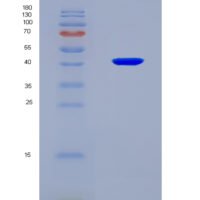
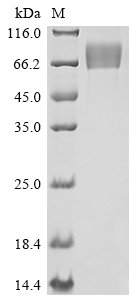
PurityGreater than 90% as determined by SDS-PAGE.
Expression SystemMammalian cell
Expression Region22-376aa
SpeciesHomo sapiens (Human)
Tag InfoC-terminal 6xHis-tagged
Molecular weight41.6kDa
ActivityPlease contact us to obtain bioactivity data.
BufferIf the delivery form is liquid, the default storage buffer is Tris/PBS-based buffer, 5%-50% glycerol. If the delivery form is lyophilized powder, the buffer before lyophilization is Tris/PBS-based buffer, 6% Trehalose.
StorageStore at -20°C/-80°C upon receipt, aliquoting is necessary for mutiple use. Avoid repeated freeze-thaw cycles.
Research AreasCancer

Function

Tyrosine-protein kinase that acts as a cell-surface receptor for fibroblast growth factors and plays an essential role in the regulation of embryonic development, cell proliferation, differentiation and migration. Required for normal mesoderm patterning and correct axial organization during embryonic development, normal skeletogenesis and normal development of the gonadotropin-releasing hormone (GnRH) neuronal system. Phosphorylates PLCG1, FRS2, GAB1 and SHB.

Biological Context

Subcellular Location: Cell membrane (Single-pass type I membrane protein); Nucleus; Cytoplasm, cytosol; Cytoplasmic vesicle
Tissue Specificity: Detected in astrocytoma, neuroblastoma and adrenal cortex cell lines. Some isoforms are detected in foreskin fibroblast cell lines, however isoform 17, isoform 18 and isoform 19 are not detected in these cells
Disease Association: Pfeiffer syndrome (PS) : A syndrome characterized by the association of craniosynostosis, broad and deviated thumbs and big toes, and partial syndactyly of the fingers and toes. Three subtypes are known: mild autosomal dominant form (type 1); cloverleaf skull, elbow ankylosis, early death, sporadic (type 2); craniosynostosis, early demise, sporadic (type 3). [The disease is caused by variants affecting the gene represented in this entry] | Hypogonadotropic hypogonadism 2 with or without anosmia (HH2) : A disorder characterized by absent or incomplete sexual maturation by the age of 18 years, in conjunction with low levels of circulating gonadotropins and testosterone and no other abnormalities of the hypothalamic-pituitary axis. In some cases, it is associated with non-reproductive phenotypes, such as anosmia, cleft palate, and sensorineural hearing loss. Anosmia or hyposmia is related to the absence or hypoplasia of the olfactory bulbs and tracts. Hypogonadism is due to deficiency in gonadotropin-releasing hormone and probably results from a failure of embryonic migration of gonadotropin-releasing hormone-synthesizing neurons. In the presence of anosmia, idiopathic hypogonadotropic hypogonadism is referred to as Kallmann syndrome, whereas in the presence of a normal sense of smell, it has been termed normosmic idiopathic hypogonadotropic hypogonadism (nIHH). [The disease is caused by variants affecting distinct genetic loci, including the gene represented in this entry. Some patients carrying mutations in FGFR1 also have a mutation other HH-associated genes including DUSP6, FGF8, FGF17, FLRT3, GNRH1, GNRHR, HS6ST1, IL17RD, ANOS1, KISS1R, NSMF, PROKR2, SPRY4 and TACR3 ] | Osteoglophonic dysplasia (OGD) : Characterized by craniosynostosis, prominent supraorbital ridge, and depressed nasal bridge, as well as by rhizomelic dwarfism and nonossifying bone lesions. Inheritance is autosomal dominant. [The disease is caused by variants affecting the gene represented in this entry] | Hartsfield syndrome (HRTFDS) : A syndrome characterized by the triad of holoprosencephaly, ectrodactyly, and cleft/lip palate. Profound intellectual disability is also present. Multiple other congenital anomalies usually occur. [The disease is caused by variants affecting the gene represented in this entry] | Trigonocephaly 1 (TRIGNO1) : A keel-shaped deformation of the forehead, caused by premature fusion of the metopic sutures. It results in a triangular shape of the head. [The disease is caused by variants affecting the gene represented in this entry] | [Chromosomal aberrations involving FGFR1 are a cause of chromosome 8p11 myeloproliferative syndrome. Translocation t(8;13)(p11;q12) with ZMYM2. Translocation t(6;8)(q27;p11) with CEP43. Insertion ins(12;8)(p11;p11p22) with FGFR1OP2. Translocation t(8;9)(p12;q33) with CNTRL. Translocation t(2;8)(q12;p11) with RANBP2. Chromosome 8p11 myeloproliferative syndrome is characterized by myeloid hyperplasia, eosinophilia and T-cell or B-cell lymphoblastic lymphoma. In general it progresses to acute myeloid leukemia. The fusion proteins FGFR1OP2-FGFR1, CEP43-FGFR1 or FGFR1-CEP43 may exhibit constitutive kinase activity and be responsible for the transforming activity. The fusion protein CNTRL-FGFR1 is found in the cytoplasm, exhibits constitutive kinase activity and may be responsible for the transforming activity] | Encephalocraniocutaneous lipomatosis (ECCL) : A sporadically occurring, neurocutaneous disorder characterized by ocular anomalies, skin lesions, and central nervous system anomalies. Clinical features include a well-demarcated hairless fatty nevus on the scalp, benign ocular tumors, intracranial and intraspinal lipomas, and congenital abnormalities of the meninges. Seizures, spasticity, and intellectual disability can be present. [The disease is caused by variants affecting the gene represented in this entry] | Jackson-Weiss syndrome (JWS) : An autosomal dominant craniosynostosis syndrome characterized by craniofacial abnormalities and abnormality of the feet: broad great toes with medial deviation and tarsal-metatarsal coalescence. [The disease is caused by variants affecting the gene represented in this entry]

Product Specifications

Recombinant Human Fibroblast growth factor receptor 1 (FGFR1), partial is a recombinant protein from Homo sapiens (Human), expressed in Mammalian cell, covering amino acids 22-376aa, with C-terminal 6xHis-tagged tag, molecular weight 41.6kDa, purity Greater than 90% as determined by SDS-PAGE.. Suitable for ELISA and Western Blot applications.

SDS-PAGE: Single band at expected molecular weight confirming purity.

ELISA: Suitable as coating antigen or detection standard.

Western Blot: Compatible with standard Western Blot protocols.

Protein Interaction: Validated for SPR (Surface Plasmon Resonance) and BLI (Bio-Layer Interferometry) studies.

Shipping: Shipped at ambient temperature. Lyophilized protein is stable during transit.

Storage: Store lyophilized protein at -20°C to -80°C. Reconstituted protein should be aliquoted and stored at -80°C. Avoid repeated freeze-thaw cycles.

Shelf Life: 12 months from date of receipt when stored as recommended.

Shipping Time: Orders placed before 2 PM EST ship same day. International orders typically deliver within 5-10 business days.

Protein Biology

Function

Tyrosine-protein kinase that acts as a cell-surface receptor for fibroblast growth factors and plays an essential role in the regulation of embryonic development, cell proliferation, differentiation and migration. Required for normal mesoderm patterning and correct axial organization during embryonic development, normal skeletogenesis and normal development of the gonadotropin-releasing hormone (GnRH) neuronal system. Phosphorylates PLCG1, FRS2, GAB1 and SHB. Ligand binding leads to the activation of several signaling cascades. Activation of PLCG1 leads to the production of the cellular signaling molecules diacylglycerol and inositol 1,4,5-trisphosphate. Phosphorylation of FRS2 triggers recruitment of GRB2, GAB1, PIK3R1 and SOS1, and mediates activation of RAS, MAPK1/ERK2, MAPK3/ERK1 and the MAP kinase signaling pathway, as well as of the AKT1 signaling pathway. Promotes phosphorylation of SHC1, STAT1 and PTPN11/SHP2. In the nucleus, enhances RPS6KA1 and CREB1 activity and contributes to the regulation of transcription. FGFR1 signaling is down-regulated by IL17RD/SEF, and by FGFR1 ubiquitination, internalization and degradation

Subcellular Location

Cell membrane (Single-pass type I membrane protein); Nucleus; Cytoplasm, cytosol; Cytoplasmic vesicle

Disease Association

Pfeiffer syndrome (PS) : A syndrome characterized by the association of craniosynostosis, broad and deviated thumbs and big toes, and partial syndactyly of the fingers and toes. Three subtypes are known: mild autosomal dominant form (type 1); cloverleaf skull, elbow ankylosis, early death, sporadic (type 2); craniosynostosis, early demise, sporadic (type 3). [The disease is caused by variants affecting the gene represented in this entry] | Hypogonadotropic hypogonadism 2 with or without anosmia (HH2) : A disorder characterized by absent or incomplete sexual maturation by the age of 18 years, in conjunction with low levels of circulating gonadotropins and testosterone and no other abnormalities of the hypothalamic-pituitary axis. In some cases, it is associated with non-reproductive phenotypes, such as anosmia, cleft palate, and sensorineural hearing loss. Anosmia or hyposmia is related to the absence or hypoplasia of the olfactory bulbs and tracts. Hypogonadism is due to deficiency in gonadotropin-releasing hormone and probably results from a failure of embryonic migration of gonadotropin-releasing hormone-synthesizing neurons. In the presence of anosmia, idiopathic hypogonadotropic hypogonadism is referred to as Kallmann syndrome, whereas in the presence of a normal sense of smell, it has been termed normosmic idiopathic hypogonadotropic hypogonadism (nIHH). [The disease is caused by variants affecting distinct genetic loci, including the gene represented in this entry. Some patients carrying mutations in FGFR1 also have a mutation other HH-associated genes including DUSP6, FGF8, FGF17, FLRT3, GNRH1, GNRHR, HS6ST1, IL17RD, ANOS1, KISS1R, NSMF, PROKR2, SPRY4 and TACR3 (PubMed:23643382)] | Osteoglophonic dysplasia (OGD) : Characterized by craniosynostosis, prominent supraorbital ridge, and depressed nasal bridge, as well as by rhizomelic dwarfism and nonossifying bone lesions. Inheritance is autosomal dominant. [The disease is caused by variants affecting the gene represented in this entry] | Hartsfield syndrome (HRTFDS) : A syndrome characterized by the triad of holoprosencephaly, ectrodactyly, and cleft/lip palate. Profound intellectual disability is also present. Multiple other congenital anomalies usually occur. [The disease is caused by variants affecting the gene represented in this entry] | Trigonocephaly 1 (TRIGNO1) : A keel-shaped deformation of the forehead, caused by premature fusion of the metopic sutures. It results in a triangular shape of the head. [The disease is caused by variants affecting the gene represented in this entry] | [Chromosomal aberrations involving FGFR1 are a cause of chromosome 8p11 myeloproliferative syndrome. Translocation t(8;13)(p11;q12) with ZMYM2. Translocation t(6;8)(q27;p11) with CEP43. Insertion ins(12;8)(p11;p11p22) with FGFR1OP2. Translocation t(8;9)(p12;q33) with CNTRL. Translocation t(2;8)(q12;p11) with RANBP2. Chromosome 8p11 myeloproliferative syndrome is characterized by myeloid hyperplasia, eosinophilia and T-cell or B-cell lymphoblastic lymphoma. In general it progresses to acute myeloid leukemia. The fusion proteins FGFR1OP2-FGFR1, CEP43-FGFR1 or FGFR1-CEP43 may exhibit constitutive kinase activity and be responsible for the transforming activity. The fusion protein CNTRL-FGFR1 is found in the cytoplasm, exhibits constitutive kinase activity and may be responsible for the transforming activity] | Encephalocraniocutaneous lipomatosis (ECCL) : A sporadically occurring, neurocutaneous disorder characterized by ocular anomalies, skin lesions, and central nervous system anomalies. Clinical features include a well-demarcated hairless fatty nevus on the scalp, benign ocular tumors, intracranial and intraspinal lipomas, and congenital abnormalities of the meninges. Seizures, spasticity, and intellectual disability can be present. [The disease is caused by variants affecting the gene represented in this entry] | Jackson-Weiss syndrome (JWS) : An autosomal dominant craniosynostosis syndrome characterized by craniofacial abnormalities and abnormality of the feet: broad great toes with medial deviation and tarsal-metatarsal coalescence. [The disease is caused by variants affecting the gene represented in this entry]

Tissue Specificity

Detected in astrocytoma, neuroblastoma and adrenal cortex cell lines. Some isoforms are detected in foreskin fibroblast cell lines, however isoform 17, isoform 18 and isoform 19 are not detected in these cells

Subunit

Monomer. Homodimer after ligand binding. Interacts predominantly with FGF1 and FGF2, but can also interact with FGF3, FGF4, FGF5, FGF6, FGF8, FGF10, FGF19, FGF21, FGF22 and FGF23 (in vitro) (PubMed:12181353, PubMed:16597617, PubMed:1697263, PubMed:1722683, PubMed:17623664, PubMed:8663044, PubMed:9655399). Ligand specificity is determined by tissue-specific expression of isoforms, and differences in the third Ig-like domain are crucial for ligand specificity. Affinity for fibroblast growth factors (FGFs) is increased by heparan sulfate glycosaminoglycans that function as coreceptors. Likewise, KLB increases the affinity for FGF19, FGF21 and FGF23 (PubMed:19966287). Interacts (phosphorylated on Tyr-766) with PLCG1 (via SH2 domains) (PubMed:1379697, PubMed:1656221, PubMed:21765395). Interacts with FRS2 (PubMed:21765395). Interacts with RPS6KA1 (PubMed:15117958). Interacts (via C-terminus) with NEDD4 (via WW3 domain) (PubMed:21765395). Interacts with KL (By similarity). Interacts with SHB (via SH2 domain) (PubMed:12181353). Interacts with GRB10 (PubMed:10454568). Interacts with ANOS1; this interaction does not interfere with FGF2-binding to FGFR1, but prevents binding of heparin-bound FGF2 (PubMed:19696444). Interacts with SOX2 and SOX3. Interacts with FLRT1, FLRT2 and FLRT3 (By similarity). Found in a ternary complex with FGF1 and ITGAV:ITGB3 (PubMed:18441324, PubMed:20422052)

Gene: FGFR1  |  Organism: Homo sapiens  |  Synonyms: Basic fibroblast growth factor receptor 1; Fms-like tyrosine kinase 2; N-sam
Key Publications

Frequently Asked Questions

How do I order or inquire about this product?

Fill out the Online Inquiry form with your required quantity and specifications. You can also email sales@biocrestsci.com. Our team typically responds within 4 business hours with a quote and availability confirmation.

What is the shipping and delivery time?

Orders placed before 2 PM EST ship the same day. Domestic (US) delivery typically takes 2-3 business days. International orders deliver within 5-10 business days. All products are shipped at ambient temperature with appropriate packaging to ensure stability.

How should I store this recombinant protein?

Lyophilized proteins should be stored at -20°C to -80°C upon receipt. After reconstitution, aliquot and store at -80°C. Avoid repeated freeze-thaw cycles. Shelf life is 12 months from date of receipt when stored as recommended.

What quality controls are performed on your products?

Each product undergoes SDS-PAGE purity analysis (typically >85-95%), endotoxin testing, and bioactivity validation. Products are validated for ELISA, Western Blot, and SPR/BLI applications as specified on this product page. A Certificate of Analysis (CoA) is available upon request.

Shopping Cart
Scroll to Top