Recombinant Human Guanine nucleotide-binding protein G (i) subunit alpha-3 (GNAI3)

Recombinant Human Guanine nucleotide-binding protein G (i) subunit alpha-3 (GNAI3) — Heterotrimeric guanine nucleotide-binding proteins (G proteins) function as transducers downstream of G protein-coupled receptors (GPCRs) in numerous signaling cascades. Purity >90%.

SKU: BCRECP-000763 Category:

Product Specifications

Product SkuBCRECP-000763
Product DescriptionRecombinant Human Guanine nucleotide-binding protein G (i) subunit alpha-3 (GNAI3) Protein is expressed from Yeast with C-terminal 6xHis-tagged. It contains 2-354aa. [Accession | P08754].
Uniprot No.P08754
Gene NamesGNAI3
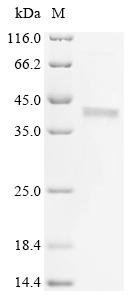
PurityGreater than 90% as determined by SDS-PAGE.
Expression SystemYeast
Expression Region2-354aa
SpeciesHomo sapiens (Human)
Tag InfoC-terminal 6xHis-tagged
Molecular weight41.4kDa
ActivityPlease contact us to obtain bioactivity data.
BufferIf the delivery form is liquid, the default storage buffer is Tris/PBS-based buffer, 5%-50% glycerol. If the delivery form is lyophilized powder, the buffer before lyophilization is Tris/PBS-based buffer, 6% Trehalose.
StorageStore at -20°C/-80°C upon receipt, aliquoting is necessary for mutiple use. Avoid repeated freeze-thaw cycles.
Research AreasCell Cycle

Function

Heterotrimeric guanine nucleotide-binding proteins (G proteins) function as transducers downstream of G protein-coupled receptors (GPCRs) in numerous signaling cascades. The alpha chain contains the guanine nucleotide binding site and alternates between an active, GTP-bound state and an inactive, GDP-bound state. Signaling by an activated GPCR promotes GDP release and GTP binding.

Biological Context

Subcellular Location: Cytoplasm; Cell membrane (Lipid-anchor); Cytoplasm, cytoskeleton, microtubule organizing center, centrosome
Disease Association: Auriculocondylar syndrome 1 (ARCND1) : An autosomal dominant form of auriculocondylar syndrome, a craniofacial malformation syndrome characterized by variable mandibular anomalies, including mild to severe micrognathia, temporomandibular joint ankylosis, cleft palate, and a characteristic ear malformation that consists of separation of the lobule from the external ear, giving the appearance of a question mark (question-mark ear). Other frequently described features include prominent cheeks, cupped and posteriorly rotated ears, preauricular tags, and microstomia. Glossoptosis, masticatory abnormalities, orthodontic problems, and malocclusion occur in a majority of affected subjects. [The disease is caused by variants affecting the gene represented in this entry]

Product Specifications

Recombinant Human Guanine nucleotide-binding protein G (i) subunit alpha-3 (GNAI3) is a recombinant protein from Homo sapiens (Human), expressed in Yeast, covering amino acids 2-354aa, with C-terminal 6xHis-tagged tag, molecular weight 41.4kDa, purity Greater than 90% as determined by SDS-PAGE.. Suitable for ELISA and Western Blot applications.
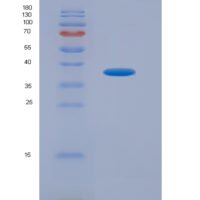
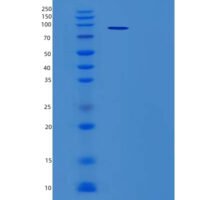
SDS-PAGE: Single band at expected molecular weight confirming purity.

ELISA: Suitable as coating antigen or detection standard.

Western Blot: Compatible with standard Western Blot protocols.

Protein Interaction: Validated for SPR (Surface Plasmon Resonance) and BLI (Bio-Layer Interferometry) studies.

Shipping: Shipped at ambient temperature. Lyophilized protein is stable during transit.

Storage: Store lyophilized protein at -20°C to -80°C. Reconstituted protein should be aliquoted and stored at -80°C. Avoid repeated freeze-thaw cycles.

Shelf Life: 12 months from date of receipt when stored as recommended.

Shipping Time: Orders placed before 2 PM EST ship same day. International orders typically deliver within 5-10 business days.

Protein Biology

Function

Heterotrimeric guanine nucleotide-binding proteins (G proteins) function as transducers downstream of G protein-coupled receptors (GPCRs) in numerous signaling cascades. The alpha chain contains the guanine nucleotide binding site and alternates between an active, GTP-bound state and an inactive, GDP-bound state. Signaling by an activated GPCR promotes GDP release and GTP binding. The alpha subunit has a low GTPase activity that converts bound GTP to GDP, thereby terminating the signal (By similarity). Both GDP release and GTP hydrolysis are modulated by numerous regulatory proteins (PubMed:18434541, PubMed:19478087, PubMed:8774883). Signaling is mediated via effector proteins, such as adenylate cyclase. Inhibits adenylate cyclase activity, leading to decreased intracellular cAMP levels (PubMed:19478087). Stimulates the activity of receptor-regulated K(+) channels (PubMed:2535845). The active GTP-bound form prevents the association of RGS14 with centrosomes and is required for the translocation of RGS14 from the cytoplasm to the plasma membrane. May play a role in cell division (PubMed:17635935). The active GTP-bound form activates the calcium permeant TRPC5 ion channels (PubMed:37137991)

Subcellular Location

Cytoplasm; Cell membrane (Lipid-anchor); Cytoplasm, cytoskeleton, microtubule organizing center, centrosome

Disease Association

Auriculocondylar syndrome 1 (ARCND1) : An autosomal dominant form of auriculocondylar syndrome, a craniofacial malformation syndrome characterized by variable mandibular anomalies, including mild to severe micrognathia, temporomandibular joint ankylosis, cleft palate, and a characteristic ear malformation that consists of separation of the lobule from the external ear, giving the appearance of a question mark (question-mark ear). Other frequently described features include prominent cheeks, cupped and posteriorly rotated ears, preauricular tags, and microstomia. Glossoptosis, masticatory abnormalities, orthodontic problems, and malocclusion occur in a majority of affected subjects. [The disease is caused by variants affecting the gene represented in this entry]

Subunit

Heterotrimeric G proteins are composed of 3 units; alpha, beta and gamma. The alpha subunit contains the guanine nucleotide binding site (By similarity). GTP binding causes dissociation of the heterotrimer, liberating the individual subunits so that they can interact with downstream effector proteins. Forms a complex with CCDC88A/GIV and EGFR which leads to enhanced EGFR signaling and triggering of cell migration; ligand stimulation is required for recruitment of GNAI3 to the complex (PubMed:20462955). Interacts (inactive GDP-bound form) with CCDC88A/GIV (via GBA motif); the interaction leads to activation of GNAI3 (PubMed:19211784, PubMed:20462955). Interacts (inactive GDP-bound form) with CCDC88C/DAPLE (via GBA motif); the interaction leads to activation of GNAI3 (PubMed:26126266). Interacts (inactive GDP-bound form) with NUCB1 (via GBA motif) and NUCB2 (via GBA motif); the interaction leads to activation of GNAI3 (By similarity). Interacts (inactive GDP-bound form) with PLCD4 (via GBA motif); the interaction leads to activation of GNAI3 (PubMed:30194280). Interacts with INSR; the interaction is probably mediated by CCDC88A/GIV (PubMed:25187647). Interacts with GPSM1 (By similarity). Interacts (GDP-bound form) with GPSM2 (via GoLoco domains) (PubMed:22952234). Does not interact with RGS2 (PubMed:19478087). Interacts with RGS8 and RGS10; this strongly enhances the intrinsic GTPase activity (PubMed:18434541, PubMed:8774883). Interacts with RGS16; this strongly enhances the intrinsic GTPase activity (PubMed:19478087). Interacts with RGS12 (By similarity). Interacts (via active GTP- or inactive GDP-bound form) with RGS14 (By similarity). Interacts (via active GTP-bound form) with TRPC5 (via ANK repeats) in a homotetrameric ion channel; the interaction is direct and activates the channel activity (PubMed:37137991)

Gene: GNAI3  |  Organism: Homo sapiens  |  Synonyms: G(i) alpha-3
Key Publications

Frequently Asked Questions

How do I order or inquire about this product?

Fill out the Online Inquiry form with your required quantity and specifications. You can also email sales@biocrestsci.com. Our team typically responds within 4 business hours with a quote and availability confirmation.

What is the shipping and delivery time?

Orders placed before 2 PM EST ship the same day. Domestic (US) delivery typically takes 2-3 business days. International orders deliver within 5-10 business days. All products are shipped at ambient temperature with appropriate packaging to ensure stability.

How should I store this recombinant protein?

Lyophilized proteins should be stored at -20°C to -80°C upon receipt. After reconstitution, aliquot and store at -80°C. Avoid repeated freeze-thaw cycles. Shelf life is 12 months from date of receipt when stored as recommended.

What quality controls are performed on your products?

Each product undergoes SDS-PAGE purity analysis (typically >85-95%), endotoxin testing, and bioactivity validation. Products are validated for ELISA, Western Blot, and SPR/BLI applications as specified on this product page. A Certificate of Analysis (CoA) is available upon request.

Shopping Cart
Scroll to Top