Recombinant Human Hypoxia-inducible factor 1-alpha (HIF1A), partial

Recombinant Human Hypoxia-inducible factor 1-alpha (HIF1A), partial — (Microbial infection) Upon infection by human coronavirus SARS-CoV-2, is required for induction of glycolysis in monocytes and the consequent pro-inflammatory state. Purity >90%.

SKU: BCRECP-000818 Category:

Product Specifications

Product SkuBCRECP-000818
Product DescriptionRecombinant Human Hypoxia-inducible factor 1-alpha (HIF1A) Protein is expressed from E.coli with N-terminal 6xHis-tagged. It contains 579-826aa. [Accession | Q16665].
Uniprot No.Q16665
Gene NamesHIF1A
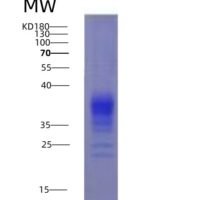
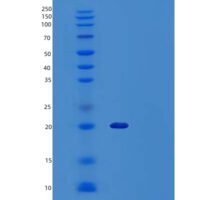
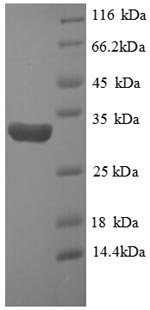
PurityGreater than 90% as determined by SDS-PAGE.
Expression SystemE.coli
Expression Region579-826aa
SpeciesHomo sapiens (Human)
Tag InfoN-terminal 6xHis-tagged
Molecular weight31.0kDa
ActivityPlease contact us to obtain bioactivity data.
BufferIf the delivery form is liquid, the default storage buffer is Tris/PBS-based buffer, 5%-50% glycerol. If the delivery form is lyophilized powder, the buffer before lyophilization is Tris/PBS-based buffer, 6% Trehalose.
StorageStore at -20°C/-80°C upon receipt, aliquoting is necessary for mutiple use. Avoid repeated freeze-thaw cycles.
Research AreasTranscription

Function

(Microbial infection) Upon infection by human coronavirus SARS-CoV-2, is required for induction of glycolysis in monocytes and the consequent pro-inflammatory state. In monocytes, induces expression of ACE2 and cytokines such as IL1B, TNF, IL6, and interferons. Promotes human coronavirus SARS-CoV-2 replication and monocyte inflammatory response.

Biological Context

Subcellular Location: Cytoplasm; Nucleus; Nucleus speckle
Tissue Specificity: Expressed in most tissues with highest levels in kidney and heart. Overexpressed in the majority of common human cancers and their metastases, due to the presence of intratumoral hypoxia and as a result of mutations in genes encoding oncoproteins and tumor suppressors. A higher level expression seen in pituitary tumors as compared to the pituitary gland

Product Specifications

Recombinant Human Hypoxia-inducible factor 1-alpha (HIF1A), partial is a recombinant protein from Homo sapiens (Human), expressed in E.coli, covering amino acids 579-826aa, with N-terminal 6xHis-tagged tag, molecular weight 31.0kDa, purity Greater than 90% as determined by SDS-PAGE.. Suitable for ELISA and Western Blot applications.
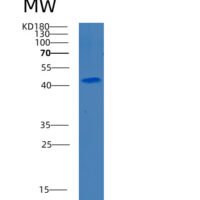
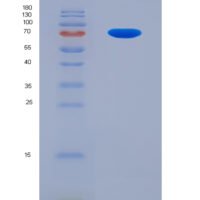
SDS-PAGE: Single band at expected molecular weight confirming purity.

ELISA: Suitable as coating antigen or detection standard.

Western Blot: Compatible with standard Western Blot protocols.

Protein Interaction: Validated for SPR (Surface Plasmon Resonance) and BLI (Bio-Layer Interferometry) studies.

Shipping: Shipped at ambient temperature. Lyophilized protein is stable during transit.

Storage: Store lyophilized protein at -20°C to -80°C. Reconstituted protein should be aliquoted and stored at -80°C. Avoid repeated freeze-thaw cycles.

Shelf Life: 12 months from date of receipt when stored as recommended.

Shipping Time: Orders placed before 2 PM EST ship same day. International orders typically deliver within 5-10 business days.

Protein Biology

Function

(Microbial infection) Upon infection by human coronavirus SARS-CoV-2, is required for induction of glycolysis in monocytes and the consequent pro-inflammatory state (PubMed:32697943). In monocytes, induces expression of ACE2 and cytokines such as IL1B, TNF, IL6, and interferons (PubMed:32697943). Promotes human coronavirus SARS-CoV-2 replication and monocyte inflammatory response (PubMed:32697943)

Subcellular Location

Cytoplasm; Nucleus; Nucleus speckle

Tissue Specificity

Expressed in most tissues with highest levels in kidney and heart. Overexpressed in the majority of common human cancers and their metastases, due to the presence of intratumoral hypoxia and as a result of mutations in genes encoding oncoproteins and tumor suppressors. A higher level expression seen in pituitary tumors as compared to the pituitary gland

Subunit

Interacts with the ARNT; forms a heterodimer that binds core DNA sequence 5'-TACGTG-3' within the hypoxia response element (HRE) of target gene promoters (PubMed:10944113, PubMed:20699359). Interacts with COPS5; the interaction increases the transcriptional activity of HIF1A through increased stability (By similarity). Interacts with EP300 (via TAZ-type 1 domains); the interaction is stimulated in response to hypoxia and inhibited by CITED2 (PubMed:11959990, PubMed:12778114, PubMed:16543236, PubMed:16973622, PubMed:8917528, PubMed:9887100). Interacts with CREBBP (via TAZ-type 1 domains) (PubMed:11959977, PubMed:8917528). Interacts with NCOA1, NCOA2, APEX1 and HSP90 (PubMed:10202154, PubMed:10594042). Interacts (hydroxylated within the ODD domain) with VHLL (via beta domain); the interaction, leads to polyubiquitination and subsequent HIF1A proteasomal degradation (PubMed:14757845). During hypoxia, sumoylated HIF1A also binds VHL; the interaction promotes the ubiquitination of HIF1A (PubMed:10944113, PubMed:11006129, PubMed:12004076, PubMed:12050673, PubMed:16862177). Interacts with SENP1; the interaction desumoylates HIF1A resulting in stabilization and activation of transcription (By similarity). Interacts (via the ODD domain) with NAA10; the interaction appears not to acetylate HIF1A nor have any affect on protein stability, during hypoxia (PubMed:12464182, PubMed:16288748). Interacts with RWDD3; the interaction enhances HIF1A sumoylation (PubMed:17956732, PubMed:23469069). Interacts with TSGA10 (By similarity). Interacts with HIF3A (By similarity). Interacts with RORA (via the DNA binding domain); the interaction enhances HIF1A transcription under hypoxia through increasing protein stability (PubMed:18658046). Interaction with PSMA7 inhibits the transactivation activity of HIF1A under both normoxic and hypoxia-mimicking conditions (PubMed:11389899). Interacts with USP20 (PubMed:15776016). Interacts with RACK1; promotes HIF1A ubiquitination and proteasome-mediated degradation (PubMed:17244529). Interacts (via N-terminus) with USP19 (PubMed:22128162). Interacts with SIRT2 (PubMed:24681946). Interacts (deacetylated form) with EGLN1 (PubMed:24681946). Interacts with CBFA2T3 (PubMed:25974097). Interacts with HSP90AA1 and HSP90AB1 (PubMed:26517842). Interacts with DCUN1D1; this interaction increases the interaction between VHL and DCUN1D1 (PubMed:23401859). Interacts with HIF1AN (PubMed:12446723)

Gene: HIF1A  |  Organism: Homo sapiens  |  Synonyms: ARNT-interacting protein; Basic-helix-loop-helix-PAS protein MOP1; Class E basic helix-loop-helix protein 78; Member of PAS protein 1; PAS domain-containing protein 8
Key Publications

Frequently Asked Questions

How do I order or inquire about this product?

Fill out the Online Inquiry form with your required quantity and specifications. You can also email sales@biocrestsci.com. Our team typically responds within 4 business hours with a quote and availability confirmation.

What is the shipping and delivery time?

Orders placed before 2 PM EST ship the same day. Domestic (US) delivery typically takes 2-3 business days. International orders deliver within 5-10 business days. All products are shipped at ambient temperature with appropriate packaging to ensure stability.

How should I store this recombinant protein?

Lyophilized proteins should be stored at -20°C to -80°C upon receipt. After reconstitution, aliquot and store at -80°C. Avoid repeated freeze-thaw cycles. Shelf life is 12 months from date of receipt when stored as recommended.

What quality controls are performed on your products?

Each product undergoes SDS-PAGE purity analysis (typically >85-95%), endotoxin testing, and bioactivity validation. Products are validated for ELISA, Western Blot, and SPR/BLI applications as specified on this product page. A Certificate of Analysis (CoA) is available upon request.

Shopping Cart
Scroll to Top