Recombinant Human Rhodopsin (RHO), partial

Recombinant Human Rhodopsin (RHO), partial — G protein-coupled photoreceptor that activates the G protein transducin (t) signaling pathway in response to light and is essential for image-forming vision under low-light conditions. Purity >90%.

SKU: BCRECP-001534 Category:

Product Specifications

Product SkuBCRECP-001534
Product DescriptionRecombinant Human Rhodopsin (RHO) Protein is expressed from E.coli with N-terminal 6xHis-SUMO-tagged. It contains 1-36aa. [Accession | P08100].
Uniprot No.P08100
Gene NamesRHO
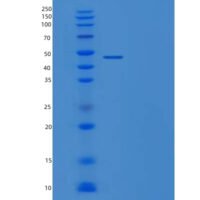
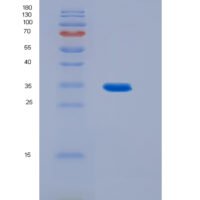
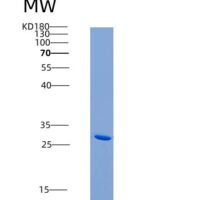
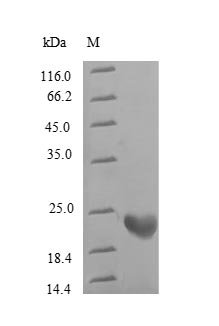
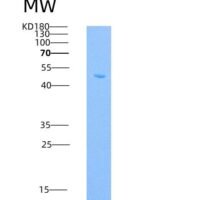
PurityGreater than 90% as determined by SDS-PAGE.
Expression SystemE.coli
Expression Region1-36aa
SpeciesHomo sapiens (Human)
Tag InfoN-terminal 6xHis-SUMO-tagged
Molecular weight20.2kDa
ActivityPlease contact us to obtain bioactivity data.
BufferIf the delivery form is liquid, the default storage buffer is Tris/PBS-based buffer, 5%-50% glycerol. If the delivery form is lyophilized powder, the buffer before lyophilization is Tris/PBS-based buffer, 6% Trehalose.
StorageStore at -20°C/-80°C upon receipt, aliquoting is necessary for mutiple use. Avoid repeated freeze-thaw cycles.
Research AreasSignal Transduction

Function

G protein-coupled photoreceptor that activates the G protein transducin (t) signaling pathway in response to light and is essential for image-forming vision under low-light conditions. Required for postnatal photoreceptor cell viability.

Product Specifications

Recombinant Human Rhodopsin (RHO), partial — G protein-coupled photoreceptor that activates the G protein transducin (t) signaling pathway in response to light and is essential for image-forming vision under low-light conditions. Purity >90%. Suitable for ELISA and Western Blot applications.

SDS-PAGE: Single band at expected molecular weight confirming purity.

ELISA: Suitable as coating antigen or detection standard.

Western Blot: Compatible with standard Western Blot protocols.

Protein Interaction: Validated for SPR (Surface Plasmon Resonance) and BLI (Bio-Layer Interferometry) studies.

Shipping: Shipped at ambient temperature. Lyophilized protein is stable during transit.

Storage: Store lyophilized protein at -20°C to -80°C. Reconstituted protein should be aliquoted and stored at -80°C. Avoid repeated freeze-thaw cycles.

Shelf Life: 12 months from date of receipt when stored as recommended.

Shipping Time: Orders placed before 2 PM EST ship same day. International orders typically deliver within 5-10 business days.

Protein Biology

Function

G protein-coupled photoreceptor that activates the G protein transducin (t) signaling pathway in response to light and is essential for image-forming vision under low-light conditions (PubMed:6140680, PubMed:7846071, PubMed:8107847). Required for postnatal photoreceptor cell viability (PubMed:12566452, PubMed:2215617). Activation occurs when the covalently bound 11-cis-retinal chromophore absorbs a photon and isomerizes to all-trans-retinal, inducing a conformational change in the opsin that triggers G protein-mediated phototransduction (Probable) (PubMed:26200343, PubMed:28753425, PubMed:8107847). Signal termination occurs via receptor phosphorylation, which promotes binding of arrestin (SAG) and displacement of the G protein alpha subunit (Probable) (PubMed:26200343)

Subcellular Location

Photoreceptor outer segment membrane (Multi-pass membrane protein); Membrane (Multi-pass membrane protein)

Disease Association

Retinitis pigmentosa 4 (RP4) : A retinal dystrophy belonging to the group of pigmentary retinopathies. Retinitis pigmentosa is characterized by retinal pigment deposits visible on fundus examination and primary loss of rod photoreceptor cells followed by secondary loss of cone photoreceptors. Patients typically have night vision blindness and loss of midperipheral visual field. As their condition progresses, they lose their far peripheral visual field and eventually central vision as well. [The disease is caused by variants affecting the gene represented in this entry] | Night blindness, congenital stationary, autosomal dominant 1 (CSNBAD1) : A non-progressive retinal disorder characterized by impaired night vision, often associated with nystagmus and myopia. [The disease is caused by variants affecting the gene represented in this entry]

Tissue Specificity

Rod shaped photoreceptor cells which mediate vision in dim light

Subunit

Homodimer (By similarity). May form a complex composed of RHO, GRK1 and RCVRN in a Ca(2+)-dependent manner; RCVRN prevents the interaction between GRK1 and RHO (By similarity). Interacts with GRK1 (PubMed:28524165). Interacts (phosphorylated form) with SAG (PubMed:26200343, PubMed:28524165, PubMed:28753425). Interacts with GNAT1 (PubMed:26200343). Interacts with GNAT3. SAG and G proteins compete for a common binding site (PubMed:26200343). Interacts with PRCD; the interaction promotes PRCD stability (By similarity). Forms a complex with ASAP1 and ARF4. Forms a complex with ASAP1, RAB11A, Rabin8/RAB3IP, ARF4 and RAB11FIP3; the complex regulates Golgi-to-cilia rhodopsin/RHO transport in photoreceptors (By similarity)

Gene: RHO  |  Organism: Homo sapiens  |  Synonyms: Opsin-2
Key Publications

Frequently Asked Questions

How do I order or inquire about this product?

Fill out the Online Inquiry form with your required quantity and specifications. You can also email sales@biocrestsci.com. Our team typically responds within 4 business hours with a quote and availability confirmation.

What is the shipping and delivery time?

Orders placed before 2 PM EST ship the same day. Domestic (US) delivery typically takes 2-3 business days. International orders deliver within 5-10 business days. All products are shipped at ambient temperature with appropriate packaging to ensure stability.
How should I store this recombinant protein?

Lyophilized proteins should be stored at -20°C to -80°C upon receipt. After reconstitution, aliquot and store at -80°C. Avoid repeated freeze-thaw cycles. Shelf life is 12 months from date of receipt when stored as recommended.

What quality controls are performed on your products?

Each product undergoes SDS-PAGE purity analysis (typically >85-95%), endotoxin testing, and bioactivity validation. Products are validated for ELISA, Western Blot, and SPR/BLI applications as specified on this product page. A Certificate of Analysis (CoA) is available upon request.

Shopping Cart
Scroll to Top