Function
Adapter required to activate the JNK and NF-kappa-B signaling pathways through the specific recognition of 'Lys-63'-linked polyubiquitin chains by its RanBP2-type zinc finger (NZF). Acts as an adapter linking MAP3K7/TAK1 and TRAF6 to 'Lys-63'-linked polyubiquitin chains. The RanBP2-type zinc finger (NZF) specifically recognizes Lys-63'-linked polyubiquitin chains unanchored or anchored to the substrate proteins such as RIPK1/RIP1 and RIPK2: this acts as a scaffold to organize a large signaling complex to promote autophosphorylation of MAP3K7/TAK1, and subsequent activation of I-kappa-B-kinase (IKK) core complex by MAP3K7/TAK1.
Biological Context
Subcellular Location: Membrane (Peripheral membrane protein); Endosome membrane (Peripheral membrane protein); Lysosome membrane (Peripheral membrane protein); Cytoplasm, cytosol
Tissue Specificity: Widely expressed. In the embryo, expressed in the ventricular trabeculae, endothelial cells of the conotruncal cushions of the outflow tract and in the endothelial cells lining the developing aortic valves
Disease Association: Congenital heart defects, multiple types, 2 (CHTD2) : A disease characterized by congenital developmental abnormalities involving structures of the heart. CHTD2 patients have left ventricular outflow tract obstruction, subaortic stenosis, residual aortic regurgitation, atrial fibrillation, bicuspid aortic valve and aortic dilation. [The disease is caused by variants affecting the gene represented in this entry. A chromosomal aberration involving TAB2 has been found in a family with congenital heart disease. Translocation t(2;6)(q21;q25)]
Product Specifications
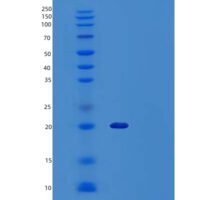
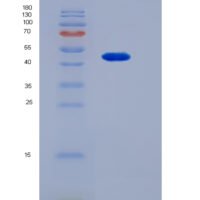
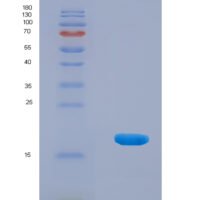
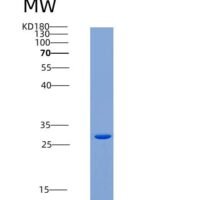
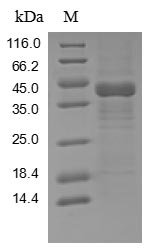
Recombinant Human TGF-beta-activated kinase 1 and MAP3K7-binding protein 2 (TAB2), partial is a recombinant protein from Homo sapiens (Human), expressed in Baculovirus, covering amino acids 401-693aa, with N-terminal 10xHis-tagged and C-terminal Myc-tagged tag, molecular weight 37.1kDa, purity Greater than 85% as determined by SDS-PAGE.. Suitable for ELISA and Western Blot applications. Explore more Kinase proteins →