Recombinant Mouse Transcription factor PU.1 (Spi1)

Recombinant Mouse Transcription factor PU.1 (Spi1) — Pioneer transcription factor, which controls hematopoietic cell fate by decompacting stem cell heterochromatin and allowing other transcription factors to enter otherwise inaccessible genomic sites. Purity >85%.

SKU: BCRECP-004468 Category:

Product Specifications

Product SkuBCRECP-004468
Product DescriptionRecombinant Mouse Transcription factor PU.1 (Spi1) Protein is expressed from E.coli with N-terminal 10xHis-tagged and C-terminal Myc-tagged. It contains 1-272aa. [Accession | P17433].
Uniprot No.P17433
Gene NamesSpi1
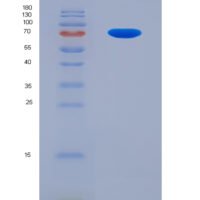
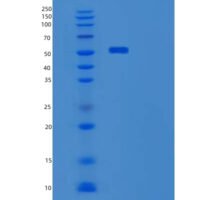
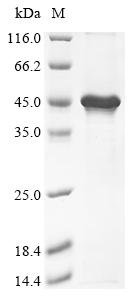
PurityGreater than 85% as determined by SDS-PAGE.
Expression SystemE.coli
Expression Region1-272aa
SpeciesMus musculus (Mouse)
Tag InfoN-terminal 10xHis-tagged and C-terminal Myc-tagged
Molecular weight38.8kDa
ActivityPlease contact us to obtain bioactivity data.
BufferIf the delivery form is liquid, the default storage buffer is Tris/PBS-based buffer, 5%-50% glycerol. If the delivery form is lyophilized powder, the buffer before lyophilization is Tris/PBS-based buffer, 6% Trehalose.
StorageStore at -20°C/-80°C upon receipt, aliquoting is necessary for mutiple use. Avoid repeated freeze-thaw cycles.
Research AreasOthers

Function

Pioneer transcription factor, which controls hematopoietic cell fate by decompacting stem cell heterochromatin and allowing other transcription factors to enter otherwise inaccessible genomic sites. Once in open chromatin, can directly control gene expression by binding genetic regulatory elements and can also more broadly influence transcription by recruiting transcription factors, such as interferon regulatory factors (IRFs), to otherwise inaccessible genomic regions. Transcriptionally activates genes important for myeloid and lymphoid lineages, such as CSF1R.

Biological Context

Subcellular Location: Nucleus
Tissue Specificity: Expressed in spleen, thymus and bone-marrow macrophages
Disease Association: [May be involved in murine acute Friend erythroleukemia. It is a target region for SFFV proviral insertion]

Product Specifications

Recombinant Mouse Transcription factor PU.1 (Spi1) is a recombinant protein from Mus musculus (Mouse), expressed in E.coli, covering amino acids 1-272aa, with N-terminal 10xHis-tagged and C-terminal Myc-tagged tag, molecular weight 38.8kDa, purity Greater than 85% as determined by SDS-PAGE.. Suitable for ELISA and Western Blot applications.
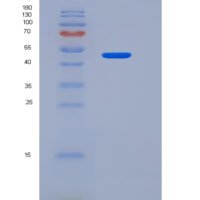
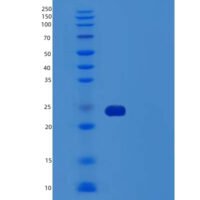
SDS-PAGE: Single band at expected molecular weight confirming purity.

ELISA: Suitable as coating antigen or detection standard.

Western Blot: Compatible with standard Western Blot protocols.

Protein Interaction: Validated for SPR (Surface Plasmon Resonance) and BLI (Bio-Layer Interferometry) studies.

Shipping: Shipped at ambient temperature. Lyophilized protein is stable during transit.

Storage: Store lyophilized protein at -20°C to -80°C. Reconstituted protein should be aliquoted and stored at -80°C. Avoid repeated freeze-thaw cycles.

Shelf Life: 12 months from date of receipt when stored as recommended.

Shipping Time: Orders placed before 2 PM EST ship same day. International orders typically deliver within 5-10 business days.

Protein Biology

Function

Pioneer transcription factor, which controls hematopoietic cell fate by decompacting stem cell heterochromatin and allowing other transcription factors to enter otherwise inaccessible genomic sites (PubMed:8079170). Once in open chromatin, can directly control gene expression by binding genetic regulatory elements and can also more broadly influence transcription by recruiting transcription factors, such as interferon regulatory factors (IRFs), to otherwise inaccessible genomic regions (By similarity). Transcriptionally activates genes important for myeloid and lymphoid lineages, such as CSF1R (By similarity). Transcriptional activation from certain promoters, possibly containing low affinity binding sites, is achieved cooperatively with other transcription factors. FCER1A transactivation is achieved in cooperation with GATA1 (By similarity). May be particularly important for the pro- to pre-B cell transition (PubMed:8079170). Binds (via the ETS domain) onto the purine-rich DNA core sequence 5'-GAGGAA-3', also known as the PU-box (PubMed:2180582). In vitro can bind RNA and interfere with pre-mRNA splicing (PubMed:8626664)

Subcellular Location

Nucleus

Disease Association

[May be involved in murine acute Friend erythroleukemia. It is a target region for SFFV proviral insertion]

Tissue Specificity

Expressed in spleen, thymus and bone-marrow macrophages

Subunit

Binds DNA as a monomer. Can form homomers (By similarity). Directly interacts with CEBPD/NF-IL6-beta; this interaction does not affect DNA-binding properties of each partner (PubMed:7594592). Interacts with NONO/p54(nrb) (PubMed:8626664). Interacts with RUNX1/AML1 (By similarity). Interacts with GFI1; the interaction represses SPI1 transcriptional activity, hence blocks SPI1-induced macrophage differentiation of myeloid progenitor cells (PubMed:17197705). Interacts with CEBPE (By similarity). Interacts with IRF4/Pip and IRF8 (By similarity). Interacts with JUN (By similarity). Interacts with RB1 (By similarity). Interacts with TBP (By similarity)

Gene: Spi1  |  Organism: Mus musculus  |  Synonyms: 31 kDa-transforming protein; SFFV proviral integration 1 protein
Key Publications

Frequently Asked Questions

How do I order or inquire about this product?

Fill out the Online Inquiry form with your required quantity and specifications. You can also email sales@biocrestsci.com. Our team typically responds within 4 business hours with a quote and availability confirmation.

What is the shipping and delivery time?

Orders placed before 2 PM EST ship the same day. Domestic (US) delivery typically takes 2-3 business days. International orders deliver within 5-10 business days. All products are shipped at ambient temperature with appropriate packaging to ensure stability.

How should I store this recombinant protein?

Lyophilized proteins should be stored at -20°C to -80°C upon receipt. After reconstitution, aliquot and store at -80°C. Avoid repeated freeze-thaw cycles. Shelf life is 12 months from date of receipt when stored as recommended.

What quality controls are performed on your products?

Each product undergoes SDS-PAGE purity analysis (typically >85-95%), endotoxin testing, and bioactivity validation. Products are validated for ELISA, Western Blot, and SPR/BLI applications as specified on this product page. A Certificate of Analysis (CoA) is available upon request.

Shopping Cart
Scroll to Top