Recombinant Rat Cellular tumor antigen p53 (Tp53)

Recombinant Rat Cellular tumor antigen p53 (Tp53) — Multifunctional transcription factor that induces cell cycle arrest, DNA repair or apoptosis upon binding to its target DNA sequence. Purity >90%.

SKU: BCRECP-004597 Category:

Product Specifications

Product SkuBCRECP-004597
Product DescriptionRecombinant Rat Cellular tumor antigen p53 (Tp53) Protein is expressed from E.coli with N-terminal 6xHis-tagged. It contains 1-391aa. [Accession | P10361].
Uniprot No.P10361
Gene NamesTp53
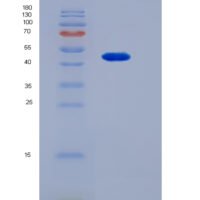
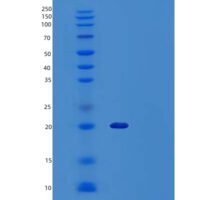
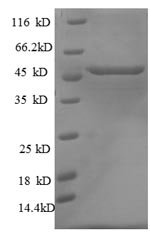
PurityGreater than 90% as determined by SDS-PAGE.
Expression SystemE.coli
Expression Region1-391aa
SpeciesRattus norvegicus (Rat)
Tag InfoN-terminal 6xHis-tagged
Molecular weight47.5kDa
ActivityPlease contact us to obtain bioactivity data.
BufferIf the delivery form is liquid, the default storage buffer is Tris/PBS-based buffer, 5%-50% glycerol. If the delivery form is lyophilized powder, the buffer before lyophilization is Tris/PBS-based buffer, 6% Trehalose.
StorageStore at -20°C/-80°C upon receipt, aliquoting is necessary for mutiple use. Avoid repeated freeze-thaw cycles.
Research AreasOthers

Function

Multifunctional transcription factor that induces cell cycle arrest, DNA repair or apoptosis upon binding to its target DNA sequence. Acts as a tumor suppressor in many tumor types; induces growth arrest or apoptosis depending on the physiological circumstances and cell type. Negatively regulates cell division by controlling expression of a set of genes required for this process.

Biological Context

Subcellular Location: Cytoplasm; Nucleus; Nucleus, PML body; Endoplasmic reticulum; Mitochondrion matrix; Cytoplasm, cytoskeleton, microtubule organizing center, centrosome
Disease Association: [p53 is found in increased amounts in a wide variety of transformed cells. p53 is frequently mutated or inactivated in many types of cancer]

Product Specifications

Recombinant Rat Cellular tumor antigen p53 (Tp53) is a recombinant protein from Rattus norvegicus (Rat), expressed in E.coli, covering amino acids 1-391aa, with N-terminal 6xHis-tagged tag, molecular weight 47.5kDa, purity Greater than 90% as determined by SDS-PAGE.. Suitable for ELISA and Western Blot applications.
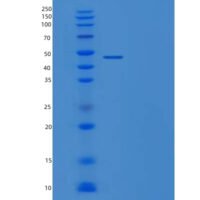
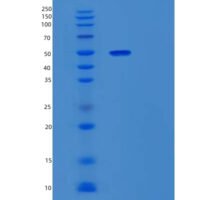
SDS-PAGE: Single band at expected molecular weight confirming purity.

ELISA: Suitable as coating antigen or detection standard.

Western Blot: Compatible with standard Western Blot protocols.

Protein Interaction: Validated for SPR (Surface Plasmon Resonance) and BLI (Bio-Layer Interferometry) studies.

Shipping: Shipped at ambient temperature. Lyophilized protein is stable during transit.

Storage: Store lyophilized protein at -20°C to -80°C. Reconstituted protein should be aliquoted and stored at -80°C. Avoid repeated freeze-thaw cycles.

Shelf Life: 12 months from date of receipt when stored as recommended.

Shipping Time: Orders placed before 2 PM EST ship same day. International orders typically deliver within 5-10 business days.

Protein Biology

Function

Multifunctional transcription factor that induces cell cycle arrest, DNA repair or apoptosis upon binding to its target DNA sequence. Acts as a tumor suppressor in many tumor types; induces growth arrest or apoptosis depending on the physiological circumstances and cell type. Negatively regulates cell division by controlling expression of a set of genes required for this process. One of the activated genes is an inhibitor of cyclin-dependent kinases. Apoptosis induction seems to be mediated either by stimulation of BAX and FAS antigen expression, or by repression of Bcl-2 expression. Its pro-apoptotic activity is activated via its interaction with PPP1R13B/ASPP1 or TP53BP2/ASPP2 (By similarity). However, this activity is inhibited when the interaction with PPP1R13B/ASPP1 or TP53BP2/ASPP2 is displaced by PPP1R13L/iASPP (By similarity). In cooperation with mitochondrial PPIF is involved in activating oxidative stress-induced necrosis; the function is largely independent of transcription. Prevents CDK7 kinase activity when associated to CAK complex in response to DNA damage, thus stopping cell cycle progression. Induces the transcription of long intergenic non-coding RNA p21 (lincRNA-p21) and lincRNA-Mkln1. LincRNA-p21 participates in TP53-dependent transcriptional repression leading to apoptosis and seems to have an effect on cell-cycle regulation. Regulates the circadian clock by repressing CLOCK-ARNTL/BMAL1-mediated transcriptional activation of PER2

Subcellular Location

Cytoplasm; Nucleus; Nucleus, PML body; Endoplasmic reticulum; Mitochondrion matrix; Cytoplasm, cytoskeleton, microtubule organizing center, centrosome

Disease Association

[p53 is found in increased amounts in a wide variety of transformed cells. p53 is frequently mutated or inactivated in many types of cancer]

Subunit

Forms homodimers and homotetramers (By similarity). Binds DNA as a homotetramer. Interacts with AXIN1. Probably part of a complex consisting of TP53, HIPK2 and AXIN1 (By similarity). Interacts with histone acetyltransferases EP300 and methyltransferases HRMT1L2 and CARM1, and recruits them to promoters. Interacts (via C-terminus) with TAF1; when TAF1 is part of the TFIID complex. Interacts with ING4; this interaction may be indirect. Found in a complex with CABLES1 and TP73. Interacts with HIPK1, HIPK2, and TP53INP1. Interacts with WWOX. Interacts with USP7 and SYVN1. Interacts with HSP90AB1 (PubMed:8663025). Interacts with CHD8; leading to recruit histone H1 and prevent transactivation activity (By similarity). Interacts with ARMC10, BANP, CDKN2AIP, NUAK1, STK11/LKB1, UHRF2 and E4F1. Interacts with YWHAZ; the interaction enhances TP53 transcriptional activity. Phosphorylation of YWHAZ on 'Ser-58' inhibits this interaction. Interacts (via DNA-binding domain) with MAML1 (via N-terminus). Interacts with MKRN1. Interacts with PML (via C-terminus). Interacts with MDM2; leading to ubiquitination and proteasomal degradation of TP53. Interacts with PDCD5; the interaction is direct and prevents the interaction between TP53 and MDM2, thereby stabilizing TP53. Directly interacts with FBXO42; leading to ubiquitination and degradation of TP53. Interacts (phosphorylated at Ser-15 by ATM) with the phosphatase PP2A-PPP2R5C holoenzyme; regulates stress-induced TP53-dependent inhibition of cell proliferation. Interacts with PPP2R2A. Interacts with AURKA, DAXX, BRD7 and TRIM24. Interacts (when monomethylated at Lys-380) with L3MBTL1. Interacts with GRK5. Binds to the CAK complex (CDK7, cyclin H and MAT1) in response to DNA damage. Interacts with CDK5 in neurons. Interacts with AURKB, SETD2, UHRF2 and NOC2L. Interacts (via N-terminus) with PTK2/FAK1; this promotes ubiquitination by MDM2. Interacts with PTK2B/PYK2; this promotes ubiquitination by MDM2. Interacts with PRKCG. Interacts with PPIF; the association implicates preferentially tetrameric TP53, is induced by oxidative stress and is impaired by cyclosporin A (CsA). Interacts with SNAI1; the interaction induces SNAI1 degradation via MDM2-mediated ubiquitination and inhibits SNAI1-induced cell invasion. Interacts with UBC9. Interacts with ZNF385B; the interaction is direct. Interacts (via DNA-binding domain) with ZNF385A; the interaction is direct and enhances p53/TP53 transactivation functions on cell-cycle arrest target genes, resulting in growth arrest. Interacts with ANKRD2. Interacts with RFFL and RNF34; involved in p53/TP53 ubiquitination. Interacts with MTA1 and COP1. Interacts with CCAR2 (via N-terminus). Interacts with MORC3. Interacts (via C-terminus) with POU4F2 (via C-terminus). Interacts (via oligomerization region) with NOP53; the interaction is direct and may prevent the MDM2-mediated proteasomal degradation of TP53. Interacts with AFG1L; mediates mitochondrial translocation of TP53. Interacts with UBD (By similarity). Interacts with TAF6 (By similarity). Binds DNA as a homotetramer. Interacts with AXIN1. Probably part of a complex consisting of TP53, HIPK2 and AXIN1. Interacts with histone acetyltransferases EP300 and methyltransferases HRMT1L2 and CARM1, and recruits them to promoters. Interacts (via C-terminus) with TAF1; when TAF1 is part of the TFIID complex. Interacts with ING4; this interaction may be indirect. Found in a complex with CABLES1 and TP73. Interacts with HIPK1, HIPK2, and TP53INP1. Interacts with WWOX. Interacts with USP7 and SYVN1. Interacts with HSP90AB1. Interacts with CHD8; leading to recruit histone H1 and prevent transactivation activity. Interacts with ARMC10, BANP, CDKN2AIP, NUAK1, STK11/LKB1, UHRF2 and E4F. Interacts with YWHAZ; the interaction enhances TP53 transcriptional activity. Phosphorylation of YWHAZ on 'Ser-58' inhibits this interaction. Interacts (via DNA-binding domain) with MAML1 (via N-terminus). Interacts with MKRN1. Interacts with PML (via C-terminus). Interacts with MDM2; leading to ubiquitination and proteasomal degradation of TP53. Directly interacts with FBXO42; leading to ubiquitination and degradation of TP53. Interacts (phosphorylated at Ser-18 by ATM) with the phosphatase PP2A-PPP2R5C holoenzyme; regulates stress-induced TP53-dependent inhibition of cell proliferation. Interacts with PPP2R2A. Interacts with AURKA, DAXX, BRD7 and TRIM24. Interacts (when monomethylated at Lys-379) with L3MBTL1. Interacts with GRK5. Binds to the CAK complex (CDK7, cyclin H and MAT1) in response to DNA damage. Interacts with CDK5 in neurons. Interacts with AURKB, SETD2, UHRF2 and NOC2L. Interacts (via N-terminus) with PTK2/FAK1; this promotes ubiquitination by MDM2. Interacts with PTK2B/PYK2; this promotes ubiquitination by MDM2. Interacts with PRKCG. Interacts with PPIF; the association implicates preferentially tetrameric TP53, is induced by oxidative stress and is impaired by cyclosporin A (CsA). Interacts with SNAI1; the interaction induces SNAI1 degradation via MDM2-mediated ubiquitination and inhibits SNAI1-induced cell invasion. Interacts with UBC9. Interacts with ZNF385B; the interaction is direct. Interacts (via DNA-binding domain) with ZNF385A; the interaction is direct and enhances p53/TP53 transactivation functions on cell-cycle arrest target genes, resulting in growth arrest (By similarity). Interacts with ANKRD2. Interacts with RFFL and RNF34; involved in p53/TP53 ubiquitination. Interacts with MTA1 and COP1. Interacts with CCAR2 (via N-terminus). Interacts with MORC3. Interacts (via C-terminus) with POU4F2 (via C-terminus). Interacts (via oligomerization region) with NOP53; the interaction is direct and may prevent the MDM2-mediated proteasomal degradation of TP53. Interacts with AFG1L; mediates mitochondrial translocation of TP53. Interacts with UBD (By similarity). Interacts with C10orf90/FATS; the interaction inhibits binding of TP53 and MDM2 (By similarity). Interacts with NUPR1; interaction is stress-dependent. Forms a complex with EP300 and NUPR1; this complex binds CDKN1A promoter leading to transcriptional induction of CDKN1A (By similarity). Interacts with PRMT5 in response to DNA damage; the interaction is TTC5/STRAP dependent (By similarity). Interacts with PPP1R13L (via SH3 domain and ANK repeats); the interaction inhibits pro-apoptotic activity of p53/TP53 (By similarity). Interacts with PPP1R13B/ASPP1 and TP53BP2/ASPP2; the interactions promotes pro-apoptotic activity (By similarity). When phosphorylated at Ser-15, interacts with DDX3X and gamma-tubulin (By similarity). Interacts with KAT7/HBO1; leading to inhibit histone acetyltransferase activity of KAT7/HBO1 (By similarity). Interacts (via N-terminus) with E3 ubiquitin-protein ligase MUL1; the interaction results in ubiquitination of cytoplasmic TP53 at Lys-24 and subsequent proteasomal degradation (By similarity). Interacts with S100A4; this interaction promotes TP53 degradation (By similarity). Interacts with TTC5/STRAP; the interaction may result in increased mitochondrial-dependent apoptosis (By similarity). Interacts with NQO1; this interaction is NADH-dependent, stabilizes TP53 in response to oxidative stress and protects it from ubiquitin-independent degradation by the 20S proteasome (By similarity). Interacts with DAZAP2 at TP53 target gene promoters; the interaction is triggered by DNA damage and leads to modulation of the expression of a subset of TP53 target genes, reducing DNA damage-induced cell death by limiting the expression of cell death-mediating TP53 target genes (By similarity). Interacts (via N-terminus) with ZNF768 (via zinc-finger domains); interaction might be facilitated by TP53 oligomerization state (By similarity). Forms a ternary complex with ALDOB and G6PD; this interaction is direct. ALDOB stabilizes the complex inhibiting G6PD activity and keeping oxidative pentose phosphate metabolism in check. Interacts with MORN3; the interactions mediate post-transcriptional modifications of TP53 by MDM2 and SIRT1 (By similarity). Interacts with HSPA9/MOT-2; the interaction promotes the degradation of TP53 (By similarity). Interacts with FBXO22; this interaction promotes TP53 proteasomal degradation (By similarity)

Gene: Tp53  |  Organism: Rattus norvegicus  |  Synonyms: Tumor suppressor p53
Key Publications

Frequently Asked Questions

How do I order or inquire about this product?

Fill out the Online Inquiry form with your required quantity and specifications. You can also email sales@biocrestsci.com. Our team typically responds within 4 business hours with a quote and availability confirmation.

What is the shipping and delivery time?

Orders placed before 2 PM EST ship the same day. Domestic (US) delivery typically takes 2-3 business days. International orders deliver within 5-10 business days. All products are shipped at ambient temperature with appropriate packaging to ensure stability.

How should I store this recombinant protein?

Lyophilized proteins should be stored at -20°C to -80°C upon receipt. After reconstitution, aliquot and store at -80°C. Avoid repeated freeze-thaw cycles. Shelf life is 12 months from date of receipt when stored as recommended.

What quality controls are performed on your products?

Each product undergoes SDS-PAGE purity analysis (typically >85-95%), endotoxin testing, and bioactivity validation. Products are validated for ELISA, Western Blot, and SPR/BLI applications as specified on this product page. A Certificate of Analysis (CoA) is available upon request.

Shopping Cart
Scroll to Top