Recombinant Escherichia coli Multidrug efflux pump subunit AcrB (acrB), partial

Recombinant Escherichia coli Multidrug efflux pump subunit AcrB (acrB), partial — (Microbial infection) Involved in contact-dependent growth inhibition (CDI), acts downstream of BamA, the receptor for CDI. Purity >95%.

SKU: BCRECP-002010 Category:

Product Specifications

Product SkuBCRECP-002010
Product DescriptionRecombinant Escherichia coli Multidrug efflux pump subunit AcrB (acrB) Protein is expressed from E.coli with C-terminal 6xHis-tagged. It contains 29-336aa. [Accession | P31224].
Uniprot No.P31224
Gene NamesacrB
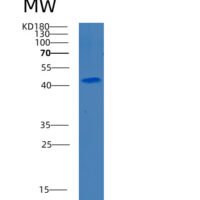
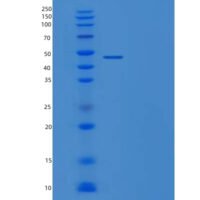
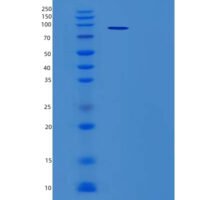
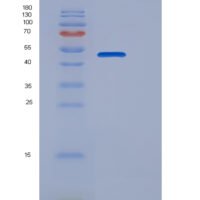
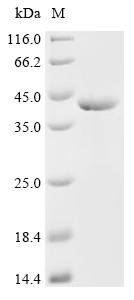
PurityGreater than 95% as determined by SDS-PAGE.
Expression SystemE.coli
Expression Region29-336aa
SpeciesEscherichia coli (strain K12)
Tag InfoC-terminal 6xHis-tagged
Molecular weight39.8kDa
ActivityPlease contact us to obtain bioactivity data.
BufferIf the delivery form is liquid, the default storage buffer is Tris/PBS-based buffer, 5%-50% glycerol. If the delivery form is lyophilized powder, the buffer before lyophilization is Tris/PBS-based buffer, 6% Trehalose.
StorageStore at -20°C/-80°C upon receipt, aliquoting is necessary for mutiple use. Avoid repeated freeze-thaw cycles.
Research AreasOthers

Function

(Microbial infection) Involved in contact-dependent growth inhibition (CDI), acts downstream of BamA, the receptor for CDI. Its role in CDI is independent of the AcrAB-TolC efflux pump complex.

Biological Context

Subcellular Location: Cell inner membrane (Multi-pass membrane protein)

Product Specifications

Recombinant Escherichia coli Multidrug efflux pump subunit AcrB (acrB), partial is a recombinant protein from Escherichia coli (strain K12), expressed in E.coli, covering amino acids 29-336aa, with C-terminal 6xHis-tagged tag, molecular weight 39.8kDa, purity Greater than 95% as determined by SDS-PAGE.. Suitable for ELISA and Western Blot applications.

SDS-PAGE: Single band at expected molecular weight confirming purity.

ELISA: Suitable as coating antigen or detection standard.

Western Blot: Compatible with standard Western Blot protocols.

Protein Interaction: Validated for SPR (Surface Plasmon Resonance) and BLI (Bio-Layer Interferometry) studies.

Shipping: Shipped at ambient temperature. Lyophilized protein is stable during transit.

Storage: Store lyophilized protein at -20°C to -80°C. Reconstituted protein should be aliquoted and stored at -80°C. Avoid repeated freeze-thaw cycles.

Shelf Life: 12 months from date of receipt when stored as recommended.

Shipping Time: Orders placed before 2 PM EST ship same day. International orders typically deliver within 5-10 business days.

Protein Biology

Function

(Microbial infection) Involved in contact-dependent growth inhibition (CDI), acts downstream of BamA, the receptor for CDI (PubMed:18761695). Its role in CDI is independent of the AcrAB-TolC efflux pump complex (PubMed:18761695)

Subcellular Location

Cell inner membrane (Multi-pass membrane protein)

Subunit

Homotrimer, with large porter and funnel domains (PubMed:10920254, PubMed:12374972, PubMed:12738864, PubMed:15228545, PubMed:16079137, PubMed:16915237, PubMed:16946072, PubMed:17194213, PubMed:19023693, PubMed:28355133, PubMed:31201302). Extends into the periplasm, where the trimer interacts with AcrA and TolC (PubMed:10920254, PubMed:12374972, PubMed:12738864, PubMed:15228545, PubMed:16079137, PubMed:16915237, PubMed:16946072, PubMed:17194213, PubMed:19023693, PubMed:28355133, PubMed:31201302). Component of the AcrAB-TolC multidrug efflux complex, composed of six AcrA subunits forming a hexameric tube, binding to an AcrB trimer, which interact with the trimeric TolC outer membrane channel protein (PubMed:10920254, PubMed:12374972, PubMed:12738864, PubMed:15228545, PubMed:16079137, PubMed:16915237, PubMed:16946072, PubMed:17194213, PubMed:24747401, PubMed:28355133, PubMed:31201302). TolC is thought to not contact AcrB stably; instead, AcrA joins AcrB and TolC by forming a funnel-like hexamer anchored to the inner membrane (PubMed:15228545, PubMed:24747401, PubMed:28355133, PubMed:31201302). AcrA may initially form a hexameric ring complex with AcrB, in a bipartite complex, which may be stabilized by binding of AcrA with the peptidoglycan layer, prior to forming the full AcrAB-TolC efflux pump complex (PubMed:22308040, PubMed:28355133, PubMed:31201302). Contact between AcrA-AcrB and TolC may prompt a conformational change in the presence of substrate, allowing the periplasmic gate to open (PubMed:28355133, PubMed:31201302). Each AcrB protomer adopts one of three different conformational states, probably cycling between access, binding, and extrusion of substrate (PubMed:10920254, PubMed:12374972, PubMed:12738864, PubMed:15228545, PubMed:16079137, PubMed:16915237, PubMed:16946072, PubMed:17015667, PubMed:17194213, PubMed:19023693, PubMed:19425588, PubMed:25248080, PubMed:28355133, PubMed:31201302). Several charged residues in the transmembrane region of AcrB may constitute a proton translocation pathway, playing a key energetic role in the conformational changes driving efflux (PubMed:17015667, PubMed:19425588, PubMed:25248080). It is thought that, under high intracellular substrate concentration, AcrB ejects substrate into the tunnel formed by AcrA-TolC; as the substrate level declines, conformational changes in AcrB cause efflux to reduce and stop and the whole complex shifts to the closed state (PubMed:16915237, PubMed:16946072, PubMed:17194213, PubMed:25248080, PubMed:28355133, PubMed:31201302). Interacts with AcrZ; the interaction is direct (PubMed:23010927, PubMed:32348749). Component of the AcrABZ-TolC efflux pump complex, composed of six AcrA subunits forming a hexameric tube binding to an AcrB trimer, which interact with the trimeric TolC outer membrane channel protein; AcrZ interacts directly with AcrB, probably in 1:1 stoichiometry (PubMed:23010927, PubMed:24747401, PubMed:28355133, PubMed:32348749)

Gene: acrB  |  Organism: Escherichia coli (strain K12)  |  Synonyms: AcrAB-TolC multidrug efflux pump subunit AcrB; Acridine resistance protein B
Key Publications

Frequently Asked Questions

How do I order or inquire about this product?

Fill out the Online Inquiry form with your required quantity and specifications. You can also email sales@biocrestsci.com. Our team typically responds within 4 business hours with a quote and availability confirmation.

What is the shipping and delivery time?

Orders placed before 2 PM EST ship the same day. Domestic (US) delivery typically takes 2-3 business days. International orders deliver within 5-10 business days. All products are shipped at ambient temperature with appropriate packaging to ensure stability.

How should I store this recombinant protein?

Lyophilized proteins should be stored at -20°C to -80°C upon receipt. After reconstitution, aliquot and store at -80°C. Avoid repeated freeze-thaw cycles. Shelf life is 12 months from date of receipt when stored as recommended.

What quality controls are performed on your products?

Each product undergoes SDS-PAGE purity analysis (typically >85-95%), endotoxin testing, and bioactivity validation. Products are validated for ELISA, Western Blot, and SPR/BLI applications as specified on this product page. A Certificate of Analysis (CoA) is available upon request.

Shopping Cart
Scroll to Top