, ,

Recombinant Rat Serine/threonine-protein kinase Chk1 (Chek1)

Recombinant Rat Serine/threonine-protein kinase Chk1 (Chek1) — Serine/threonine-protein kinase which is required for checkpoint-mediated cell cycle arrest and activation of DNA repair in response to the presence of DNA damage or unreplicated DNA. Purity >85%.

SKU: BCRECP-002363 Categories: , ,

Product Specifications

Product SkuBCRECP-002363
Product DescriptionRecombinant Rat Serine/threonine-protein kinase Chk1 (Chek1) Protein is expressed from Baculovirus with C-terminal 6xHis-tagged. It contains 1-476aa. [Accession | Q91ZN7].
Uniprot No.Q91ZN7
Gene NamesChek1
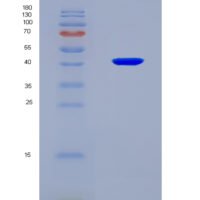
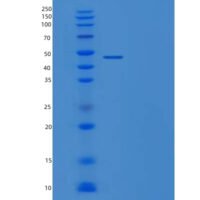
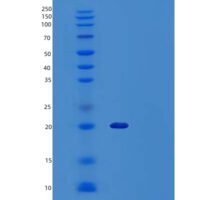
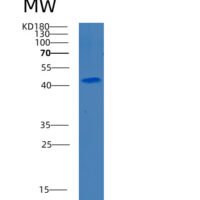
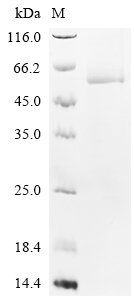
PurityGreater than 85% as determined by SDS-PAGE.
Expression SystemBaculovirus
Expression Region1-476aa
SpeciesRattus norvegicus (Rat)
Tag InfoC-terminal 6xHis-tagged
Molecular weight57.2kDa
ActivityPlease contact us to obtain bioactivity data.
BufferIf the delivery form is liquid, the default storage buffer is Tris/PBS-based buffer, 5%-50% glycerol. If the delivery form is lyophilized powder, the buffer before lyophilization is Tris/PBS-based buffer, 6% Trehalose.
StorageStore at -20°C/-80°C upon receipt, aliquoting is necessary for mutiple use. Avoid repeated freeze-thaw cycles.
Research AreasCancer

Function

Serine/threonine-protein kinase which is required for checkpoint-mediated cell cycle arrest and activation of DNA repair in response to the presence of DNA damage or unreplicated DNA. May also negatively regulate cell cycle progression during unperturbed cell cycles. This regulation is achieved by a number of mechanisms that together help to preserve the integrity of the genome.

Biological Context

Subcellular Location: Nucleus; Chromosome; Cytoplasm; Cytoplasm, cytoskeleton, microtubule organizing center, centrosome
Tissue Specificity: Expressed only in liver

Product Specifications

Recombinant Rat Serine/threonine-protein kinase Chk1 (Chek1) is a recombinant protein from Rattus norvegicus (Rat), expressed in Baculovirus, covering amino acids 1-476aa, with C-terminal 6xHis-tagged tag, molecular weight 57.2kDa, purity Greater than 85% as determined by SDS-PAGE.. Suitable for ELISA and Western Blot applications.

SDS-PAGE: Single band at expected molecular weight confirming purity.

ELISA: Suitable as coating antigen or detection standard.

Western Blot: Compatible with standard Western Blot protocols.

Protein Interaction: Validated for SPR (Surface Plasmon Resonance) and BLI (Bio-Layer Interferometry) studies.

Shipping: Shipped at ambient temperature. Lyophilized protein is stable during transit.

Storage: Store lyophilized protein at -20°C to -80°C. Reconstituted protein should be aliquoted and stored at -80°C. Avoid repeated freeze-thaw cycles.

Shelf Life: 12 months from date of receipt when stored as recommended.

Shipping Time: Orders placed before 2 PM EST ship same day. International orders typically deliver within 5-10 business days.

Protein Biology

Function

Serine/threonine-protein kinase which is required for checkpoint-mediated cell cycle arrest and activation of DNA repair in response to the presence of DNA damage or unreplicated DNA. May also negatively regulate cell cycle progression during unperturbed cell cycles. This regulation is achieved by a number of mechanisms that together help to preserve the integrity of the genome. Recognizes the substrate consensus sequence [R-X-X-S/T]. Binds to and phosphorylates CDC25A, CDC25B and CDC25C. Phosphorylation of CDC25A at 'Ser-178' and 'Thr-507' and phosphorylation of CDC25C at 'Ser-216' creates binding sites for 14-3-3 proteins which inhibit CDC25A and CDC25C. Phosphorylation of CDC25A at 'Ser-76', 'Ser-124', 'Ser-178', 'Ser-279' and 'Ser-293' promotes proteolysis of CDC25A. Phosphorylation of CDC25A at 'Ser-76' primes the protein for subsequent phosphorylation at 'Ser-79', 'Ser-82' and 'Ser-88' by NEK11, which is required for polyubiquitination and degradation of CDCD25A. Inhibition of CDC25 leads to increased inhibitory tyrosine phosphorylation of CDK-cyclin complexes and blocks cell cycle progression. Also phosphorylates NEK6. Binds to and phosphorylates RAD51 at 'Thr-309', which promotes the release of RAD51 from BRCA2 and enhances the association of RAD51 with chromatin, thereby promoting DNA repair by homologous recombination. Phosphorylates multiple sites within the C-terminus of TP53, which promotes activation of TP53 by acetylation and promotes cell cycle arrest and suppression of cellular proliferation. Also promotes repair of DNA cross-links through phosphorylation of FANCE. Binds to and phosphorylates TLK1 at 'Ser-743', which prevents the TLK1-dependent phosphorylation of the chromatin assembly factor ASF1A. This may enhance chromatin assembly both in the presence or absence of DNA damage. May also play a role in replication fork maintenance through regulation of PCNA (By similarity). May regulate the transcription of genes that regulate cell-cycle progression through the phosphorylation of histones. Phosphorylates histone H3.1 (to form H3T11ph), which leads to epigenetic inhibition of a subset of genes (By similarity). May also phosphorylate RB1 to promote its interaction with the E2F family of transcription factors and subsequent cell cycle arrest. Phosphorylates SPRTN, promoting SPRTN recruitment to chromatin (By similarity). Reduces replication stress and activates the G2/M checkpoint, by phosphorylating and inactivating PABIR1/FAM122A and promoting the serine/threonine-protein phosphatase 2A-mediated dephosphorylation and stabilization of WEE1 levels and activity (By similarity)

Subcellular Location

Nucleus; Chromosome; Cytoplasm; Cytoplasm, cytoskeleton, microtubule organizing center, centrosome

Tissue Specificity

Expressed only in liver

Subunit

Interacts (phosphorylated by ATR) with RAD51. Interacts with and phosphorylates CLSPN, an adapter protein that regulates the ATR-dependent phosphorylation of CHEK1. Interacts with BRCA1. Interacts with and phosphorylates CDC25A, CDC25B and CDC25C. Interacts with FBXO6, which regulates CHEK1. Interacts with PPM1D, which regulates CHEK1 through dephosphorylation. Interacts with TIMELESS; DNA damage-dependent. Interacts with FEM1B; activates CHEK1 in response to stress. Interacts with TLK1. Interacts with XPO1 and YWHAZ. Interacts with CDK5RAP3; antagonizes CHEK1. Interacts with KRCC1; the interaction promotes CHEK1 phosphorylation at Ser-296

Gene: Chek1  |  Organism: Rattus norvegicus  |  Synonyms: CHK1 checkpoint homolog; Checkpoint kinase-1

Frequently Asked Questions

How do I order or inquire about this product?

Fill out the Online Inquiry form with your required quantity and specifications. You can also email sales@biocrestsci.com. Our team typically responds within 4 business hours with a quote and availability confirmation.

What is the shipping and delivery time?

Orders placed before 2 PM EST ship the same day. Domestic (US) delivery typically takes 2-3 business days. International orders deliver within 5-10 business days. All products are shipped at ambient temperature with appropriate packaging to ensure stability.

How should I store this recombinant protein?

Lyophilized proteins should be stored at -20°C to -80°C upon receipt. After reconstitution, aliquot and store at -80°C. Avoid repeated freeze-thaw cycles. Shelf life is 12 months from date of receipt when stored as recommended.

What quality controls are performed on your products?

Each product undergoes SDS-PAGE purity analysis (typically >85-95%), endotoxin testing, and bioactivity validation. Products are validated for ELISA, Western Blot, and SPR/BLI applications as specified on this product page. A Certificate of Analysis (CoA) is available upon request.

Shopping Cart
Scroll to Top