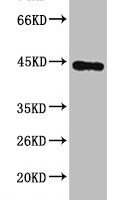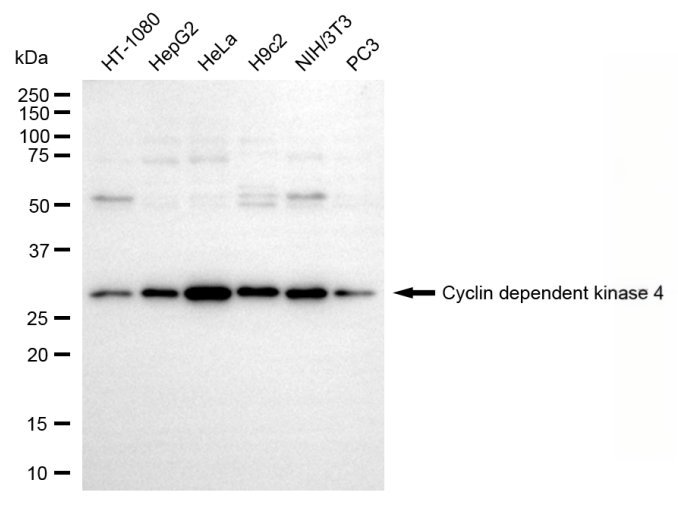
Mouse anti-Human/Mouse/Rat sapiens (Human) CDK4 Monoclonal Antibody

Mouse anti-Human/Mouse/Rat sapiens (Human) CDK4 Monoclonal Antibody — Ser/Thr-kinase component of cyclin D-CDK4 (DC) complexes that phosphorylate and inhibit members of the retinoblastoma (RB) protein family including RB1 and regulate the cell-cycle during G(1)/S tra…

SKU: BCREC-000965MA Category:

Product Specifications

Uniprot No.P11802
Target NamesCDK4
Species ReactivityMouse
ImmunogenRecombinant Human CDK4 protein
Immunogen SpeciesHomo sapiens (Human)
ConjugateNon-conjugated
IsotypeMouse IgG2a kappa
ClonalityMonoclonal
ApplicationsELISA, WB
BufferPBS, 50% glycerol, 0.05% Proclin 300, 0.05%BSA
StorageUpon receipt, store at -20°C or -80°C. Avoid repeated freeze.

Function

Ser/Thr-kinase component of cyclin D-CDK4 (DC) complexes that phosphorylate and inhibit members of the retinoblastoma (RB) protein family including RB1 and regulate the cell-cycle during G(1)/S transition. Phosphorylation of RB1 allows dissociation of the transcription factor E2F from the RB/E2F complexes and the subsequent transcription of E2F target genes which are responsible for the progression through the G(1) phase. Hypophosphorylates RB1 in early G(1) phase.

Biological Context

Subcellular Location: Cytoplasm; Nucleus; Nucleus membrane
Disease Association: Melanoma, cutaneous malignant 3 (CMM3) : A malignant neoplasm of melanocytes, arising de novo or from a pre-existing benign nevus, which occurs most often in the skin but may also involve other sites. [Disease susceptibility is associated with variants affecting the gene represented in this entry]

Product Specifications

Mouse anti-Human/Mouse/Rat sapiens (Human) CDK4 Monoclonal Antibody is a recombinant protein. Suitable for ELISA and Western Blot applications.

SDS-PAGE: Single band at expected molecular weight confirming purity.

ELISA: Suitable as coating antigen or detection standard.

Western Blot: Compatible with standard Western Blot protocols.

Protein Interaction: Validated for SPR (Surface Plasmon Resonance) and BLI (Bio-Layer Interferometry) studies.

Shipping: Shipped at ambient temperature. Lyophilized protein is stable during transit.

Storage: Store lyophilized protein at -20°C to -80°C. Reconstituted protein should be aliquoted and stored at -80°C. Avoid repeated freeze-thaw cycles.

Shelf Life: 12 months from date of receipt when stored as recommended.

Shipping Time: Orders placed before 2 PM EST ship same day. International orders typically deliver within 5-10 business days.

Protein Biology

Function

Ser/Thr-kinase component of cyclin D-CDK4 (DC) complexes that phosphorylate and inhibit members of the retinoblastoma (RB) protein family including RB1 and regulate the cell-cycle during G(1)/S transition. Phosphorylation of RB1 allows dissociation of the transcription factor E2F from the RB/E2F complexes and the subsequent transcription of E2F target genes which are responsible for the progression through the G(1) phase. Hypophosphorylates RB1 in early G(1) phase. Cyclin D-CDK4 complexes are major integrators of various mitogenenic and antimitogenic signals. Also phosphorylates SMAD3 in a cell-cycle-dependent manner and represses its transcriptional activity. Component of the ternary complex, cyclin D/CDK4/CDKN1B, required for nuclear translocation and activity of the cyclin D-CDK4 complex

Subcellular Location

Cytoplasm; Nucleus; Nucleus membrane

Disease Association

Melanoma, cutaneous malignant 3 (CMM3) : A malignant neoplasm of melanocytes, arising de novo or from a pre-existing benign nevus, which occurs most often in the skin but may also involve other sites. [Disease susceptibility is associated with variants affecting the gene represented in this entry]

Subunit

Component of the D-CDK4 complex, composed of CDK4 and some D-type G1 cyclin (CCND1, CCND2 or CCND3). Interacts directly in the complex with CCND1, CCND2 or CCND3. Interacts with SEI1 and ZNF655. Forms a ternary complex, cyclin D-CDK4-CDKN1B, involved in modulating CDK4 enzymatic activity. Interacts directly with CDKN1B (phosphorylated on 'Tyr-88' and 'Tyr-89'); the interaction allows assembly of the cyclin D-CDK4 complex, Thr-172 phosphorylation, nuclear translocation and enhances the cyclin D-CDK4 complex activity. CDK4 activity is either inhibited or enhanced depending on stoichiometry of complex. The non-tyrosine-phosphorylated form of CDKN1B prevents T-loop phosphorylation of CDK4 producing inactive CDK4. Interacts (unphosphorylated form) with CDK2. Also forms ternary complexes with CDKN1A or CDKN2A. Interacts directly with CDKN1A (via its N-terminal); the interaction promotes the assembly of the cyclin D-CDK4 complex, its nuclear translocation and promotes the cyclin D-dependent enzyme activity of CDK4. Interacts with CCND1; the interaction is prevented with the binding of CCND1 to INSM1 during cell cycle progression. Probably forms a complex composed of chaperones HSP90 and HSP70, co-chaperones CDC37, PPP5C, TSC1 and client protein TSC2, CDK4, AKT, RAF1 and NR3C1; this complex does not contain co-chaperones STIP1/HOP and PTGES3/p23 (PubMed:29127155). Interacts with CEBPA (when phosphorylated) (PubMed:15107404). Interacts with FNIP1 and FNIP2 (PubMed:27353360)

Gene: CDK4  |  Organism: Homo sapiens  |  Synonyms: Cell division protein kinase 4; PSK-J3

Frequently Asked Questions

How do I order or inquire about this product?

Fill out the Online Inquiry form with your required quantity and specifications. You can also email sales@biocrestsci.com. Our team typically responds within 4 business hours with a quote and availability confirmation.

What is the shipping and delivery time?

Orders placed before 2 PM EST ship the same day. Domestic (US) delivery typically takes 2-3 business days. International orders deliver within 5-10 business days. All products are shipped at ambient temperature with appropriate packaging to ensure stability.

How should I store this recombinant protein?

Lyophilized proteins should be stored at -20°C to -80°C upon receipt. After reconstitution, aliquot and store at -80°C. Avoid repeated freeze-thaw cycles. Shelf life is 12 months from date of receipt when stored as recommended.

What quality controls are performed on your products?

Each product undergoes SDS-PAGE purity analysis (typically >85-95%), endotoxin testing, and bioactivity validation. Products are validated for ELISA, Western Blot, and SPR/BLI applications as specified on this product page. A Certificate of Analysis (CoA) is available upon request.

Shopping Cart
Scroll to Top