Mouse anti-Human/Mouse/Rat sapiens (Human) SUMO1 Monoclonal Antibody

Mouse anti-Human/Mouse/Rat sapiens (Human) SUMO1 Monoclonal Antibody — Ubiquitin-like protein that can be covalently attached to proteins as a monomer or a lysine-linked polymer.

SKU: BCREC-000222MA Category:

Product Specifications

Uniprot No.P63165
Target NamesSUMO1
Species ReactivityMouse
ImmunogenRecombinant Human SUMO1 protein
Immunogen SpeciesHomo sapiens (Human)
ConjugateNon-conjugated
IsotypeMouse IgG1
ClonalityMonoclonal
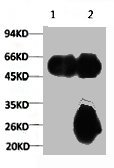
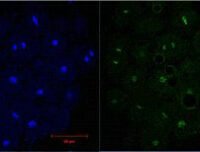
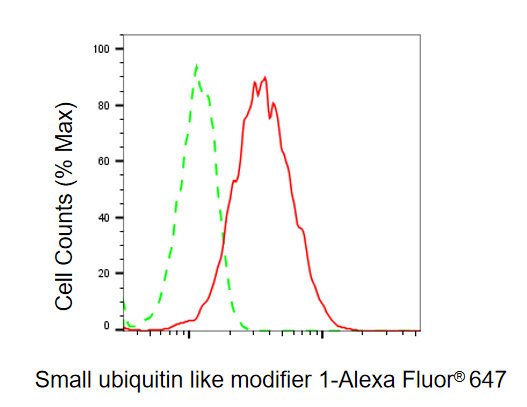
ApplicationsELISA, WB, FC
BufferPBS, 50% glycerol, 0.05% Proclin 300, 0.05%BSA
StorageUpon receipt, store at -20°C or -80°C. Avoid repeated freeze.

Function

Ubiquitin-like protein that can be covalently attached to proteins as a monomer or a lysine-linked polymer. Covalent attachment via an isopeptide bond to its substrates requires prior activation by the E1 complex SAE1-SAE2 and linkage to the E2 enzyme UBE2I, and can be promoted by E3 ligases such as PIAS1-4, RANBP2 or CBX4. This post-translational modification on lysine residues of proteins plays a crucial role in a number of cellular processes such as nuclear transport, DNA replication and repair, mitosis and signal transduction.

Biological Context

Subcellular Location: Nucleus membrane; Nucleus speckle; Cytoplasm; Nucleus, PML body; Cell membrane; Nucleus
Disease Association: Non-syndromic orofacial cleft 10 (OFC10) : A birth defect consisting of cleft lips with or without cleft palate. Cleft lips are associated with cleft palate in two-third of cases. A cleft lip can occur on one or both sides and range in severity from a simple notch in the upper lip to a complete opening in the lip extending into the floor of the nostril and involving the upper gum. [The disease is caused by variants affecting the gene represented in this entry. A chromosomal aberration involving SUMO1 is the cause of OFC10. Translocation t(2;8)(q33.1;q24.3). The breakpoint occurred in the SUMO1 gene and resulted in haploinsufficiency confirmed by protein assays]

Product Specifications

Mouse anti-Human/Mouse/Rat sapiens (Human) SUMO1 Monoclonal Antibody is a recombinant protein. Suitable for ELISA and Western Blot applications.

Applications: ELISA, WB, FC

Biological Activity: Not implied unless activity data are explicitly listed on this product page, the datasheet, or the CoA.

Storage: Upon receipt, store at -20°C or -80°C. Avoid repeated freeze.

Shipping & Lead Time: Availability, shipping conditions, and estimated lead time are confirmed in the formal quotation or order confirmation based on the product format, destination, and order requirements.

Protein Biology

Function

Ubiquitin-like protein that can be covalently attached to proteins as a monomer or a lysine-linked polymer. Covalent attachment via an isopeptide bond to its substrates requires prior activation by the E1 complex SAE1-SAE2 and linkage to the E2 enzyme UBE2I, and can be promoted by E3 ligases such as PIAS1-4, RANBP2 or CBX4. This post-translational modification on lysine residues of proteins plays a crucial role in a number of cellular processes such as nuclear transport, DNA replication and repair, mitosis and signal transduction. Involved for instance in targeting RANGAP1 to the nuclear pore complex protein RANBP2. Covalently attached to the voltage-gated potassium channel KCNB1; this modulates the gating characteristics of KCNB1 (PubMed:19223394). Polymeric SUMO1 chains are also susceptible to polyubiquitination which functions as a signal for proteasomal degradation of modified proteins. May also regulate a network of genes involved in palate development. Covalently attached to ZFHX3 (PubMed:24651376)

Subcellular Location

Nucleus membrane; Nucleus speckle; Cytoplasm; Nucleus, PML body; Cell membrane; Nucleus

Disease Association

Non-syndromic orofacial cleft 10 (OFC10) : A birth defect consisting of cleft lips with or without cleft palate. Cleft lips are associated with cleft palate in two-third of cases. A cleft lip can occur on one or both sides and range in severity from a simple notch in the upper lip to a complete opening in the lip extending into the floor of the nostril and involving the upper gum. [The disease is caused by variants affecting the gene represented in this entry. A chromosomal aberration involving SUMO1 is the cause of OFC10. Translocation t(2;8)(q33.1;q24.3). The breakpoint occurred in the SUMO1 gene and resulted in haploinsufficiency confirmed by protein assays]

Subunit

(Microbial infection) Interacts (via N-terminus) with Hantaan hantavirus nucleoprotein

Gene: SUMO1  |  Organism: Homo sapiens  |  Synonyms: GAP-modifying protein 1; SMT3 homolog 3; Sentrin; Ubiquitin-homology domain protein PIC1; Ubiquitin-like protein SMT3C; Ubiquitin-like protein UBL1
Key Publications

Frequently Asked Questions

How do I order or inquire about this product?

Submit the Online Inquiry form with your required quantity and specifications, or email sales@biocrestsci.com. Available sizes, pricing, stock status, documentation, and estimated lead time are confirmed in the formal quotation.

What is the shipping and delivery time?

Availability, dispatch timing, shipping conditions, and delivery estimates depend on the product format, destination, and order requirements. These details are confirmed in the formal quotation or order confirmation.

How should this product be stored?

Follow the storage and handling instructions in the product-specific datasheet and Certificate of Analysis (CoA). Requirements may vary by product form and formulation; contact BioCrest Sci if product-specific guidance is needed.

What quality controls are performed on your products?

Quality-control data such as identity, purity, endotoxin level, or biological activity are provided only when specified on this product page, the datasheet, or Certificate of Analysis (CoA). Biological activity is not implied unless explicitly stated.

Shopping Cart
Scroll to Top