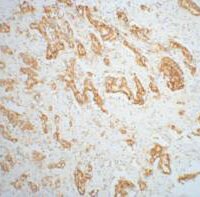
Mouse anti-Human sapiens (Human) AMACR Monoclonal Antibody

Mouse anti-Human sapiens (Human) AMACR Monoclonal Antibody — Catalyzes the interconversion of (R)- and (S)-stereoisomers of alpha-methyl-branched-chain fatty acyl-CoA esters.

SKU: BCREC-000651MA Category:

Product Specifications

Uniprot No.Q9UHK6
Target NamesAMACR
Species ReactivityMouse
ImmunogenSynthesized peptide derived from human AMACR
Immunogen SpeciesHomo sapiens (Human)
ConjugateNon-conjugated
IsotypeIgG1, Kappa
ClonalityMonoclonal
ApplicationsELISA, IHC
BufferPBS, 50% glycerol, 0.05% Proclin 300, 0.05%BSA
StorageUpon receipt, store at -20°C or -80°C. Avoid repeated freeze.

Function

Catalyzes the interconversion of (R)- and (S)-stereoisomers of alpha-methyl-branched-chain fatty acyl-CoA esters. Acts only on coenzyme A thioesters, not on free fatty acids, and accepts as substrates a wide range of alpha-methylacyl-CoAs, including pristanoyl-CoA, trihydroxycoprostanoyl-CoA (an intermediate in bile acid synthesis), and arylpropionic acids like the anti-inflammatory drug ibuprofen (2-(4-isobutylphenyl)propionic acid) but neither 3-methyl-branched nor linear-chain acyl-CoAs.

Biological Context

Subcellular Location: Peroxisome; Mitochondrion
Disease Association: Alpha-methylacyl-CoA racemase deficiency (AMACRD) : A rare autosomal recessive peroxisomal disorder characterized by elevated plasma concentrations of pristanic acid C27-bile-acid intermediates, and adult onset of variable neurodegenerative symptoms affecting the central and peripheral nervous systems. Features may include seizures, visual failure, sensorimotor neuropathy, spasticity, migraine, and white matter hyperintensities on brain imaging. [The disease is caused by variants affecting the gene represented in this entry] | Congenital bile acid synthesis defect 4 (CBAS4) : A disorder characterized by the presence of trihydroxycoprostanic acid in the bile and absence of cholic acid. Patients manifest neonatal jaundice, intrahepatic cholestasis and bile duct deficiency. [The disease is caused by variants affecting the gene represented in this entry]
Pathway: Lipid metabolism; fatty acid metabolism

Product Specifications

Mouse anti-Human sapiens (Human) AMACR Monoclonal Antibody is a recombinant protein. Suitable for ELISA and Western Blot applications.

Applications: ELISA, IHC

Biological Activity: Not implied unless activity data are explicitly listed on this product page, the datasheet, or the CoA.

Storage: Upon receipt, store at -20°C or -80°C. Avoid repeated freeze.

Shipping & Lead Time: Availability, shipping conditions, and estimated lead time are confirmed in the formal quotation or order confirmation based on the product format, destination, and order requirements.

Protein Biology

Function

Catalyzes the interconversion of (R)- and (S)-stereoisomers of alpha-methyl-branched-chain fatty acyl-CoA esters (PubMed:10655068, PubMed:11060359, PubMed:7649182). Acts only on coenzyme A thioesters, not on free fatty acids, and accepts as substrates a wide range of alpha-methylacyl-CoAs, including pristanoyl-CoA, trihydroxycoprostanoyl-CoA (an intermediate in bile acid synthesis), and arylpropionic acids like the anti-inflammatory drug ibuprofen (2-(4-isobutylphenyl)propionic acid) but neither 3-methyl-branched nor linear-chain acyl-CoAs (PubMed:10655068, PubMed:11060359, PubMed:7649182)

Subcellular Location

Peroxisome; Mitochondrion

Disease Association

Alpha-methylacyl-CoA racemase deficiency (AMACRD) : A rare autosomal recessive peroxisomal disorder characterized by elevated plasma concentrations of pristanic acid C27-bile-acid intermediates, and adult onset of variable neurodegenerative symptoms affecting the central and peripheral nervous systems. Features may include seizures, visual failure, sensorimotor neuropathy, spasticity, migraine, and white matter hyperintensities on brain imaging. [The disease is caused by variants affecting the gene represented in this entry] | Congenital bile acid synthesis defect 4 (CBAS4) : A disorder characterized by the presence of trihydroxycoprostanic acid in the bile and absence of cholic acid. Patients manifest neonatal jaundice, intrahepatic cholestasis and bile duct deficiency. [The disease is caused by variants affecting the gene represented in this entry]

Subunit

Monomer

Pathway

Lipid metabolism; fatty acid metabolism

Gene: AMACR  |  Organism: Homo sapiens  |  Synonyms: 2-methylacyl-CoA racemase
Key Publications

Frequently Asked Questions

How do I order or inquire about this product?

Submit the Online Inquiry form with your required quantity and specifications, or email sales@biocrestsci.com. Available sizes, pricing, stock status, documentation, and estimated lead time are confirmed in the formal quotation.

What is the shipping and delivery time?

Availability, dispatch timing, shipping conditions, and delivery estimates depend on the product format, destination, and order requirements. These details are confirmed in the formal quotation or order confirmation.

How should this product be stored?

Follow the storage and handling instructions in the product-specific datasheet and Certificate of Analysis (CoA). Requirements may vary by product form and formulation; contact BioCrest Sci if product-specific guidance is needed.

What quality controls are performed on your products?

Quality-control data such as identity, purity, endotoxin level, or biological activity are provided only when specified on this product page, the datasheet, or Certificate of Analysis (CoA). Biological activity is not implied unless explicitly stated.

Shopping Cart
Scroll to Top