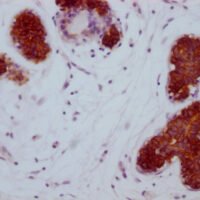
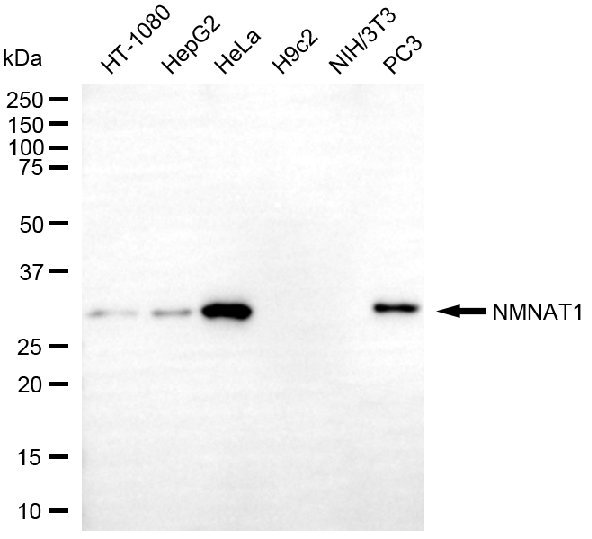
Mouse anti-Human sapiens (Human) NMNAT1 Monoclonal Antibody

Mouse anti-Human sapiens (Human) NMNAT1 Monoclonal Antibody — Catalyzes the formation of NAD(+) from nicotinamide mononucleotide (NMN) and ATP.

SKU: BCREC-000384MA Category:

Product Specifications

Uniprot No.Q9HAN9
Target NamesNMNAT1
Species ReactivityMouse
ImmunogenRecombinant Human NMNAT1 protein
Immunogen SpeciesHomo sapiens (Human)
ConjugateNon-conjugated
IsotypeMouse IgG1
ClonalityMonoclonal
ApplicationsELISA, WB
BufferPBS, 50% glycerol, 0.05% Proclin 300, 0.05%BSA
StorageUpon receipt, store at -20°C or -80°C. Avoid repeated freeze.

Function

Catalyzes the formation of NAD(+) from nicotinamide mononucleotide (NMN) and ATP. Can also use the deamidated form; nicotinic acid mononucleotide (NaMN) as substrate with the same efficiency. Can use triazofurin monophosphate (TrMP) as substrate.

Biological Context

Subcellular Location: Nucleus
Tissue Specificity: Widely expressed with highest levels in skeletal muscle, heart and kidney. Also expressed in the liver pancreas and placenta. Widely expressed throughout the brain
Disease Association: Leber congenital amaurosis 9 (LCA9) : A severe dystrophy of the retina, typically becoming evident in the first years of life. Visual function is usually poor and often accompanied by nystagmus, sluggish or near-absent pupillary responses, photophobia, high hyperopia and keratoconus. [The disease is caused by variants affecting the gene represented in this entry] | Spondyloepiphyseal dysplasia, sensorineural hearing loss, impaired intellectual development, and Leber congenital amaurosis (SHILCA) : An autosomal recessive disorder characterized by early-onset retinal degeneration, sensorineural hearing loss, short stature due to spondyloepiphyseal dysplasia, and motor and intellectual delay. Brain imaging shows abnormalities including delayed myelination, leukoencephalopathy, and cerebellar hypoplasia. [The disease is caused by variants affecting the gene represented in this entry]
Pathway: Cofactor biosynthesis; NAD(+) biosynthesis; deamido-NAD(+) from nicotinate D-ribonucleotide: step 1/1

Product Specifications

Mouse anti-Human sapiens (Human) NMNAT1 Monoclonal Antibody is a recombinant protein. Suitable for ELISA and Western Blot applications.

SDS-PAGE: Single band at expected molecular weight confirming purity.

ELISA: Suitable as coating antigen or detection standard.

Western Blot: Compatible with standard Western Blot protocols.

Protein Interaction: Validated for SPR (Surface Plasmon Resonance) and BLI (Bio-Layer Interferometry) studies.

Shipping: Shipped at ambient temperature. Lyophilized protein is stable during transit.

Storage: Store lyophilized protein at -20°C to -80°C. Reconstituted protein should be aliquoted and stored at -80°C. Avoid repeated freeze-thaw cycles.

Shelf Life: 12 months from date of receipt when stored as recommended.

Shipping Time: Orders placed before 2 PM EST ship same day. International orders typically deliver within 5-10 business days.

Protein Biology

Function

Catalyzes the formation of NAD(+) from nicotinamide mononucleotide (NMN) and ATP (PubMed:17402747). Can also use the deamidated form; nicotinic acid mononucleotide (NaMN) as substrate with the same efficiency (PubMed:17402747). Can use triazofurin monophosphate (TrMP) as substrate (PubMed:17402747). Also catalyzes the reverse reaction, i.e. the pyrophosphorolytic cleavage of NAD(+) (PubMed:17402747). For the pyrophosphorolytic activity, prefers NAD(+) and NaAD as substrates and degrades NADH, nicotinic acid adenine dinucleotide phosphate (NHD) and nicotinamide guanine dinucleotide (NGD) less effectively (PubMed:17402747). Involved in the synthesis of ATP in the nucleus, together with PARP1, PARG and NUDT5 (PubMed:27257257). Nuclear ATP generation is required for extensive chromatin remodeling events that are energy-consuming (PubMed:27257257). Also acts as a cofactor for glutamate and aspartate ADP-ribosylation by directing PARP1 catalytic activity to glutamate and aspartate residues on histones (By similarity). Fails to cleave phosphorylated dinucleotides NADP(+), NADPH and NaADP(+) (PubMed:17402747). Protects against axonal degeneration following mechanical or toxic insults (By similarity). Neural protection does not correlate with cellular NAD(+) levels but may still require enzyme activity (By similarity)

Subcellular Location

Nucleus

Disease Association

Leber congenital amaurosis 9 (LCA9) : A severe dystrophy of the retina, typically becoming evident in the first years of life. Visual function is usually poor and often accompanied by nystagmus, sluggish or near-absent pupillary responses, photophobia, high hyperopia and keratoconus. [The disease is caused by variants affecting the gene represented in this entry] | Spondyloepiphyseal dysplasia, sensorineural hearing loss, impaired intellectual development, and Leber congenital amaurosis (SHILCA) : An autosomal recessive disorder characterized by early-onset retinal degeneration, sensorineural hearing loss, short stature due to spondyloepiphyseal dysplasia, and motor and intellectual delay. Brain imaging shows abnormalities including delayed myelination, leukoencephalopathy, and cerebellar hypoplasia. [The disease is caused by variants affecting the gene represented in this entry]

Tissue Specificity

Widely expressed with highest levels in skeletal muscle, heart and kidney. Also expressed in the liver pancreas and placenta. Widely expressed throughout the brain

Subunit

Homohexamer (PubMed:11751893). Interacts with ADPRT/PARP1 (PubMed:11248244)

Pathway

Cofactor biosynthesis; NAD(+) biosynthesis; deamido-NAD(+) from nicotinate D-ribonucleotide: step 1/1

Gene: NMNAT1  |  Organism: Homo sapiens  |  Synonyms: Nicotinamide-nucleotide adenylyltransferase 1; Nicotinate-nucleotide adenylyltransferase 1
Key Publications

Frequently Asked Questions

How do I order or inquire about this product?

Fill out the Online Inquiry form with your required quantity and specifications. You can also email sales@biocrestsci.com. Our team typically responds within 4 business hours with a quote and availability confirmation.

What is the shipping and delivery time?

Orders placed before 2 PM EST ship the same day. Domestic (US) delivery typically takes 2-3 business days. International orders deliver within 5-10 business days. All products are shipped at ambient temperature with appropriate packaging to ensure stability.

How should I store this recombinant protein?

Lyophilized proteins should be stored at -20°C to -80°C upon receipt. After reconstitution, aliquot and store at -80°C. Avoid repeated freeze-thaw cycles. Shelf life is 12 months from date of receipt when stored as recommended.

What quality controls are performed on your products?

Each product undergoes SDS-PAGE purity analysis (typically >85-95%), endotoxin testing, and bioactivity validation. Products are validated for ELISA, Western Blot, and SPR/BLI applications as specified on this product page. A Certificate of Analysis (CoA) is available upon request.

Shopping Cart
Scroll to Top