Recombinant Bacillus phage phi29 DNA polymerase (2)

Recombinant Bacillus phage phi29 DNA polymerase (2) — Polymerase responsible for protein-primed viral DNA replication by strand displacement with high processivity and fidelity. Purity >90%.

SKU: BCRECP-001956 Category:

Product Specifications

Product SkuBCRECP-001956
Product DescriptionRecombinant Bacillus phage phi29 DNA polymerase (2) Protein is expressed from E.coli with N-terminal 10xHis-tagged and C-terminal Myc-tagged. It contains 1-575aa. [Accession | P03680].
Uniprot No.P03680
Gene Names2
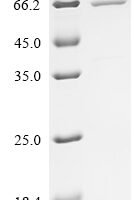
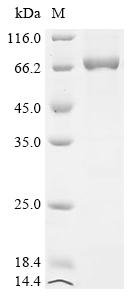
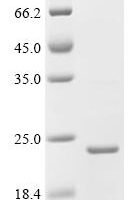
PurityGreater than 90% as determined by SDS-PAGE.
Expression SystemE.coli
Expression Region1-575aa
SpeciesBacillus phage phi29 (Bacteriophage phi-29)
Tag InfoN-terminal 10xHis-tagged and C-terminal Myc-tagged
Molecular weight74.2kDa
ActivityPlease contact us to obtain bioactivity data.
BufferIf the delivery form is liquid, the default storage buffer is Tris/PBS-based buffer, 5%-50% glycerol. If the delivery form is lyophilized powder, the buffer before lyophilization is Tris/PBS-based buffer, 6% Trehalose.
StorageStore at -20°C/-80°C upon receipt, aliquoting is necessary for mutiple use. Avoid repeated freeze-thaw cycles.
Research AreasOthers

Function

Polymerase responsible for protein-primed viral DNA replication by strand displacement with high processivity and fidelity. To start replication, the DNA polymerase forms a heterodimer with a free primer terminal protein (TP), recognizes the replication origins at both 5' ends of the linear chromosome, and initiates replication using as primer the OH-group of Ser-232 of the TP. This polymerase possesses three enzymatic activities: DNA synthesis (polymerase), primer terminal protein (TP) deoxynucleotidylation, which is the formation of a covalent linkage (phosphoester) between the hydroxyl group of a specific serine residue in TP and 5'-dAMP, a reaction directed by the second T at the 3' end, and 3' to 5' exonuclease activity.

Product Specifications

Recombinant Bacillus phage phi29 DNA polymerase (2) is a recombinant protein from Bacillus phage phi29 (Bacteriophage phi-29), expressed in E.coli, covering amino acids 1-575aa, with N-terminal 10xHis-tagged and C-terminal Myc-tagged tag, molecular weight 74.2kDa, purity Greater than 90% as determined by SDS-PAGE.. Suitable for ELISA and Western Blot applications.
Recommended applications depend on the target, product format, and product-specific validation data. Refer to the product datasheet or Certificate of Analysis (CoA), or contact BioCrest Sci for application guidance.

Biological Activity: Please contact us to obtain bioactivity data.

Storage: Store at -20°C/-80°C upon receipt, aliquoting is necessary for mutiple use. Avoid repeated freeze-thaw cycles.

Shipping & Lead Time: Availability, shipping conditions, and estimated lead time are confirmed in the formal quotation or order confirmation based on the product format, destination, and order requirements.

Protein Biology

Function

Polymerase responsible for protein-primed viral DNA replication by strand displacement with high processivity and fidelity (PubMed:2498321, PubMed:3863101). To start replication, the DNA polymerase forms a heterodimer with a free primer terminal protein (TP), recognizes the replication origins at both 5' ends of the linear chromosome, and initiates replication using as primer the OH-group of Ser-232 of the TP (PubMed:22210885). This polymerase possesses three enzymatic activities: DNA synthesis (polymerase), primer terminal protein (TP) deoxynucleotidylation, which is the formation of a covalent linkage (phosphoester) between the hydroxyl group of a specific serine residue in TP and 5'-dAMP, a reaction directed by the second T at the 3' end, and 3' to 5' exonuclease activity (PubMed:2790959). Exonuclease activity has a proofreading purpose (PubMed:2790959). DNA polymerase edits the polymerization errors using an intramolecular pathway as the primer terminus travels from one active site to the other without dissociation from the DNA (PubMed:10493855). DNA polymerization catalyzed by the DNA polymerase is a highly accurate process, but the protein-primed initiation is a quite inaccurate reaction (PubMed:8428945). Since the polymerase initiates the replication on the second thymine, the TP-dAMP initiation product translocates backwards to recover the template information of the first nucleotide (sliding back-mechanism) (PubMed:19011105)

Subunit

Interacts with the primer terminal protein; this interaction allows the initiation of TP-primed DNA replication at both viral DNA ends. Interacts with DNA

Gene: 2  |  Organism: Bacillus phage phi29  |  Synonyms: Gene product 2; Protein p2
Key Publications

Frequently Asked Questions

How do I order or inquire about this product?

Submit the Online Inquiry form with your required quantity and specifications, or email sales@biocrestsci.com. Available sizes, pricing, stock status, documentation, and estimated lead time are confirmed in the formal quotation.

What is the shipping and delivery time?

Availability, dispatch timing, shipping conditions, and delivery estimates depend on the product format, destination, and order requirements. These details are confirmed in the formal quotation or order confirmation.

How should this product be stored?

Follow the storage and handling instructions in the product-specific datasheet and Certificate of Analysis (CoA). Requirements may vary by product form and formulation; contact BioCrest Sci if product-specific guidance is needed.

What quality controls are performed on your products?

Quality-control data such as identity, purity, endotoxin level, or biological activity are provided only when specified on this product page, the datasheet, or Certificate of Analysis (CoA). Biological activity is not implied unless explicitly stated.

Shopping Cart
Scroll to Top