,

Recombinant Cavia porcellus Potassium voltage-gated channel subfamily KQT member 1 (KCNQ1) Protein

Recombinant Cavia porcellus Potassium voltage-gated channel subfamily KQT member 1 (KCNQ1) Protein — Pore-forming subunit of the voltage-gated potassium (Kv) channel involved in the regulation of cardiomyocyte excitability and important in normal development and functions of myocardium, inner ear…

SKU: BCRECP-00073TM Categories: ,

Product Specifications

Uniprot No.O70344
Gene NamesKCNQ1
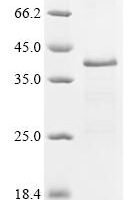
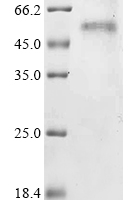
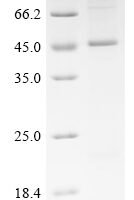
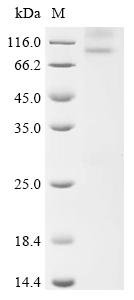
PurityGreater than 85% as determined by SDS-PAGE.
Expression Systemin vitro E.coli expression system
Expression Region1-671aa
SpeciesCavia porcellus (Guinea pig)
Tag InfoN-terminal 10xHis-tagged
Molecular weight80.5kDa
ActivityNot Test
BufferIf the delivery form is liquid, the default storage buffer is Tris/PBS-based buffer, 5%-50% glycerol.If the delivery form is lyophilized powder, the buffer before lyophilization is Tris/PBS-based buffer, 6% Trehalose.
StorageStore at -20°C/-80°C upon receipt, aliquoting is necessary for mutiple use. Avoid repeated freeze-thaw cycles.

Function

Pore-forming subunit of the voltage-gated potassium (Kv) channel involved in the regulation of cardiomyocyte excitability and important in normal development and functions of myocardium, inner ear, stomach and colon. Associates with KCNE beta subunits that modulates current kinetics. Induces a voltage-dependent by rapidly activating and slowly deactivating potassium-selective outward current.

Biological Context

Subcellular Location: Cell membrane (Multi-pass membrane protein); Cytoplasmic vesicle membrane; Early endosome; Membrane raft; Endoplasmic reticulum; Basolateral cell membrane

Product Specifications

Recombinant Cavia porcellus Potassium voltage-gated channel subfamily KQT member 1 (KCNQ1) Protein is a recombinant protein from Cavia porcellus (Guinea pig), expressed in in vitro E.coli expression system, covering amino acids 1-671aa, with N-terminal 10xHis-tagged tag, molecular weight 80.5kDa, purity Greater than 85% as determined by SDS-PAGE.. Suitable for ELISA and Western Blot applications.

SDS-PAGE: Single band at expected molecular weight confirming purity.

ELISA: Suitable as coating antigen or detection standard.

Western Blot: Compatible with standard Western Blot protocols.

Protein Interaction: Validated for SPR (Surface Plasmon Resonance) and BLI (Bio-Layer Interferometry) studies.

Shipping: Shipped at ambient temperature. Lyophilized protein is stable during transit.

Storage: Store lyophilized protein at -20°C to -80°C. Reconstituted protein should be aliquoted and stored at -80°C. Avoid repeated freeze-thaw cycles.

Shelf Life: 12 months from date of receipt when stored as recommended.

Shipping Time: Orders placed before 2 PM EST ship same day. International orders typically deliver within 5-10 business days.

Protein Biology

Function

Pore-forming subunit of the voltage-gated potassium (Kv) channel involved in the regulation of cardiomyocyte excitability and important in normal development and functions of myocardium, inner ear, stomach and colon (By similarity). Associates with KCNE beta subunits that modulates current kinetics (By similarity). Induces a voltage-dependent by rapidly activating and slowly deactivating potassium-selective outward current (By similarity). Also promotes a delayed voltage activated potassium current showing outward rectification characteristic (By similarity). During beta-adrenergic receptor stimulation participates in cardiac repolarization by associating with KCNE1 to form the I(Ks) cardiac potassium current that increases the amplitude and slows down the activation kinetics of outward potassium current I(Ks) (By similarity). Muscarinic agonist oxotremorine-M strongly suppresses KCNQ1/KCNE1 current (By similarity). When associated with KCNE3, forms the potassium channel that is important for cyclic AMP-stimulated intestinal secretion of chloride ions (By similarity). This interaction with KCNE3 is reduced by 17beta-estradiol, resulting in the reduction of currents (By similarity). During conditions of increased substrate load, maintains the driving force for proximal tubular and intestinal sodium ions absorption, gastric acid secretion, and cAMP-induced jejunal chloride ions secretion (By similarity). Allows the provision of potassium ions to the luminal membrane of the secretory canaliculus in the resting state as well as during stimulated acid secretion (By similarity). When associated with KCNE2, forms a heterooligomer complex leading to currents with an apparently instantaneous activation, a rapid deactivation process and a linear current-voltage relationship and decreases the amplitude of the outward current (By similarity). When associated with KCNE4, inhibits voltage-gated potassium channel activity (By similarity). When associated with KCNE5, this complex only conducts current upon strong and continued depolarization (By similarity). Also forms a heterotetramer with KCNQ5 that has a voltage-gated potassium channel activity (By similarity). Binds with phosphatidylinositol 4,5-bisphosphate (By similarity)

Subcellular Location

Cell membrane (Multi-pass membrane protein); Cytoplasmic vesicle membrane; Early endosome; Membrane raft; Endoplasmic reticulum; Basolateral cell membrane

Subunit

Tetramer. Heterotetramer with KCNE1; targets to the membrane raft. Interacts (via C-terminus) with CALM; forms a heterooctameric structure (with 4:4 KCNQ1:CALM stoichiometry) in a calcium-independent manner. Interacts with AKAP9; targets protein kinase A (PKA) catalytic and regulatory subunits and protein phosphatase 1 (PP1) to the KCNQ1-KCNE1 complex, allowing PKA-mediated phosphorylation and increase of delayed rectifier potassium channel activity. Interacts with KCNE2; form a heterooligomer complex that targets to the membrane raft and leading to currents with an apparently instantaneous activation, a rapid deactivation process and a linear current-voltage relationship and decreases the amplitude of the outward current. Interacts with AP2M1; mediates estrogen-induced internalization via clathrin-coated vesicles. Interacts with NEDD4L; promotes internalization and decreases I(Ks) currents. Interacts with USP2; counteracts the NEDD4L-specific down-regulation of I(Ks) and restore plasma membrane localization. Heterotetramer with KCNQ5; has a voltage-gated potassium channel activity. Interacts with KCNE3; four KCNE3 molecules are bound to one KCNQ1 tetramer (4:4 KCNQ1:KCNE3 stoichiometry); alters membrane raft localization; affects KCNQ1 structure and gating properties. Interacts with KCNE4; impairs KCNQ1 localization in lipid rafts and inhibits voltage-gated potassium channel activity. Interacts with KCNE5; impairs KCNQ1 localization in lipid rafts and only conducts current upon strong and continued depolarization

Gene: KCNQ1  |  Organism: Cavia porcellus  |  Synonyms: IKs producing slow voltage-gated potassium channel subunit alpha KvLQT1; KQT-like 1; Voltage-gated potassium channel subunit Kv7.1

Frequently Asked Questions

How do I order or inquire about this product?

Fill out the Online Inquiry form with your required quantity and specifications. You can also email sales@biocrestsci.com. Our team typically responds within 4 business hours with a quote and availability confirmation.

What is the shipping and delivery time?

Orders placed before 2 PM EST ship the same day. Domestic (US) delivery typically takes 2-3 business days. International orders deliver within 5-10 business days. All products are shipped at ambient temperature with appropriate packaging to ensure stability.

How should I store this recombinant protein?

Lyophilized proteins should be stored at -20°C to -80°C upon receipt. After reconstitution, aliquot and store at -80°C. Avoid repeated freeze-thaw cycles. Shelf life is 12 months from date of receipt when stored as recommended.

What quality controls are performed on your products?

Each product undergoes SDS-PAGE purity analysis (typically >85-95%), endotoxin testing, and bioactivity validation. Products are validated for ELISA, Western Blot, and SPR/BLI applications as specified on this product page. A Certificate of Analysis (CoA) is available upon request.

Shopping Cart
Scroll to Top