,

Recombinant Epstein-Barr virus Deneddylase BPLF1 (BPLF1), partial

Recombinant Epstein-Barr virus Deneddylase BPLF1 (BPLF1), partial — Large tegument protein that plays multiple roles in the viral cycle. Purity >85%.

SKU: BCRECP-002230 Categories: ,

Product Specifications

Product SkuBCRECP-002230
Product DescriptionRecombinant Epstein-Barr virus Deneddylase BPLF1 (BPLF1) Protein is expressed from E.coli with N-terminal 10xHis-tagged and C-terminal Myc-tagged. It contains 1-320aa. [Accession | P03186].
Uniprot No.P03186
Gene NamesBPLF1
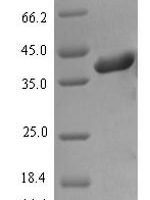
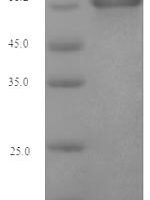
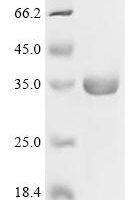
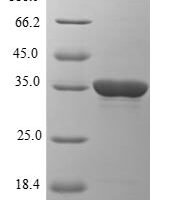
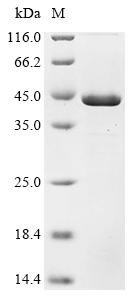
PurityGreater than 85% as determined by SDS-PAGE.
Expression SystemE.coli
Expression Region1-320aa
SpeciesEpstein-Barr virus (strain B95-8) (HHV-4) (Human herpesvirus 4)
Tag InfoN-terminal 10xHis-tagged and C-terminal Myc-tagged
Molecular weight41.9kDa
ActivityPlease contact us to obtain bioactivity data.
BufferIf the delivery form is liquid, the default storage buffer is Tris/PBS-based buffer, 5%-50% glycerol. If the delivery form is lyophilized powder, the buffer before lyophilization is Tris/PBS-based buffer, 6% Trehalose.
StorageStore at -20°C/-80°C upon receipt, aliquoting is necessary for mutiple use. Avoid repeated freeze-thaw cycles.
Research AreasOthers

Function

Large tegument protein that plays multiple roles in the viral cycle. During viral entry, remains associated with the capsid while most of the tegument is detached and participates in the capsid transport toward the host nucleus. Plays a role in the routing of the capsid at the nuclear pore complex and subsequent uncoating.

Biological Context

Subcellular Location: Virion tegument; Host cytoplasm; Host nucleus

Product Specifications

Recombinant Epstein-Barr virus Deneddylase BPLF1 (BPLF1), partial is a recombinant protein from Epstein-Barr virus (strain B95-8) (HHV-4) (Human herpesvirus 4), expressed in E.coli, covering amino acids 1-320aa, with N-terminal 10xHis-tagged and C-terminal Myc-tagged tag, molecular weight 41.9kDa, purity Greater than 85% as determined by SDS-PAGE.. Suitable for ELISA and Western Blot applications.

SDS-PAGE: Single band at expected molecular weight confirming purity.

ELISA: Suitable as coating antigen or detection standard.

Western Blot: Compatible with standard Western Blot protocols.

Protein Interaction: Validated for SPR (Surface Plasmon Resonance) and BLI (Bio-Layer Interferometry) studies.

Shipping: Shipped at ambient temperature. Lyophilized protein is stable during transit.

Storage: Store lyophilized protein at -20°C to -80°C. Reconstituted protein should be aliquoted and stored at -80°C. Avoid repeated freeze-thaw cycles.

Shelf Life: 12 months from date of receipt when stored as recommended.

Shipping Time: Orders placed before 2 PM EST ship same day. International orders typically deliver within 5-10 business days.

Protein Biology

Function

Large tegument protein that plays multiple roles in the viral cycle. During viral entry, remains associated with the capsid while most of the tegument is detached and participates in the capsid transport toward the host nucleus. Plays a role in the routing of the capsid at the nuclear pore complex and subsequent uncoating. Within the host nucleus, acts as a deneddylase and promotes the degradation of nuclear CRLs (cullin-RING ubiquitin ligases) and thereby stabilizes nuclear CRL substrates, while cytoplasmic CRLs remain unaffected. These modifications prevent host cell cycle S-phase progression and create a favorable environment allowing efficient viral genome replication. Participates later in the secondary envelopment of capsids. Indeed, plays a linker role for the association of the outer viral tegument to the capsids together with the inner tegument protein (By similarity). Counteracts host TLR-mediated NF-kappa-B activation through both MYD88 and TICAM1-dependent pathways by interfering with 'Lys-63'- and 'Lys-48'-linked ubiquitination of signaling intermediates such as TRAF6 and IKBKG (PubMed:24586164). Inhibits type I interferon production by forming a tri-molecular complex with host TRIM25 and 14-3-3 thereby promoting TRIM25 autoubiquitination and sequestration of the ligase into inactive protein aggregates (PubMed:31710640). In turn, host RIGI is recruited to the complex but ubiquitination is severely impaired leading to inhibition of the pathway (PubMed:29357390). Also catalyzes the removal of 'Lys-48'- and 'Lys-63'-linked ubiquitin chains on host TBK1 and STING1 suppressing cGAS-STING signaling in addition to the RIGI-MAVS pathway (PubMed:36802409). Inhibits selective autophagy by deubiquitinating host SQSTM1. In turn, decreased SQSTM1 ubiquitination fails to recruit LC3 to SQSTM1-positive aggregates (PubMed:34543352). In the host nucleus, deubiquitinates topoisomerase II subunits TOP2A and TOP2B thereby stabilizing SUMOylated TOP2 which halts the DNA damage response to TOP2-induced double strand DNA breaks and promotes cell survival (PubMed:34543352)

Subcellular Location

Virion tegument; Host cytoplasm; Host nucleus

Subunit

Interacts with host CUL1 and CUL4A; these interactions inhibit the E3 ligase activity of cullins (PubMed:22474075). Interacts with inner tegument protein. Interacts with capsid vertex specific component CVC2. Interacts with the major capsid protein/MCP (By similarity). Interacts with host TRIM25 and YWHAZ (PubMed:29357390, PubMed:31710640)

Organism: Epstein-Barr virus (strain B95-8)
Key Publications

Frequently Asked Questions

How do I order or inquire about this product?

Fill out the Online Inquiry form with your required quantity and specifications. You can also email sales@biocrestsci.com. Our team typically responds within 4 business hours with a quote and availability confirmation.

What is the shipping and delivery time?

Orders placed before 2 PM EST ship the same day. Domestic (US) delivery typically takes 2-3 business days. International orders deliver within 5-10 business days. All products are shipped at ambient temperature with appropriate packaging to ensure stability.

How should I store this recombinant protein?

Lyophilized proteins should be stored at -20°C to -80°C upon receipt. After reconstitution, aliquot and store at -80°C. Avoid repeated freeze-thaw cycles. Shelf life is 12 months from date of receipt when stored as recommended.

What quality controls are performed on your products?

Each product undergoes SDS-PAGE purity analysis (typically >85-95%), endotoxin testing, and bioactivity validation. Products are validated for ELISA, Western Blot, and SPR/BLI applications as specified on this product page. A Certificate of Analysis (CoA) is available upon request.

Shopping Cart
Scroll to Top