Recombinant Human Actin, alpha skeletal muscle (ACTA1)

Recombinant Human Actin, alpha skeletal muscle (ACTA1) — recombinant protein from Homo sapiens (Human), expressed in E.coli. Purity >90%.

SKU: BCRECP-000024 Category:

Product Specifications

Product SkuBCRECP-000024
Product DescriptionRecombinant Human Actin, alpha skeletal muscle (ACTA1) Protein is expressed from E.coli with N-terminal 6xHis-tagged. It contains 3-377aa. [Accession | P68133].
Uniprot No.P68133
Gene NamesACTA1
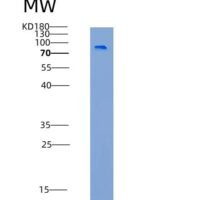
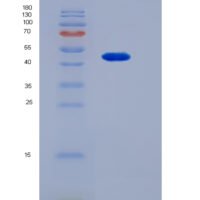
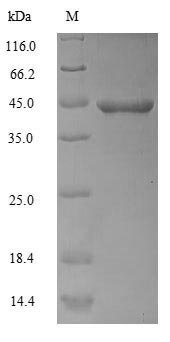
PurityGreater than 90% as determined by SDS-PAGE.
Expression SystemE.coli
Expression Region3-377aa
SpeciesHomo sapiens (Human)
Tag InfoN-terminal 6xHis-tagged
Molecular weight45.8kDa
ActivityPlease contact us to obtain bioactivity data.
BufferIf the delivery form is liquid, the default storage buffer is Tris/PBS-based buffer, 5%-50% glycerol. If the delivery form is lyophilized powder, the buffer before lyophilization is Tris/PBS-based buffer, 6% Trehalose.
StorageStore at -20°C/-80°C upon receipt, aliquoting is necessary for mutiple use. Avoid repeated freeze-thaw cycles.
Research AreasSignal Transduction

Function

Actins are highly conserved proteins that are involved in various types of cell motility and are ubiquitously expressed in all eukaryotic cells.

Biological Context

Subcellular Location: Cytoplasm, cytoskeleton
Disease Association: Congenital myopathy 2A, typical, autosomal dominant (CMYO2A) : A muscular disorder characterized by generalized muscle weakness, delayed motor milestones, hypotonia, and muscle fiber abnormalities on histologic examination. Histologic findings include abnormal thread- or rod-like structures (nemaline rods), intranuclear rods, clumped filaments, cores, or fiber-type disproportion. The spectrum of clinical phenotypes ranges from severe neonatal presentations to onset of a milder disorder in childhood. [The disease is caused by variants affecting the gene represented in this entry] | Congenital myopathy 2B, severe infantile, autosomal recessive (CMYO2B) : An autosomal recessive skeletal muscle disorder characterized by severe hypotonia with lack of spontaneous movements and respiratory insufficiency, usually leading to death in infancy or early childhood. Longer survival has been reported. [The disease is caused by variants affecting the gene represented in this entry] | Congenital myopathy 2C, severe infantile, autosomal dominant (CMYO2C) : An autosomal dominant skeletal muscle disorder characterized by severe congenital weakness usually resulting in death from respiratory failure in the first year or so of life. Patients present at birth with hypotonia, lack of antigravity movements, poor head control, and difficulties feeding or breathing, often requiring tube-feeding and mechanical ventilation. Decreased fetal movements may be observed in some cases. [The disease is caused by variants affecting the gene represented in this entry] | Myopathy, scapulohumeroperoneal (SHPM) : An autosomal dominant muscular disorder characterized by progressive muscle weakness with initial scapulo-humeral-peroneal and distal distribution. Over time, muscle weakness progresses to proximal muscle groups. Clinical characteristics include scapular winging, mild lower facial weakness, foot drop due to foot eversion and dorsiflexion weakness, and selective muscle atrophy. Age at onset and disease progression are variable. [The disease is caused by variants affecting the gene represented in this entry]

Product Specifications

Recombinant Human Actin, alpha skeletal muscle (ACTA1) is a recombinant protein from Homo sapiens (Human), expressed in E.coli, covering amino acids 3-377aa, with N-terminal 6xHis-tagged tag, molecular weight 45.8kDa, purity Greater than 90% as determined by SDS-PAGE.. Suitable for ELISA and Western Blot applications.
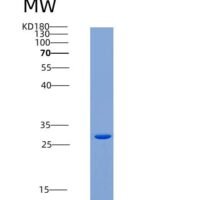
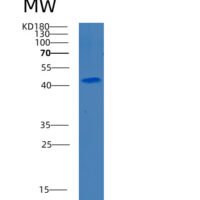
SDS-PAGE: Single band at expected molecular weight confirming purity.

ELISA: Suitable as coating antigen or detection standard.

Western Blot: Compatible with standard Western Blot protocols.

Protein Interaction: Validated for SPR (Surface Plasmon Resonance) and BLI (Bio-Layer Interferometry) studies.

Shipping: Shipped at ambient temperature. Lyophilized protein is stable during transit.

Storage: Store lyophilized protein at -20°C to -80°C. Reconstituted protein should be aliquoted and stored at -80°C. Avoid repeated freeze-thaw cycles.

Shelf Life: 12 months from date of receipt when stored as recommended.

Shipping Time: Orders placed before 2 PM EST ship same day. International orders typically deliver within 5-10 business days.

Protein Biology

Function

Actins are highly conserved proteins that are involved in various types of cell motility and are ubiquitously expressed in all eukaryotic cells

Subcellular Location

Cytoplasm, cytoskeleton

Disease Association

Congenital myopathy 2A, typical, autosomal dominant (CMYO2A) : A muscular disorder characterized by generalized muscle weakness, delayed motor milestones, hypotonia, and muscle fiber abnormalities on histologic examination. Histologic findings include abnormal thread- or rod-like structures (nemaline rods), intranuclear rods, clumped filaments, cores, or fiber-type disproportion. The spectrum of clinical phenotypes ranges from severe neonatal presentations to onset of a milder disorder in childhood. [The disease is caused by variants affecting the gene represented in this entry] | Congenital myopathy 2B, severe infantile, autosomal recessive (CMYO2B) : An autosomal recessive skeletal muscle disorder characterized by severe hypotonia with lack of spontaneous movements and respiratory insufficiency, usually leading to death in infancy or early childhood. Longer survival has been reported. [The disease is caused by variants affecting the gene represented in this entry] | Congenital myopathy 2C, severe infantile, autosomal dominant (CMYO2C) : An autosomal dominant skeletal muscle disorder characterized by severe congenital weakness usually resulting in death from respiratory failure in the first year or so of life. Patients present at birth with hypotonia, lack of antigravity movements, poor head control, and difficulties feeding or breathing, often requiring tube-feeding and mechanical ventilation. Decreased fetal movements may be observed in some cases. [The disease is caused by variants affecting the gene represented in this entry] | Myopathy, scapulohumeroperoneal (SHPM) : An autosomal dominant muscular disorder characterized by progressive muscle weakness with initial scapulo-humeral-peroneal and distal distribution. Over time, muscle weakness progresses to proximal muscle groups. Clinical characteristics include scapular winging, mild lower facial weakness, foot drop due to foot eversion and dorsiflexion weakness, and selective muscle atrophy. Age at onset and disease progression are variable. [The disease is caused by variants affecting the gene represented in this entry]

Subunit

Polymerization of globular actin (G-actin) leads to a structural filament (F-actin) in the form of a two-stranded helix. Each actin can bind to 4 others. Interacts with alpha-actinin (By similarity). Identified in a complex composed of ACTA1, COBL, GSN AND TMSB4X (By similarity). Interacts with TTID (PubMed:10958653). Interacts (via its C-terminus) with USP25; the interaction occurs for all USP25 isoforms but is strongest for isoform USP25m in muscle differentiating cells (PubMed:16501887)

Gene: ACTA1  |  Organism: Homo sapiens  |  Synonyms: Alpha-actin-1
Key Publications

Frequently Asked Questions

How do I order or inquire about this product?

Fill out the Online Inquiry form with your required quantity and specifications. You can also email sales@biocrestsci.com. Our team typically responds within 4 business hours with a quote and availability confirmation.

What is the shipping and delivery time?

Orders placed before 2 PM EST ship the same day. Domestic (US) delivery typically takes 2-3 business days. International orders deliver within 5-10 business days. All products are shipped at ambient temperature with appropriate packaging to ensure stability.

How should I store this recombinant protein?

Lyophilized proteins should be stored at -20°C to -80°C upon receipt. After reconstitution, aliquot and store at -80°C. Avoid repeated freeze-thaw cycles. Shelf life is 12 months from date of receipt when stored as recommended.

What quality controls are performed on your products?

Each product undergoes SDS-PAGE purity analysis (typically >85-95%), endotoxin testing, and bioactivity validation. Products are validated for ELISA, Western Blot, and SPR/BLI applications as specified on this product page. A Certificate of Analysis (CoA) is available upon request.

Shopping Cart
Scroll to Top