Recombinant Human Actin-like protein 6B (ACTL6B)

Recombinant Human Actin-like protein 6B (ACTL6B) — Involved in transcriptional activation and repression of select genes by chromatin remodeling (alteration of DNA-nucleosome topology). Purity >90%.

SKU: BCRECP-000028 Category:

Product Specifications

Product SkuBCRECP-000028
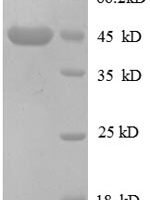
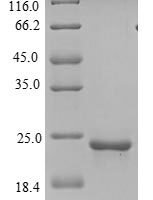
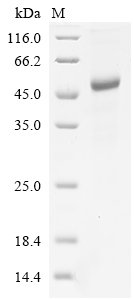
Product DescriptionRecombinant Human Actin-like protein 6B (ACTL6B) Protein is expressed from E.coli with C-terminal 6xHis-Flag-tagged. It contains 1-426aa. [Accession | O94805].
Uniprot No.O94805
Gene NamesACTL6B
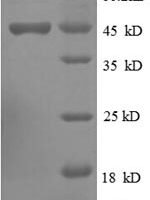
PurityGreater than 90% as determined by SDS-PAGE.
Expression SystemE.coli
Expression Region1-426aa
SpeciesHomo sapiens (Human)
Tag InfoC-terminal 6xHis-Flag-tagged
Molecular weight48.8kDa
ActivityPlease contact us to obtain bioactivity data.
BufferIf the delivery form is liquid, the default storage buffer is Tris/PBS-based buffer, 5%-50% glycerol. If the delivery form is lyophilized powder, the buffer before lyophilization is Tris/PBS-based buffer, 6% Trehalose.
StorageStore at -20°C/-80°C upon receipt, aliquoting is necessary for mutiple use. Avoid repeated freeze-thaw cycles.
Research AreasEpigenetics and Nuclear Signaling

Function

Involved in transcriptional activation and repression of select genes by chromatin remodeling (alteration of DNA-nucleosome topology). Component of SWI/SNF chromatin remodeling complexes that carry out key enzymatic activities, changing chromatin structure by altering DNA-histone contacts within a nucleosome in an ATP-dependent manner. Belongs to the neuron-specific chromatin remodeling complex (nBAF complex), as such plays a role in remodeling mononucleosomes in an ATP-dependent fashion, and is required for postmitotic neural development and dendritic outgrowth.

Biological Context

Subcellular Location: Nucleus
Disease Association: Developmental and epileptic encephalopathy 76 (DEE76) : A form of epileptic encephalopathy, a heterogeneous group of severe early-onset epilepsies characterized by refractory seizures, neurodevelopmental impairment, and poor prognosis. Development is normal prior to seizure onset, after which cognitive and motor delays become apparent. DEE76 is an autosomal recessive form that may result in death in childhood. [The disease is caused by variants affecting the gene represented in this entry] | Intellectual developmental disorder with severe speech and ambulation defects (IDDSSAD) : An autosomal dominant neurodevelopmental disorder with onset in infancy, and characterized by global developmental delay, intellectual disability, ambulation deficits, severe language impairment, and minor dysmorphic features including a wide mouth, diastema, and bulbous nose. Additional manifestations are spasticity, hypotonia and autistic features including stereotypies. Brain imaging show thin corpus callosum, generalized atrophy, and mild periventricular gliosis. [The disease is caused by variants affecting the gene represented in this entry]

Product Specifications

Recombinant Human Actin-like protein 6B (ACTL6B) is a recombinant protein from Homo sapiens (Human), expressed in E.coli, covering amino acids 1-426aa, with C-terminal 6xHis-Flag-tagged tag, molecular weight 48.8kDa, purity Greater than 90% as determined by SDS-PAGE.. Suitable for ELISA and Western Blot applications.
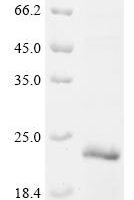
Recommended applications depend on the target, product format, and product-specific validation data. Refer to the product datasheet or Certificate of Analysis (CoA), or contact BioCrest Sci for application guidance.

Biological Activity: Please contact us to obtain bioactivity data.

Storage: Store at -20°C/-80°C upon receipt, aliquoting is necessary for mutiple use. Avoid repeated freeze-thaw cycles.

Shipping & Lead Time: Availability, shipping conditions, and estimated lead time are confirmed in the formal quotation or order confirmation based on the product format, destination, and order requirements.

Protein Biology

Function

Involved in transcriptional activation and repression of select genes by chromatin remodeling (alteration of DNA-nucleosome topology). Component of SWI/SNF chromatin remodeling complexes that carry out key enzymatic activities, changing chromatin structure by altering DNA-histone contacts within a nucleosome in an ATP-dependent manner. Belongs to the neuron-specific chromatin remodeling complex (nBAF complex), as such plays a role in remodeling mononucleosomes in an ATP-dependent fashion, and is required for postmitotic neural development and dendritic outgrowth. During neural development a switch from a stem/progenitor to a postmitotic chromatin remodeling mechanism occurs as neurons exit the cell cycle and become committed to their adult state. The transition from proliferating neural stem/progenitor cells to postmitotic neurons requires a switch in subunit composition of the npBAF and nBAF complexes. As neural progenitors exit mitosis and differentiate into neurons, npBAF complexes which contain ACTL6A/BAF53A and PHF10/BAF45A, are exchanged for homologous alternative ACTL6B/BAF53B and DPF1/BAF45B or DPF3/BAF45C subunits in neuron-specific complexes (nBAF). The npBAF complex is essential for the self-renewal/proliferative capacity of the multipotent neural stem cells. The nBAF complex along with CREST plays a role regulating the activity of genes essential for dendrite growth. ACTL6B/BAF53B is not essential for assembly of the nBAF complex but is required for targeting the complex and CREST to the promoter of genes essential for dendritic growth (By similarity). Essential for neuronal maturation and dendrite development (PubMed:31031012)

Subcellular Location

Nucleus

Disease Association

Developmental and epileptic encephalopathy 76 (DEE76) : A form of epileptic encephalopathy, a heterogeneous group of severe early-onset epilepsies characterized by refractory seizures, neurodevelopmental impairment, and poor prognosis. Development is normal prior to seizure onset, after which cognitive and motor delays become apparent. DEE76 is an autosomal recessive form that may result in death in childhood. [The disease is caused by variants affecting the gene represented in this entry] | Intellectual developmental disorder with severe speech and ambulation defects (IDDSSAD) : An autosomal dominant neurodevelopmental disorder with onset in infancy, and characterized by global developmental delay, intellectual disability, ambulation deficits, severe language impairment, and minor dysmorphic features including a wide mouth, diastema, and bulbous nose. Additional manifestations are spasticity, hypotonia and autistic features including stereotypies. Brain imaging show thin corpus callosum, generalized atrophy, and mild periventricular gliosis. [The disease is caused by variants affecting the gene represented in this entry]

Subunit

Component of the multiprotein chromatin-remodeling complexes SWI/SNF: SWI/SNF-A (BAF), SWI/SNF-B (PBAF) and related complexes. The canonical complex contains a catalytic subunit (either SMARCA4/BRG1/BAF190A or SMARCA2/BRM/BAF190B) and at least SMARCE1, ACTL6A/BAF53, SMARCC1/BAF155, SMARCC2/BAF170 and SMARCB1/SNF5/BAF47. Other subunits specific to each of the complexes may also be present permitting several possible combinations developmentally and tissue specific (PubMed:22952240, PubMed:26601204). Component of the BAF complex, which includes at least actin (ACTB), ARID1A/BAF250A, ARID1B/BAF250B, SMARCA2/BRM, SMARCA4/BRG1/BAF190A, ACTL6A/BAF53, ACTL6B/BAF53B, SMARCE1/BAF57, SMARCC1/BAF155, SMARCC2/BAF170, SMARCB1/SNF5/INI1 and one or more SMARCD1/BAF60A, SMARCD2/BAF60B, or SMARCD3/BAF60C (PubMed:22952240, PubMed:26601204). Component of neuron-specific chromatin remodeling complex (nBAF complex) composed of at least, ARID1A/BAF250A or ARID1B/BAF250B, SMARCD1/BAF60A or SMARCD2/BAF60B or SMARCD3/BAF60C, SMARCA2/BRM/BAF190B, SMARCA4/BRG1/BAF190A, SMARCB1/BAF47, SMARCC1/BAF155, SMARCE1/BAF57, SMARCC2/BAF170, DPF1/BAF45B, DPF3/BAF45C, ACTL6B/BAF53B and actin (ACTB). Note that the nBAF complex is polymorphic in regard to the ATPase, SMARCA2 and SMARCA4 occupying mutually exclusive positions. May be a component of the SWI/SNF-B (PBAF) chromatin remodeling complex, at least composed of SMARCA4/BRG1, SMARCB1/BAF47/SNF5, ACTL6A/BAF53A or ACTL6B/BAF53B, SMARCE1/BAF57, SMARCD1/BAF60A, SMARCD2/BAF60B, perhaps SMARCD3/BAF60C, SMARCC1/BAF155, SMARCC2/BAF170, PBRM1/BAF180, ARID2/BAF200 and actin (PubMed:22952240, PubMed:26601204)

Gene: ACTL6B  |  Organism: Homo sapiens  |  Synonyms: 53 kDa BRG1-associated factor B; Actin-related protein Baf53b; ArpNalpha; BRG1-associated factor 53B
Key Publications

Frequently Asked Questions

How do I order or inquire about this product?

Submit the Online Inquiry form with your required quantity and specifications, or email sales@biocrestsci.com. Available sizes, pricing, stock status, documentation, and estimated lead time are confirmed in the formal quotation.

What is the shipping and delivery time?

Availability, dispatch timing, shipping conditions, and delivery estimates depend on the product format, destination, and order requirements. These details are confirmed in the formal quotation or order confirmation.

How should this product be stored?

Follow the storage and handling instructions in the product-specific datasheet and Certificate of Analysis (CoA). Requirements may vary by product form and formulation; contact BioCrest Sci if product-specific guidance is needed.

What quality controls are performed on your products?

Quality-control data such as identity, purity, endotoxin level, or biological activity are provided only when specified on this product page, the datasheet, or Certificate of Analysis (CoA). Biological activity is not implied unless explicitly stated.

Shopping Cart
Scroll to Top