Function
Involved in the biosynthesis of highly unsaturated fatty acids (HUFA) from the essential polyunsaturated fatty acids (PUFA) linoleic acid (LA) (18:2n-6) and alpha-linolenic acid (ALA) (18:3n-3) precursors, acting as a fatty acyl-coenzyme A (CoA) desaturase that introduces a cis double bond at carbon 6 of the fatty acyl chain. Catalyzes the first and rate limiting step in this pathway which is the desaturation of LA (18:2n-6) and ALA (18:3n-3) into gamma-linoleate (GLA) (18:3n-6) and stearidonate (18:4n-3), respectively. Subsequently, in the biosynthetic pathway of HUFA n-3 series, it desaturates tetracosapentaenoate (24:5n-3) to tetracosahexaenoate (24:6n-3), which is then converted to docosahexaenoate (DHA)(22:6n-3), an important lipid for nervous system function.
Biological Context
Subcellular Location: Endoplasmic reticulum membrane (Multi-pass membrane protein)
Tissue Specificity: Expressed in a wide array of tissues, highest expression is found in liver followed by brain, lung, heart, and retina. A lower level is found in breast tumor when compared with normal tissues; lowest levels were found in patients with poor prognostic index
Pathway: Lipid metabolism; polyunsaturated fatty acid biosynthesis
Product Specifications
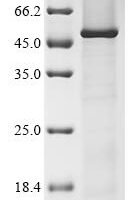
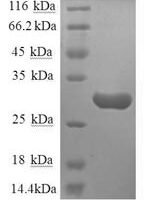
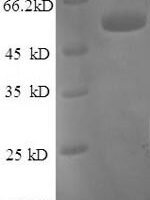
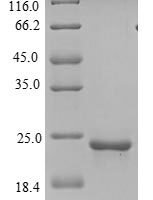
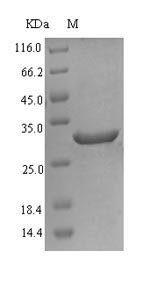
Recombinant Human Acyl-CoA 6-desaturase (FADS2), partial is a recombinant protein from Homo sapiens (Human), expressed in E.coli, covering amino acids 1-131aa, with N-terminal 6xHis-SUMO-tagged tag, molecular weight 30.9kDa, purity Greater than 90% as determined by SDS-PAGE.. Suitable for ELISA and Western Blot applications.