Recombinant Human ADP/ATP translocase 3 (SLC25A6), partial

Recombinant Human ADP/ATP translocase 3 (SLC25A6), partial — ADP:ATP antiporter that mediates import of ADP into the mitochondrial matrix for ATP synthesis, and export of ATP out to fuel the cell. Purity >85%.

SKU: BCRECP-001647 Category:

Product Specifications

Product SkuBCRECP-001647
Product DescriptionRecombinant Human ADP/ATP translocase 3 (SLC25A6) Protein is expressed from E.coli with N-terminal 6xHis-KSI-tagged. It contains 232-272aa. [Accession | P12236].
Uniprot No.P12236
Gene NamesSLC25A6
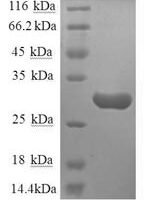
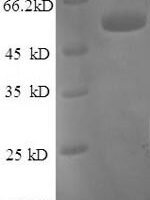
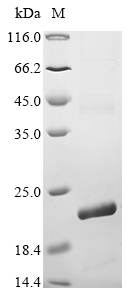
PurityGreater than 85% as determined by SDS-PAGE.
Expression SystemE.coli
Expression Region232-272aa
SpeciesHomo sapiens (Human)
Tag InfoN-terminal 6xHis-KSI-tagged
Molecular weight20.2kDa
ActivityPlease contact us to obtain bioactivity data.
BufferIf the delivery form is liquid, the default storage buffer is Tris/PBS-based buffer, 5%-50% glycerol. If the delivery form is lyophilized powder, the buffer before lyophilization is Tris/PBS-based buffer, 6% Trehalose.
StorageStore at -20°C/-80°C upon receipt, aliquoting is necessary for mutiple use. Avoid repeated freeze-thaw cycles.
Research AreasCell Biology

Function

ADP:ATP antiporter that mediates import of ADP into the mitochondrial matrix for ATP synthesis, and export of ATP out to fuel the cell. Cycles between the cytoplasmic-open state (c-state) and the matrix-open state (m-state): operates by the alternating access mechanism with a single substrate-binding site intermittently exposed to either the cytosolic (c-state) or matrix (m-state) side of the inner mitochondrial membrane. In addition to its ADP:ATP antiporter activity, also involved in mitochondrial uncoupling and mitochondrial permeability transition pore (mPTP) activity.

Biological Context

Subcellular Location: Mitochondrion inner membrane (Multi-pass membrane protein); Membrane (Multi-pass membrane protein)
Tissue Specificity: Expressed in erythrocytes (at protein level)

Product Specifications

Recombinant Human ADP/ATP translocase 3 (SLC25A6), partial is a recombinant protein from Homo sapiens (Human), expressed in E.coli, covering amino acids 232-272aa, with N-terminal 6xHis-KSI-tagged tag, molecular weight 20.2kDa, purity Greater than 85% as determined by SDS-PAGE.. Suitable for ELISA and Western Blot applications.
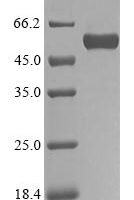
SDS-PAGE: Single band at expected molecular weight confirming purity.

ELISA: Suitable as coating antigen or detection standard.

Western Blot: Compatible with standard Western Blot protocols.

Protein Interaction: Validated for SPR (Surface Plasmon Resonance) and BLI (Bio-Layer Interferometry) studies.

Shipping: Shipped at ambient temperature. Lyophilized protein is stable during transit.

Storage: Store lyophilized protein at -20°C to -80°C. Reconstituted protein should be aliquoted and stored at -80°C. Avoid repeated freeze-thaw cycles.

Shelf Life: 12 months from date of receipt when stored as recommended.

Shipping Time: Orders placed before 2 PM EST ship same day. International orders typically deliver within 5-10 business days.

Protein Biology

Function

ADP:ATP antiporter that mediates import of ADP into the mitochondrial matrix for ATP synthesis, and export of ATP out to fuel the cell (By similarity). Cycles between the cytoplasmic-open state (c-state) and the matrix-open state (m-state): operates by the alternating access mechanism with a single substrate-binding site intermittently exposed to either the cytosolic (c-state) or matrix (m-state) side of the inner mitochondrial membrane (By similarity). In addition to its ADP:ATP antiporter activity, also involved in mitochondrial uncoupling and mitochondrial permeability transition pore (mPTP) activity (PubMed:15033708). Plays a role in mitochondrial uncoupling by acting as a proton transporter: proton transport uncouples the proton flows via the electron transport chain and ATP synthase to reduce the efficiency of ATP production and cause mitochondrial thermogenesis (By similarity). Proton transporter activity is inhibited by ADP:ATP antiporter activity, suggesting that SLC25A6/ANT3 acts as a master regulator of mitochondrial energy output by maintaining a delicate balance between ATP production (ADP:ATP antiporter activity) and thermogenesis (proton transporter activity) (By similarity). Proton transporter activity requires free fatty acids as cofactor, but does not transport it (By similarity). Also plays a key role in mPTP opening, a non-specific pore that enables free passage of the mitochondrial membranes to solutes of up to 1.5 kDa, and which contributes to cell death (PubMed:15033708). It is however unclear if SLC25A6/ANT3 constitutes a pore-forming component of mPTP or regulates it (By similarity)

Subcellular Location

Mitochondrion inner membrane (Multi-pass membrane protein); Membrane (Multi-pass membrane protein)

Tissue Specificity

Expressed in erythrocytes (at protein level)

Subunit

(Microbial infection) Interacts with HIV-1 Vpr

Gene: SLC25A6  |  Organism: Homo sapiens  |  Synonyms: ADP,ATP carrier protein 3; ADP,ATP carrier protein, isoform T2; Adenine nucleotide translocator 3; Solute carrier family 25 member 6
Key Publications

Frequently Asked Questions

How do I order or inquire about this product?

Fill out the Online Inquiry form with your required quantity and specifications. You can also email sales@biocrestsci.com. Our team typically responds within 4 business hours with a quote and availability confirmation.

What is the shipping and delivery time?

Orders placed before 2 PM EST ship the same day. Domestic (US) delivery typically takes 2-3 business days. International orders deliver within 5-10 business days. All products are shipped at ambient temperature with appropriate packaging to ensure stability.

How should I store this recombinant protein?

Lyophilized proteins should be stored at -20°C to -80°C upon receipt. After reconstitution, aliquot and store at -80°C. Avoid repeated freeze-thaw cycles. Shelf life is 12 months from date of receipt when stored as recommended.

What quality controls are performed on your products?

Each product undergoes SDS-PAGE purity analysis (typically >85-95%), endotoxin testing, and bioactivity validation. Products are validated for ELISA, Western Blot, and SPR/BLI applications as specified on this product page. A Certificate of Analysis (CoA) is available upon request.

Shopping Cart
Scroll to Top