Recombinant Human Alpha-ketoglutarate-dependent dioxygenase FTO (FTO)

Recombinant Human Alpha-ketoglutarate-dependent dioxygenase FTO (FTO) — RNA demethylase that mediates oxidative demethylation of different RNA species, such as mRNAs, tRNAs and snRNAs, and acts as a regulator of fat mass, adipogenesis and energy homeostasis. Purity >85%.

SKU: BCRECP-000700 Category:

Product Specifications

Product SkuBCRECP-000700
Product DescriptionRecombinant Human Alpha-ketoglutarate-dependent dioxygenase FTO (FTO) Protein is expressed from E.coli with N-terminal 10xHis-tagged and C-terminal Myc-tagged. It contains 1-505aa. [Accession | Q9C0B1].
Uniprot No.Q9C0B1
Gene NamesFTO
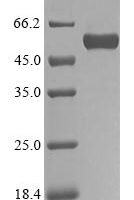
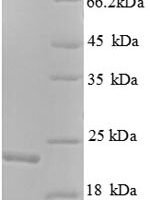
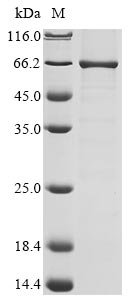
PurityGreater than 85% as determined by SDS-PAGE.
Expression SystemE.coli
Expression Region1-505aa
SpeciesHomo sapiens (Human)
Tag InfoN-terminal 10xHis-tagged and C-terminal Myc-tagged
Molecular weight65.7kDa
ActivityPlease contact us to obtain bioactivity data.
BufferIf the delivery form is liquid, the default storage buffer is Tris/PBS-based buffer, 5%-50% glycerol. If the delivery form is lyophilized powder, the buffer before lyophilization is Tris/PBS-based buffer, 6% Trehalose.
StorageStore at -20°C/-80°C upon receipt, aliquoting is necessary for mutiple use. Avoid repeated freeze-thaw cycles.
Research AreasCardiovascular

Function

RNA demethylase that mediates oxidative demethylation of different RNA species, such as mRNAs, tRNAs and snRNAs, and acts as a regulator of fat mass, adipogenesis and energy homeostasis. Specifically demethylates N(6)-methyladenosine (m6A) RNA, the most prevalent internal modification of messenger RNA (mRNA) in higher eukaryotes. M6A demethylation by FTO affects mRNA expression and stability.

Biological Context

Subcellular Location: Nucleus; Nucleus speckle; Cytoplasm
Tissue Specificity: Ubiquitously expressed, with relatively high expression in adrenal glands and brain; especially in hypothalamus and pituitary. Highly expressed in highly expressed in acute myeloid leukemias (AML) with t(11;11)(q23;23) with KMT2A/MLL1 rearrangements, t(15;17)(q21;q21)/PML-RARA, FLT3-ITD, and/or NPM1 mutations
Disease Association: Growth retardation, developmental delay, and facial dysmorphism (GDFD) : A severe polymalformation syndrome characterized by postnatal growth retardation, microcephaly, severe psychomotor delay, functional brain deficits and characteristic facial dysmorphism. In some patients, structural brain malformations, cardiac defects, genital anomalies, and cleft palate are observed. Early death occurs by the age of 3 years. [The disease is caused by variants affecting the gene represented in this entry] | Obesity (OBESITY) : A condition characterized by an increase of body weight beyond the limitation of skeletal and physical requirements, as the result of excessive accumulation of body fat. [Disease susceptibility is associated with variants affecting the gene represented in this entry. It is unclear whether variations associated with obesity directly affect FTO function or alter the expression of adjacent genes such as IRX3, rather than FTO itself. A pathogenic intronic FTO variation (rs1421085) disrupts an evolutionarily conserved motif for ARID5B binding. Loss of ARID5B binding results in overexpression of two genes distal to FTO, IRX3 and IRX5. IRX3 and IRX5 overexpression shifts pre-adipocytes differentiation from brown to white fat cells, resulting in increased lipid storage and loss of mitochondrial thermogenesis ]

Product Specifications

Recombinant Human Alpha-ketoglutarate-dependent dioxygenase FTO (FTO) is a recombinant protein from Homo sapiens (Human), expressed in E.coli, covering amino acids 1-505aa, with N-terminal 10xHis-tagged and C-terminal Myc-tagged tag, molecular weight 65.7kDa, purity Greater than 85% as determined by SDS-PAGE.. Suitable for ELISA and Western Blot applications.
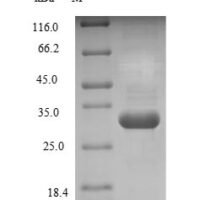
SDS-PAGE: Single band at expected molecular weight confirming purity.

ELISA: Suitable as coating antigen or detection standard.

Western Blot: Compatible with standard Western Blot protocols.

Protein Interaction: Validated for SPR (Surface Plasmon Resonance) and BLI (Bio-Layer Interferometry) studies.

Shipping: Shipped at ambient temperature. Lyophilized protein is stable during transit.

Storage: Store lyophilized protein at -20°C to -80°C. Reconstituted protein should be aliquoted and stored at -80°C. Avoid repeated freeze-thaw cycles.

Shelf Life: 12 months from date of receipt when stored as recommended.

Shipping Time: Orders placed before 2 PM EST ship same day. International orders typically deliver within 5-10 business days.

Protein Biology

Function

RNA demethylase that mediates oxidative demethylation of different RNA species, such as mRNAs, tRNAs and snRNAs, and acts as a regulator of fat mass, adipogenesis and energy homeostasis (PubMed:22002720, PubMed:25452335, PubMed:26457839, PubMed:26458103, PubMed:28002401, PubMed:30197295). Specifically demethylates N(6)-methyladenosine (m6A) RNA, the most prevalent internal modification of messenger RNA (mRNA) in higher eukaryotes (PubMed:22002720, PubMed:25452335, PubMed:26457839, PubMed:26458103, PubMed:30197295). M6A demethylation by FTO affects mRNA expression and stability (PubMed:30197295). Also able to demethylate m6A in U6 small nuclear RNA (snRNA) (PubMed:30197295). Mediates demethylation of N(6),2'-O-dimethyladenosine cap (m6A(m)), by demethylating the N(6)-methyladenosine at the second transcribed position of mRNAs and U6 snRNA (PubMed:28002401, PubMed:30197295). Demethylation of m6A(m) in the 5'-cap by FTO affects mRNA stability by promoting susceptibility to decapping (PubMed:28002401). Also acts as a tRNA demethylase by removing N(1)-methyladenine from various tRNAs (PubMed:30197295). Has no activity towards 1-methylguanine (PubMed:20376003). Has no detectable activity towards double-stranded DNA (PubMed:20376003). Also able to repair alkylated DNA and RNA by oxidative demethylation: demethylates single-stranded RNA containing 3-methyluracil, single-stranded DNA containing 3-methylthymine and has low demethylase activity towards single-stranded DNA containing 1-methyladenine or 3-methylcytosine (PubMed:18775698, PubMed:20376003). Ability to repair alkylated DNA and RNA is however unsure in vivo (PubMed:18775698, PubMed:20376003). Involved in the regulation of fat mass, adipogenesis and body weight, thereby contributing to the regulation of body size and body fat accumulation (PubMed:18775698, PubMed:20376003). Involved in the regulation of thermogenesis and the control of adipocyte differentiation into brown or white fat cells (PubMed:26287746). Regulates activity of the dopaminergic midbrain circuitry via its ability to demethylate m6A in mRNAs (By similarity). Plays an oncogenic role in a number of acute myeloid leukemias by enhancing leukemic oncogene-mediated cell transformation: acts by mediating m6A demethylation of target transcripts such as MYC, CEBPA, ASB2 and RARA, leading to promote their expression (PubMed:28017614, PubMed:29249359)

Subcellular Location

Nucleus; Nucleus speckle; Cytoplasm

Disease Association

Growth retardation, developmental delay, and facial dysmorphism (GDFD) : A severe polymalformation syndrome characterized by postnatal growth retardation, microcephaly, severe psychomotor delay, functional brain deficits and characteristic facial dysmorphism. In some patients, structural brain malformations, cardiac defects, genital anomalies, and cleft palate are observed. Early death occurs by the age of 3 years. [The disease is caused by variants affecting the gene represented in this entry] | Obesity (OBESITY) : A condition characterized by an increase of body weight beyond the limitation of skeletal and physical requirements, as the result of excessive accumulation of body fat. [Disease susceptibility is associated with variants affecting the gene represented in this entry. It is unclear whether variations associated with obesity directly affect FTO function or alter the expression of adjacent genes such as IRX3, rather than FTO itself (PubMed:24646999, PubMed:26287746). A pathogenic intronic FTO variation (rs1421085) disrupts an evolutionarily conserved motif for ARID5B binding (PubMed:26287746). Loss of ARID5B binding results in overexpression of two genes distal to FTO, IRX3 and IRX5. IRX3 and IRX5 overexpression shifts pre-adipocytes differentiation from brown to white fat cells, resulting in increased lipid storage and loss of mitochondrial thermogenesis (PubMed:26287746)]

Tissue Specificity

Ubiquitously expressed, with relatively high expression in adrenal glands and brain; especially in hypothalamus and pituitary (PubMed:17434869, PubMed:17496892). Highly expressed in highly expressed in acute myeloid leukemias (AML) with t(11;11)(q23;23) with KMT2A/MLL1 rearrangements, t(15;17)(q21;q21)/PML-RARA, FLT3-ITD, and/or NPM1 mutations (PubMed:28017614)

Subunit

Monomer (By similarity). May also exist as homodimer (By similarity)

Gene: FTO  |  Organism: Homo sapiens  |  Synonyms: Fat mass and obesity-associated protein; U6 small nuclear RNA (2'-O-methyladenosine-N(6)-)-demethylase FTO; U6 small nuclear RNA N(6)-methyladenosine-demethylase FTO; mRNA (2'-O-methyladenosine-N(6)-)-demethylase FTO; mRNA N(6)-methyladenosine demethylase FTO; tRNA N1-methyl adenine demethylase FTO
Key Publications

Frequently Asked Questions

How do I order or inquire about this product?

Fill out the Online Inquiry form with your required quantity and specifications. You can also email sales@biocrestsci.com. Our team typically responds within 4 business hours with a quote and availability confirmation.

What is the shipping and delivery time?

Orders placed before 2 PM EST ship the same day. Domestic (US) delivery typically takes 2-3 business days. International orders deliver within 5-10 business days. All products are shipped at ambient temperature with appropriate packaging to ensure stability.

How should I store this recombinant protein?

Lyophilized proteins should be stored at -20°C to -80°C upon receipt. After reconstitution, aliquot and store at -80°C. Avoid repeated freeze-thaw cycles. Shelf life is 12 months from date of receipt when stored as recommended.

What quality controls are performed on your products?

Each product undergoes SDS-PAGE purity analysis (typically >85-95%), endotoxin testing, and bioactivity validation. Products are validated for ELISA, Western Blot, and SPR/BLI applications as specified on this product page. A Certificate of Analysis (CoA) is available upon request.

Shopping Cart
Scroll to Top