Recombinant Human Apolipoprotein E (APOE) (Active)

Recombinant Human Apolipoprotein E (APOE) (Active) — (Microbial infection) Through its interaction with HCV envelope glycoprotein E2, participates in the attachment of HCV to HSPGs and other receptors (LDLr, VLDLr, and SR-B1) on the cell surface and … Purity >90%.

SKU: BCRECP-000112 Category:

Product Specifications

Product SkuBCRECP-000112
Product DescriptionRecombinant Human Apolipoprotein E (APOE) (Active) Protein is expressed from Mammalian cell with N-terminal 10xHis-tagged. It contains 19-317aa. [Accession | P02649].
Uniprot No.P02649
Gene NamesAPOE
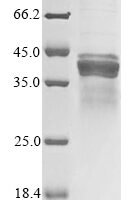
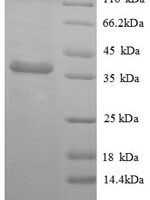
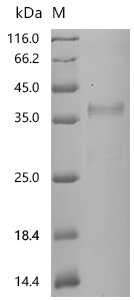
PurityGreater than 90% as determined by SDS-PAGE.
Expression SystemMammalian cell
Expression Region19-317aa
SpeciesHomo sapiens (Human)
Tag InfoN-terminal 10xHis-tagged
Molecular weight37.0kDa
ActivityPlease contact us to obtain bioactivity data.
BufferIf the delivery form is liquid, the default storage buffer is Tris/PBS-based buffer, 5%-50% glycerol. If the delivery form is lyophilized powder, the buffer before lyophilization is Tris/PBS-based buffer, 6% Trehalose.
StorageStore at -20°C/-80°C upon receipt, aliquoting is necessary for mutiple use. Avoid repeated freeze-thaw cycles.
Research AreasNeuroscience

Function

(Microbial infection) Through its interaction with HCV envelope glycoprotein E2, participates in the attachment of HCV to HSPGs and other receptors (LDLr, VLDLr, and SR-B1) on the cell surface and to the assembly, maturation and infectivity of HCV viral particles. This interaction is probably promoted via the up-regulation of cellular autophagy by the virus.

Biological Context

Subcellular Location: Secreted; Secreted, extracellular space; Secreted, extracellular space, extracellular matrix; Extracellular vesicle; Endosome, multivesicular body
Tissue Specificity: Produced by several tissues and cell types and mainly found associated with lipid particles in the plasma, the interstitial fluid and lymph. Mainly synthesized by liver hepatocytes. Significant quantities are also produced in brain, mainly by astrocytes and glial cells in the cerebral cortex, but also by neurons in frontal cortex and hippocampus. It is also expressed by cells of the peripheral nervous system. Also expressed by adrenal gland, testis, ovary, skin, kidney, spleen and adipose tissue and macrophages in various tissues
Disease Association: Hyperlipoproteinemia 3 (HLPP3) : A disorder characterized by the accumulation of intermediate-density lipoprotein particles (IDL or broad-beta-lipoprotein) rich in cholesterol. Clinical features include xanthomas, yellowish lipid deposits in the palmar crease, or less specific on tendons and on elbows. The disorder rarely manifests before the third decade in men. In women, it is usually expressed only after the menopause. [The disease is caused by variants affecting the gene represented in this entry. The vast majority of the patients are homozygous for APOE*2 alleles. More severe cases of HLPP3 have also been observed in individuals heterozygous for rare APOE variants. The influence of APOE on lipid levels is often suggested to have major implications for the risk of coronary artery disease (CAD). Individuals carrying the common APOE*4 variant are at higher risk of CAD] | Alzheimer disease 2 (AD2) : A late-onset form of Alzheimer disease. Alzheimer disease is a neurodegenerative disorder characterized by progressive dementia, loss of cognitive abilities, and deposition of fibrillar amyloid proteins as intraneuronal neurofibrillary tangles, extracellular amyloid plaques and vascular amyloid deposits. The major constituents of these plaques are neurotoxic amyloid-beta protein 40 and amyloid-beta protein 42, that are produced by the proteolysis of the transmembrane APP protein. The cytotoxic C-terminal fragments (CTFs) and the caspase-cleaved products, such as C31, are also implicated in neuronal death. [Disease susceptibility is associated with variants affecting the gene represented in this entry. The APOE*4 allele (APOE form E4) is genetically associated with the common late onset familial and sporadic forms of Alzheimer disease. Risk for AD increased from 20% to 90% and mean age at onset decreased from 84 to 68 years with increasing number of APOE*4 alleles in 42 families with late onset AD. Thus APOE*4 gene dose is a major risk factor for late onset AD and, in these families, homozygosity for APOE*4 was virtually sufficient to cause AD by age 80. The mechanism by which APOE*4 participates in pathogenesis is not known] | Sea-blue histiocyte disease (SBHD) : Characterized by splenomegaly, mild thrombocytopenia and, in the bone marrow, numerous histiocytes containing cytoplasmic granules which stain bright blue with the usual hematologic stains. The syndrome is the consequence of an inherited metabolic defect analogous to Gaucher disease and other sphingolipidoses. [The disease is caused by variants affecting the gene represented in this entry] | Lipoprotein glomerulopathy (LPG) : Uncommon kidney disease characterized by proteinuria, progressive kidney failure, and distinctive lipoprotein thrombi in glomerular capillaries. [The disease is caused by variants affecting the gene represented in this entry]

Product Specifications

Recombinant Human Apolipoprotein E (APOE) (Active) is a recombinant protein from Homo sapiens (Human), expressed in Mammalian cell, covering amino acids 19-317aa, with N-terminal 10xHis-tagged tag, molecular weight 37.0kDa, purity Greater than 90% as determined by SDS-PAGE.. Suitable for ELISA and Western Blot applications.
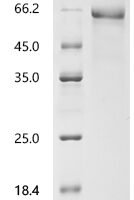
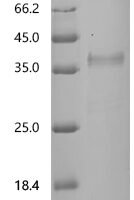
SDS-PAGE: Single band at expected molecular weight confirming purity.

ELISA: Suitable as coating antigen or detection standard.

Western Blot: Compatible with standard Western Blot protocols.

Protein Interaction: Validated for SPR (Surface Plasmon Resonance) and BLI (Bio-Layer Interferometry) studies.

Shipping: Shipped at ambient temperature. Lyophilized protein is stable during transit.

Storage: Store lyophilized protein at -20°C to -80°C. Reconstituted protein should be aliquoted and stored at -80°C. Avoid repeated freeze-thaw cycles.

Shelf Life: 12 months from date of receipt when stored as recommended.

Shipping Time: Orders placed before 2 PM EST ship same day. International orders typically deliver within 5-10 business days.

Protein Biology

Function

(Microbial infection) Through its interaction with HCV envelope glycoprotein E2, participates in the attachment of HCV to HSPGs and other receptors (LDLr, VLDLr, and SR-B1) on the cell surface and to the assembly, maturation and infectivity of HCV viral particles (PubMed:25122793, PubMed:29695434). This interaction is probably promoted via the up-regulation of cellular autophagy by the virus (PubMed:29695434)

Subcellular Location

Secreted; Secreted, extracellular space; Secreted, extracellular space, extracellular matrix; Extracellular vesicle; Endosome, multivesicular body

Disease Association

Hyperlipoproteinemia 3 (HLPP3) : A disorder characterized by the accumulation of intermediate-density lipoprotein particles (IDL or broad-beta-lipoprotein) rich in cholesterol. Clinical features include xanthomas, yellowish lipid deposits in the palmar crease, or less specific on tendons and on elbows. The disorder rarely manifests before the third decade in men. In women, it is usually expressed only after the menopause. [The disease is caused by variants affecting the gene represented in this entry. The vast majority of the patients are homozygous for APOE*2 alleles. More severe cases of HLPP3 have also been observed in individuals heterozygous for rare APOE variants. The influence of APOE on lipid levels is often suggested to have major implications for the risk of coronary artery disease (CAD). Individuals carrying the common APOE*4 variant are at higher risk of CAD] | Alzheimer disease 2 (AD2) : A late-onset form of Alzheimer disease. Alzheimer disease is a neurodegenerative disorder characterized by progressive dementia, loss of cognitive abilities, and deposition of fibrillar amyloid proteins as intraneuronal neurofibrillary tangles, extracellular amyloid plaques and vascular amyloid deposits. The major constituents of these plaques are neurotoxic amyloid-beta protein 40 and amyloid-beta protein 42, that are produced by the proteolysis of the transmembrane APP protein. The cytotoxic C-terminal fragments (CTFs) and the caspase-cleaved products, such as C31, are also implicated in neuronal death. [Disease susceptibility is associated with variants affecting the gene represented in this entry. The APOE*4 allele (APOE form E4) is genetically associated with the common late onset familial and sporadic forms of Alzheimer disease. Risk for AD increased from 20% to 90% and mean age at onset decreased from 84 to 68 years with increasing number of APOE*4 alleles in 42 families with late onset AD. Thus APOE*4 gene dose is a major risk factor for late onset AD and, in these families, homozygosity for APOE*4 was virtually sufficient to cause AD by age 80. The mechanism by which APOE*4 participates in pathogenesis is not known] | Sea-blue histiocyte disease (SBHD) : Characterized by splenomegaly, mild thrombocytopenia and, in the bone marrow, numerous histiocytes containing cytoplasmic granules which stain bright blue with the usual hematologic stains. The syndrome is the consequence of an inherited metabolic defect analogous to Gaucher disease and other sphingolipidoses. [The disease is caused by variants affecting the gene represented in this entry] | Lipoprotein glomerulopathy (LPG) : Uncommon kidney disease characterized by proteinuria, progressive kidney failure, and distinctive lipoprotein thrombi in glomerular capillaries. [The disease is caused by variants affecting the gene represented in this entry]

Tissue Specificity

Produced by several tissues and cell types and mainly found associated with lipid particles in the plasma, the interstitial fluid and lymph (PubMed:25173806). Mainly synthesized by liver hepatocytes (PubMed:25173806). Significant quantities are also produced in brain, mainly by astrocytes and glial cells in the cerebral cortex, but also by neurons in frontal cortex and hippocampus (PubMed:10027417, PubMed:3115992). It is also expressed by cells of the peripheral nervous system (PubMed:10027417, PubMed:25173806). Also expressed by adrenal gland, testis, ovary, skin, kidney, spleen and adipose tissue and macrophages in various tissues (PubMed:25173806)

Subunit

(Microbial infection) Interacts with hepatitis C virus (HCV) envelope glycoprotein E2; this interaction is required for HCV infectivity and production

Gene: APOE  |  Organism: Homo sapiens
Key Publications

Frequently Asked Questions

How do I order or inquire about this product?

Fill out the Online Inquiry form with your required quantity and specifications. You can also email sales@biocrestsci.com. Our team typically responds within 4 business hours with a quote and availability confirmation.

What is the shipping and delivery time?

Orders placed before 2 PM EST ship the same day. Domestic (US) delivery typically takes 2-3 business days. International orders deliver within 5-10 business days. All products are shipped at ambient temperature with appropriate packaging to ensure stability.

How should I store this recombinant protein?

Lyophilized proteins should be stored at -20°C to -80°C upon receipt. After reconstitution, aliquot and store at -80°C. Avoid repeated freeze-thaw cycles. Shelf life is 12 months from date of receipt when stored as recommended.

What quality controls are performed on your products?

Each product undergoes SDS-PAGE purity analysis (typically >85-95%), endotoxin testing, and bioactivity validation. Products are validated for ELISA, Western Blot, and SPR/BLI applications as specified on this product page. A Certificate of Analysis (CoA) is available upon request.

Shopping Cart
Scroll to Top