,

Recombinant Human B-cell receptor CD22 (CD22), partial (Active)

Recombinant Human B-cell receptor CD22 (CD22), partial (Active) — Most highly expressed siglec (sialic acid-binding immunoglobulin-like lectin) on B-cells that plays a role in various aspects of B-cell biology including differentiation, antigen presentation, and … Purity >90%.

SKU: BCACP-000007 Categories: ,
Product SKUBCACP-000007
Product DescriptionRecombinant Human B-cell receptor CD22 (CD22) protein is expressed from Mammalian cell with C-terminal 6xHis-tagged. It contains 20-687aa. [Accession | P20273].
Uniprot No.P20273
Gene NamesCD22
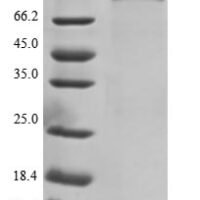
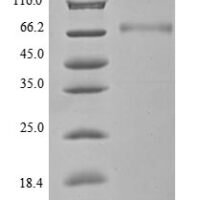
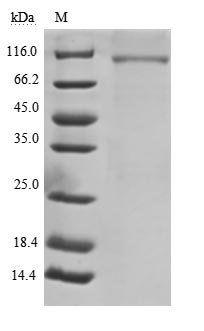
PurityGreater than 90% as determined by SDS-PAGE.
Expression SystemMammalian cell
Expression Region20-687aa
SpeciesHomo sapiens (Human)
Tag InfoC-terminal 6xHis-tagged
Molecular weight77.9 kDa
ActivityMeasured by its binding ability in a functional ELISA. Immobilized CD22 at 2 μg/ml can bind Anti-CD22 rabbit monoclonal antibody, the EC50 of human CD22 protein is 4.034-4.800 ng/ml.
BufferLyophilized from a 0.2 μm filtered 20 mM Tris-HCl, 0.5 M NaCl, 6% Trehalose, pH 8.0
StorageStore at -20°C/-80°C upon receipt, aliquoting is necessary for mutiple use. Avoid repeated freeze-thaw cycles.
Alternative NamesB cell receptor CD22 precursor; B lymphocyte cell adhesion molecule; B-cell receptor CD22; B-lymphocyte cell adhesion molecule; BL CAM; BL-CAM; BLCAM; CD 22; CD22; CD22 antigen; CD22 molecule; CD22 protein; CD22_HUMAN; Lectin 2; Leu14; Lyb8; MGC130020; sialic acid binding Ig like lectin 2; Sialic acid binding immunoglobulin like lectin 2; Sialic acid-binding Ig-like lectin 2; SIGLEC 2; Siglec-2; SIGLEC2; T cell surface antigen Leu 14; T-cell surface antigen Leu-14

Function

Most highly expressed siglec (sialic acid-binding immunoglobulin-like lectin) on B-cells that plays a role in various aspects of B-cell biology including differentiation, antigen presentation, and trafficking to bone marrow. Binds to alpha 2,6-linked sialic acid residues of surface molecules such as CD22 itself, CD45 and IgM in a cis configuration. Can also bind to ligands on other cells as an adhesion molecule in a trans configuration.

Biological Context

Subcellular Location: Cell membrane (Single-pass type I membrane protein)
Tissue Specificity: B-lymphocytes

Product Specifications

Recombinant Human B-cell receptor CD22 (CD22), partial (Active) is a recombinant protein from Homo sapiens (Human), expressed in Mammalian cell, covering amino acids 20-687aa, with C-terminal 6xHis-tagged tag, molecular weight 77.9 kDa, purity Greater than 90% as determined by SDS-PAGE.. Suitable for ELISA and Western Blot applications.

Recommended applications depend on the target, product format, and product-specific validation data. Refer to the product datasheet or Certificate of Analysis (CoA), or contact BioCrest Sci for application guidance.

Biological Activity: Measured by its binding ability in a functional ELISA. Immobilized CD22 at 2 μg/ml can bind Anti-CD22 rabbit monoclonal antibody, the EC50 of human CD22 protein is 4.034-4.800 ng/ml.

Storage: Store at -20°C/-80°C upon receipt, aliquoting is necessary for mutiple use. Avoid repeated freeze-thaw cycles.

Shipping & Lead Time: Availability, shipping conditions, and estimated lead time are confirmed in the formal quotation or order confirmation based on the product format, destination, and order requirements.

Protein Biology

Function

Most highly expressed siglec (sialic acid-binding immunoglobulin-like lectin) on B-cells that plays a role in various aspects of B-cell biology including differentiation, antigen presentation, and trafficking to bone marrow (PubMed:34330755, PubMed:8627166). Binds to alpha 2,6-linked sialic acid residues of surface molecules such as CD22 itself, CD45 and IgM in a cis configuration. Can also bind to ligands on other cells as an adhesion molecule in a trans configuration (PubMed:20172905). Acts as an inhibitory coreceptor on the surface of B-cells and inhibits B-cell receptor induced signaling, characterized by inhibition of the calcium mobilization and cellular activation. Mechanistically, the immunoreceptor tyrosine-based inhibitory motif domain is phosphorylated by the Src kinase LYN, which in turn leads to the recruitment of the protein tyrosine phosphatase 1/PTPN6, leading to the negative regulation of BCR signaling (PubMed:8627166). If this negative signaling from is of sufficient strength, apoptosis of the B-cell can be induced (PubMed:20516366)

Subcellular Location

Cell membrane (Single-pass type I membrane protein)

Tissue Specificity

B-lymphocytes

Subunit

Predominantly monomer of isoform CD22-beta. Also found as heterodimer of isoform CD22-beta and a shorter isoform. Interacts with PTPN6/SHP-1, LYN, SYK, PIK3R1/PIK3R2 and PLCG1 upon phosphorylation. Interacts with GRB2, INPP5D and SHC1 upon phosphorylation (By similarity). May form a complex with INPP5D/SHIP, GRB2 and SHC1

Gene: CD22  |  Organism: Homo sapiens  |  Synonyms: B-lymphocyte cell adhesion molecule; Sialic acid-binding Ig-like lectin 2; T-cell surface antigen Leu-14
Key Publications

Frequently Asked Questions

How do I order or inquire about this product?

Submit the Online Inquiry form with your required quantity and specifications, or email sales@biocrestsci.com. Available sizes, pricing, stock status, documentation, and estimated lead time are confirmed in the formal quotation.

What is the shipping and delivery time?

Availability, dispatch timing, shipping conditions, and delivery estimates depend on the product format, destination, and order requirements. These details are confirmed in the formal quotation or order confirmation.

How should this product be stored?

Follow the storage and handling instructions in the product-specific datasheet and Certificate of Analysis (CoA). Requirements may vary by product form and formulation; contact BioCrest Sci if product-specific guidance is needed.

What quality controls are performed on your products?

Quality-control data such as identity, purity, endotoxin level, or biological activity are provided only when specified on this product page, the datasheet, or Certificate of Analysis (CoA). Biological activity is not implied unless explicitly stated.

Shopping Cart
Scroll to Top