Recombinant Human Beclin 1-associated autophagy-related key regulator (ATG14)

Recombinant Human Beclin 1-associated autophagy-related key regulator (ATG14) — Required for both basal and inducible autophagy. Purity >90%.

SKU: BCRECP-000129 Category:

Product Specifications

Product SkuBCRECP-000129
Product DescriptionRecombinant Human Beclin 1-associated autophagy-related key regulator (ATG14) Protein is expressed from E.coli with N-terminal 10xHis-tagged and C-terminal Myc-tagged. It contains 1-492aa. [Accession | Q6ZNE5].
Uniprot No.Q6ZNE5
Gene NamesATG14
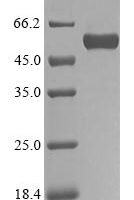
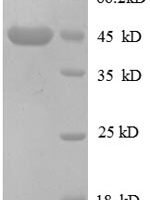
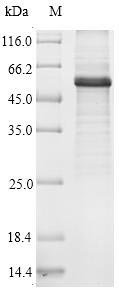
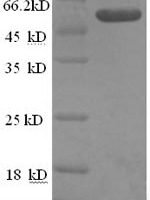
PurityGreater than 90% as determined by SDS-PAGE.
Expression SystemE.coli
Expression Region1-492aa
SpeciesHomo sapiens (Human)
Tag InfoN-terminal 10xHis-tagged and C-terminal Myc-tagged
Molecular weight60.3kDa
ActivityPlease contact us to obtain bioactivity data.
BufferIf the delivery form is liquid, the default storage buffer is Tris/PBS-based buffer, 5%-50% glycerol. If the delivery form is lyophilized powder, the buffer before lyophilization is Tris/PBS-based buffer, 6% Trehalose.
StorageStore at -20°C/-80°C upon receipt, aliquoting is necessary for mutiple use. Avoid repeated freeze-thaw cycles.
Research AreasOthers

Function

Required for both basal and inducible autophagy. Determines the localization of the autophagy-specific PI3-kinase complex PI3KC3-C1. Plays a role in autophagosome formation and MAP1LC3/LC3 conjugation to phosphatidylethanolamine.

Biological Context

Subcellular Location: Cytoplasm; Endoplasmic reticulum membrane (Peripheral membrane protein); Preautophagosomal structure membrane (Peripheral membrane protein); Cytoplasmic vesicle, autophagosome membrane (Peripheral membrane protein)

Product Specifications

Recombinant Human Beclin 1-associated autophagy-related key regulator (ATG14) is a recombinant protein from Homo sapiens (Human), expressed in E.coli, covering amino acids 1-492aa, with N-terminal 10xHis-tagged and C-terminal Myc-tagged tag, molecular weight 60.3kDa, purity Greater than 90% as determined by SDS-PAGE.. Suitable for ELISA and Western Blot applications.
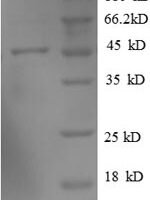
Recommended applications depend on the target, product format, and product-specific validation data. Refer to the product datasheet or Certificate of Analysis (CoA), or contact BioCrest Sci for application guidance.

Biological Activity: Please contact us to obtain bioactivity data.

Storage: Store at -20°C/-80°C upon receipt, aliquoting is necessary for mutiple use. Avoid repeated freeze-thaw cycles.

Shipping & Lead Time: Availability, shipping conditions, and estimated lead time are confirmed in the formal quotation or order confirmation based on the product format, destination, and order requirements.

Protein Biology

Function

Required for both basal and inducible autophagy. Determines the localization of the autophagy-specific PI3-kinase complex PI3KC3-C1 (PubMed:18843052, PubMed:19050071). Plays a role in autophagosome formation and MAP1LC3/LC3 conjugation to phosphatidylethanolamine (PubMed:19270696, PubMed:20713597). Promotes BECN1 translocation from the trans-Golgi network to autophagosomes (PubMed:20713597). Enhances PIK3C3 activity in a BECN1-dependent manner. Essential for the autophagy-dependent phosphorylation of BECN1 (PubMed:23878393). Stimulates the phosphorylation of BECN1, but suppresses the phosphorylation PIK3C3 by AMPK (PubMed:23878393). Binds to STX17-SNAP29 binary t-SNARE complex on autophagosomes and primes it for VAMP8 interaction to promote autophagosome-endolysosome fusion (PubMed:25686604, PubMed:37632749). Modulates the hepatic lipid metabolism (By similarity)

Subcellular Location

Cytoplasm; Endoplasmic reticulum membrane (Peripheral membrane protein); Preautophagosomal structure membrane (Peripheral membrane protein); Cytoplasmic vesicle, autophagosome membrane (Peripheral membrane protein)

Subunit

Forms homooligomers; homo-oligomerization is essential for the roles in membrane tethering and enhancement of SNARE-mediated fusion (PubMed:25686604). Component of the PI3K (PI3KC3/PI3K-III/class III phosphatidylinositol 3-kinase) complex I (PI3KC3-C1) in which the core composed of the catalytic subunit PIK3C3, the regulatory subunit PIK3R4 and BECN1 is associated with ATG14 (PubMed:18843052, PubMed:19050071, PubMed:19270696, PubMed:22314358, PubMed:23878393). PI3KC3-C1 displays a V-shaped architecture with PIK3R4 serving as a bridge between PIK3C3 and the ATG14:BECN1 subcomplex (PubMed:25490155). PI3KC3-C1 can associate with further regulatory subunits. Interacts with PIK3CB (By similarity). Interacts (via coiled-coil domain) with BECN2 (via coiled-coil domain); this interaction is tighter than BECN2 self-association (PubMed:23954414, PubMed:28218432). Interacts with the STX17-SNAP29 binary t-SNARE complex (PubMed:25686604, PubMed:37632749). Interacts with NRBF2 (By similarity). Interacts with PIK3C3 and BECN1; this interaction is increased in the absence of TMEM39A (PubMed:31806350). Interacts with STEEP1; the interaction is required for trafficking of STING1 from the endoplasmic reticulum (PubMed:32690950). Interacts with ARMC3 (via ARM domains) (By similarity)

Gene: ATG14  |  Organism: Homo sapiens  |  Synonyms: Autophagy-related protein 14-like protein
Key Publications

Frequently Asked Questions

How do I order or inquire about this product?

Submit the Online Inquiry form with your required quantity and specifications, or email sales@biocrestsci.com. Available sizes, pricing, stock status, documentation, and estimated lead time are confirmed in the formal quotation.

What is the shipping and delivery time?

Availability, dispatch timing, shipping conditions, and delivery estimates depend on the product format, destination, and order requirements. These details are confirmed in the formal quotation or order confirmation.

How should this product be stored?

Follow the storage and handling instructions in the product-specific datasheet and Certificate of Analysis (CoA). Requirements may vary by product form and formulation; contact BioCrest Sci if product-specific guidance is needed.

What quality controls are performed on your products?

Quality-control data such as identity, purity, endotoxin level, or biological activity are provided only when specified on this product page, the datasheet, or Certificate of Analysis (CoA). Biological activity is not implied unless explicitly stated.

Shopping Cart
Scroll to Top