Recombinant Human Bifunctional 3′-5′ exonuclease/ATP-dependent helicase WRN (WRN), partial

Recombinant Human Bifunctional 3′-5′ exonuclease/ATP-dependent helicase WRN (WRN), partial — Multifunctional enzyme that has magnesium and ATP-dependent 3′-5′ DNA-helicase activity on partially duplex substrates. Purity >85%.

SKU: BCRECP-001917 Category:

Product Specifications

Product SkuBCRECP-001917
Product DescriptionRecombinant Human Bifunctional 3'-5' exonuclease/ATP-dependent helicase WRN (WRN) Protein is expressed from E.coli with N-terminal 10xHis-tagged and C-terminal Myc-tagged. It contains 500-946aa. [Accession | Q14191].
Uniprot No.Q14191
Gene NamesWRN
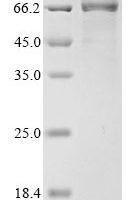
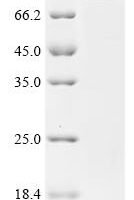
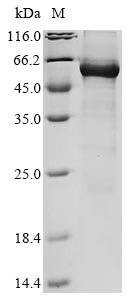
PurityGreater than 85% as determined by SDS-PAGE.
Expression SystemE.coli
Expression Region500-946aa
SpeciesHomo sapiens (Human)
Tag InfoN-terminal 10xHis-tagged and C-terminal Myc-tagged
Molecular weight58.3kDa
ActivityPlease contact us to obtain bioactivity data.
BufferIf the delivery form is liquid, the default storage buffer is Tris/PBS-based buffer, 5%-50% glycerol. If the delivery form is lyophilized powder, the buffer before lyophilization is Tris/PBS-based buffer, 6% Trehalose.
StorageStore at -20°C/-80°C upon receipt, aliquoting is necessary for mutiple use. Avoid repeated freeze-thaw cycles.
Research AreasEpigenetics and Nuclear Signaling

Function

Multifunctional enzyme that has magnesium and ATP-dependent 3'-5' DNA-helicase activity on partially duplex substrates. Also has 3'->5' exonuclease activity towards double-stranded (ds)DNA with a 5'-overhang. Has no nuclease activity towards single-stranded (ss)DNA or blunt-ended dsDNA.

Biological Context

Subcellular Location: Nucleus, nucleolus; Nucleus; Nucleus, nucleoplasm; Chromosome
Disease Association: Werner syndrome (WRN) : A rare autosomal recessive progeroid syndrome characterized by the premature onset of multiple age-related disorders, including atherosclerosis, cancer, non-insulin-dependent diabetes mellitus, ocular cataracts and osteoporosis. The major cause of death, at a median age of 47, is myocardial infarction. [The disease is caused by variants affecting the gene represented in this entry] | Colorectal cancer (CRC) : A complex disease characterized by malignant lesions arising from the inner wall of the large intestine (the colon) and the rectum. Genetic alterations are often associated with progression from premalignant lesion (adenoma) to invasive adenocarcinoma. Risk factors for cancer of the colon and rectum include colon polyps, long-standing ulcerative colitis, and genetic family history. [The disease may be caused by variants affecting the gene represented in this entry]

Product Specifications

Recombinant Human Bifunctional 3'-5' exonuclease/ATP-dependent helicase WRN (WRN), partial is a recombinant protein from Homo sapiens (Human), expressed in E.coli, covering amino acids 500-946aa, with N-terminal 10xHis-tagged and C-terminal Myc-tagged tag, molecular weight 58.3kDa, purity Greater than 85% as determined by SDS-PAGE.. Suitable for ELISA and Western Blot applications.
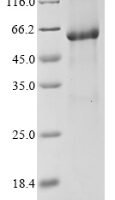
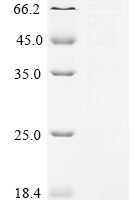
SDS-PAGE: Single band at expected molecular weight confirming purity.

ELISA: Suitable as coating antigen or detection standard.

Western Blot: Compatible with standard Western Blot protocols.

Protein Interaction: Validated for SPR (Surface Plasmon Resonance) and BLI (Bio-Layer Interferometry) studies.

Shipping: Shipped at ambient temperature. Lyophilized protein is stable during transit.

Storage: Store lyophilized protein at -20°C to -80°C. Reconstituted protein should be aliquoted and stored at -80°C. Avoid repeated freeze-thaw cycles.

Shelf Life: 12 months from date of receipt when stored as recommended.

Shipping Time: Orders placed before 2 PM EST ship same day. International orders typically deliver within 5-10 business days.

Protein Biology

Function

Multifunctional enzyme that has magnesium and ATP-dependent 3'-5' DNA-helicase activity on partially duplex substrates (PubMed:9224595, PubMed:9288107, PubMed:9611231). Also has 3'->5' exonuclease activity towards double-stranded (ds)DNA with a 5'-overhang (PubMed:11863428). Has no nuclease activity towards single-stranded (ss)DNA or blunt-ended dsDNA (PubMed:11863428). Helicase activity is most efficient with (d)ATP, but (d)CTP will substitute with reduced efficiency; strand displacement is enhanced by single-strand binding-protein (heterotrimeric replication protein A complex, RPA1, RPA2, RPA3) (PubMed:9611231). Binds preferentially to DNA substrates containing alternate secondary structures, such as replication forks and Holliday junctions. May play an important role in the dissociation of joint DNA molecules that can arise as products of homologous recombination, at stalled replication forks or during DNA repair. Alleviates stalling of DNA polymerases at the site of DNA lesions. Plays a role in the formation of DNA replication focal centers; stably associates with foci elements generating binding sites for RP-A (By similarity). Plays a role in double-strand break repair after gamma-irradiation (PubMed:9224595, PubMed:9288107, PubMed:9611231). Unwinds some G-quadruplex DNA (d(CGG)n tracts); unwinding seems to occur in both 5'-3' and 3'-5' direction and requires a short single-stranded tail (PubMed:10212265). d(CGG)n tracts have a propensity to assemble into tetraplex structures; other G-rich substrates from a telomeric or IgG switch sequence are not unwound (PubMed:10212265). Depletion leads to chromosomal breaks and genome instability (PubMed:33199508)

Subcellular Location

Nucleus, nucleolus; Nucleus; Nucleus, nucleoplasm; Chromosome

Disease Association

Werner syndrome (WRN) : A rare autosomal recessive progeroid syndrome characterized by the premature onset of multiple age-related disorders, including atherosclerosis, cancer, non-insulin-dependent diabetes mellitus, ocular cataracts and osteoporosis. The major cause of death, at a median age of 47, is myocardial infarction. [The disease is caused by variants affecting the gene represented in this entry] | Colorectal cancer (CRC) : A complex disease characterized by malignant lesions arising from the inner wall of the large intestine (the colon) and the rectum. Genetic alterations are often associated with progression from premalignant lesion (adenoma) to invasive adenocarcinoma. Risk factors for cancer of the colon and rectum include colon polyps, long-standing ulcerative colitis, and genetic family history. [The disease may be caused by variants affecting the gene represented in this entry]

Subunit

Monomer, and homooligomer (PubMed:11863428, PubMed:18596042, PubMed:20159463). May exist as homodimer, homotrimer, homotetramer and/or homohexamer (PubMed:11863428, PubMed:18596042, PubMed:20159463). Homotetramer, or homohexamer, when bound to DNA (PubMed:11863428, PubMed:18596042, PubMed:20159463). Interacts via its N-terminal domain with WRNIP1 (By similarity). Interacts with EXO1, PCNA and SUPV3L1 (PubMed:12704184, PubMed:17961633). Interacts with PML (isoform PML-4) (PubMed:21639834). Interacts (via KBM motif) with XRCC5 and XRCC6; promoting recruitment to DNA damage sites (PubMed:27063109). Interacts with RECQL5; this interaction stimulates WRN helicase activity on DNA fork duplexes (PubMed:23180761)

Gene: WRN  |  Organism: Homo sapiens  |  Synonyms: DNA helicase, RecQ-like type 3; RecQ protein-like 2; Werner syndrome protein
Key Publications

Frequently Asked Questions

How do I order or inquire about this product?

Fill out the Online Inquiry form with your required quantity and specifications. You can also email sales@biocrestsci.com. Our team typically responds within 4 business hours with a quote and availability confirmation.

What is the shipping and delivery time?

Orders placed before 2 PM EST ship the same day. Domestic (US) delivery typically takes 2-3 business days. International orders deliver within 5-10 business days. All products are shipped at ambient temperature with appropriate packaging to ensure stability.

How should I store this recombinant protein?

Lyophilized proteins should be stored at -20°C to -80°C upon receipt. After reconstitution, aliquot and store at -80°C. Avoid repeated freeze-thaw cycles. Shelf life is 12 months from date of receipt when stored as recommended.

What quality controls are performed on your products?

Each product undergoes SDS-PAGE purity analysis (typically >85-95%), endotoxin testing, and bioactivity validation. Products are validated for ELISA, Western Blot, and SPR/BLI applications as specified on this product page. A Certificate of Analysis (CoA) is available upon request.

Shopping Cart
Scroll to Top