Recombinant Human Calcium load-activated calcium channel (TMCO1) Protein

Recombinant Human Calcium load-activated calcium channel (TMCO1) Protein — Endoplasmic reticulum (ER) calcium-selective channel preventing intracellular Ca2(+) stores from overfilling and maintaining calcium homeostasis in the ER. Purity >85%.

SKU: BCRECP-00034TM Category:

Product Specifications

Uniprot No.Q9UM00
Gene NamesTMCO1
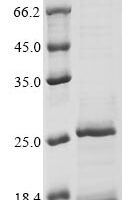
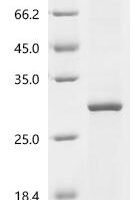
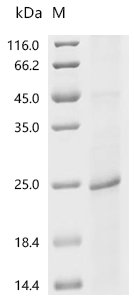
PurityGreater than 85% as determined by SDS-PAGE.
Expression Systemin vitro E.coli expression system
Expression Region1-188aa
SpeciesHomo sapiens (Human)
Tag InfoN-terminal 10xHis-tagged
Molecular weight22.7kDa
ActivityNot Test
BufferIf the delivery form is liquid, the default storage buffer is Tris/PBS-based buffer, 5%-50% glycerol.If the delivery form is lyophilized powder, the buffer before lyophilization is Tris/PBS-based buffer, 6% Trehalose.
StorageStore at -20°C/-80°C upon receipt, aliquoting is necessary for mutiple use. Avoid repeated freeze-thaw cycles.

Function

Endoplasmic reticulum (ER) calcium-selective channel preventing intracellular Ca2(+) stores from overfilling and maintaining calcium homeostasis in the ER. In response to endoplasmic reticulum (ER) Ca2(+) overloading, assembles into a homotetramer, forming a functional calcium-selective channel facilitating Ca2(+) release. Mediates ER Ca2(+) homeostasis in osteoblasts and plays a key role in bone formation, via the CaMKII-HDAC4-RUNX2 signaling axis.

Biological Context

Subcellular Location: Endoplasmic reticulum membrane (Multi-pass membrane protein); Golgi apparatus membrane (Multi-pass membrane protein); Mitochondrion membrane (Multi-pass membrane protein)
Tissue Specificity: Widely expressed in adult and fetal tissues, with higher levels in thymus, prostate, testis and small intestine and lower levels in brain, placenta, lung and kidney. Present in most tissues in the eye, including the trabecular meshwork and retina (at protein level)
Disease Association: Craniofacial dysmorphism, skeletal anomalies and impaired intellectual development syndrome 1 (CFSMR1) : An autosomal recessive disorder characterized by craniofacial and skeletal anomalies, associated with intellectual disability. Typical craniofacial dysmorphism include brachycephaly, highly arched bushy eyebrows, synophrys, long eyelashes, low-set ears, microdontism of primary teeth, and generalized gingival hyperplasia, whereas Sprengel deformity of scapula, fusion of spine, rib abnormities, pectus excavatum, and pes planus represent skeletal anomalies. [The disease is caused by variants affecting the gene represented in this entry] | Glaucoma, primary open angle (POAG) : A complex and genetically heterogeneous ocular disorder characterized by a specific pattern of optic nerve and visual field defects. The angle of the anterior chamber of the eye is open, and usually the intraocular pressure is increased. However, glaucoma can occur at any intraocular pressure. The disease is generally asymptomatic until the late stages, by which time significant and irreversible optic nerve damage has already taken place. In some cases, POAG shows digenic inheritance involving mutations in CYP1B1 and MYOC genes. [Disease susceptibility is associated with variants affecting the gene represented in this entry]

Product Specifications

Recombinant Human Calcium load-activated calcium channel (TMCO1) Protein is a recombinant protein from Homo sapiens (Human), expressed in in vitro E.coli expression system, covering amino acids 1-188aa, with N-terminal 10xHis-tagged tag, molecular weight 22.7kDa, purity Greater than 85% as determined by SDS-PAGE.. Suitable for ELISA and Western Blot applications.
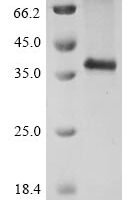
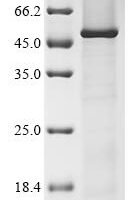
SDS-PAGE: Single band at expected molecular weight confirming purity.

ELISA: Suitable as coating antigen or detection standard.

Western Blot: Compatible with standard Western Blot protocols.

Protein Interaction: Validated for SPR (Surface Plasmon Resonance) and BLI (Bio-Layer Interferometry) studies.

Shipping: Shipped at ambient temperature. Lyophilized protein is stable during transit.

Storage: Store lyophilized protein at -20°C to -80°C. Reconstituted protein should be aliquoted and stored at -80°C. Avoid repeated freeze-thaw cycles.

Shelf Life: 12 months from date of receipt when stored as recommended.

Shipping Time: Orders placed before 2 PM EST ship same day. International orders typically deliver within 5-10 business days.

Protein Biology

Function

Endoplasmic reticulum (ER) calcium-selective channel preventing intracellular Ca2(+) stores from overfilling and maintaining calcium homeostasis in the ER (PubMed:27212239). In response to endoplasmic reticulum (ER) Ca2(+) overloading, assembles into a homotetramer, forming a functional calcium-selective channel facilitating Ca2(+) release (PubMed:27212239). Mediates ER Ca2(+) homeostasis in osteoblasts and plays a key role in bone formation, via the CaMKII-HDAC4-RUNX2 signaling axis (By similarity). Component of the multi-pass translocon (MPT) complex that mediates insertion of multi-pass membrane proteins into the lipid bilayer of membranes (PubMed:32820719, PubMed:36261522). The MPT complex takes over after the SEC61 complex: following membrane insertion of the first few transmembrane segments of proteins by the SEC61 complex, the MPT complex occludes the lateral gate of the SEC61 complex to promote insertion of subsequent transmembrane regions (PubMed:36261522). Within the MPT complex, the GEL subcomplex may mediate insertion of transmembrane regions into the membrane (PubMed:36261522)

Subcellular Location

Endoplasmic reticulum membrane (Multi-pass membrane protein); Golgi apparatus membrane (Multi-pass membrane protein); Mitochondrion membrane (Multi-pass membrane protein)

Disease Association

Craniofacial dysmorphism, skeletal anomalies and impaired intellectual development syndrome 1 (CFSMR1) : An autosomal recessive disorder characterized by craniofacial and skeletal anomalies, associated with intellectual disability. Typical craniofacial dysmorphism include brachycephaly, highly arched bushy eyebrows, synophrys, long eyelashes, low-set ears, microdontism of primary teeth, and generalized gingival hyperplasia, whereas Sprengel deformity of scapula, fusion of spine, rib abnormities, pectus excavatum, and pes planus represent skeletal anomalies. [The disease is caused by variants affecting the gene represented in this entry] | Glaucoma, primary open angle (POAG) : A complex and genetically heterogeneous ocular disorder characterized by a specific pattern of optic nerve and visual field defects. The angle of the anterior chamber of the eye is open, and usually the intraocular pressure is increased. However, glaucoma can occur at any intraocular pressure. The disease is generally asymptomatic until the late stages, by which time significant and irreversible optic nerve damage has already taken place. In some cases, POAG shows digenic inheritance involving mutations in CYP1B1 and MYOC genes. [Disease susceptibility is associated with variants affecting the gene represented in this entry]

Tissue Specificity

Widely expressed in adult and fetal tissues, with higher levels in thymus, prostate, testis and small intestine and lower levels in brain, placenta, lung and kidney (PubMed:10393320, PubMed:20018682). Present in most tissues in the eye, including the trabecular meshwork and retina (at protein level) (PubMed:22714896)

Subunit

Homodimer and homotetramer (PubMed:27212239). Homodimer under resting conditions; forms homotetramers following ER calcium overload (PubMed:27212239). Component of the GET- and EMC-like (GEL) complex, composed of RAB5IF/OPTI and TMCO1 (PubMed:36261522). The GEL complex is part of the multi-pass translocon (MPT) complex, composed of three subcomplexes, the GEL complex (composed of RAB5IF/OPTI and TMCO1), the BOS complex (composed of NCLN/Nicalin, NOMO and TMEM147) and the PAT complex (composed of WDR83OS/Asterix and CCDC47) (PubMed:32820719, PubMed:36261522). The MPT complex associates with the SEC61 complex (PubMed:36261522)

Gene: TMCO1  |  Organism: Homo sapiens  |  Synonyms: GEL complex subunit TMCO1; Transmembrane and coiled-coil domain-containing protein 1; Transmembrane and coiled-coil domains protein 4; Xenogeneic cross-immune protein PCIA3
Key Publications

Frequently Asked Questions

How do I order or inquire about this product?

Fill out the Online Inquiry form with your required quantity and specifications. You can also email sales@biocrestsci.com. Our team typically responds within 4 business hours with a quote and availability confirmation.

What is the shipping and delivery time?

Orders placed before 2 PM EST ship the same day. Domestic (US) delivery typically takes 2-3 business days. International orders deliver within 5-10 business days. All products are shipped at ambient temperature with appropriate packaging to ensure stability.

How should I store this recombinant protein?

Lyophilized proteins should be stored at -20°C to -80°C upon receipt. After reconstitution, aliquot and store at -80°C. Avoid repeated freeze-thaw cycles. Shelf life is 12 months from date of receipt when stored as recommended.

What quality controls are performed on your products?

Each product undergoes SDS-PAGE purity analysis (typically >85-95%), endotoxin testing, and bioactivity validation. Products are validated for ELISA, Western Blot, and SPR/BLI applications as specified on this product page. A Certificate of Analysis (CoA) is available upon request.

Shopping Cart
Scroll to Top