,

Recombinant Human Carcinoembryonic antigen-related cell adhesion molecule 1 (CEACAM1), partial, Biotinylated (Active)

Recombinant Human Carcinoembryonic antigen-related cell adhesion molecule 1 (CEACAM1), partial, Biotinylated (Active) — Cell adhesion protein that mediates homophilic cell adhesion in a calcium-independent manner. Purity >95%.

SKU: BCRECP-000334 Categories: ,

Product Specifications

Product SkuBCRECP-000334
Product DescriptionRecombinant Human Carcinoembryonic antigen-related cell adhesion molecule 1 (CEACAM1) Protein is expressed from Mammalian cell with C-terminal 10xHis-Avi-tagged. It contains 35-428aa. [Accession | P13688].
Uniprot No.P13688
Gene NamesCEACAM1
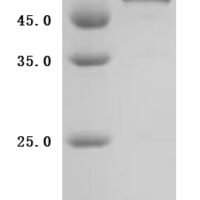
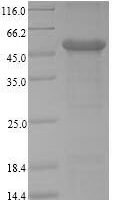
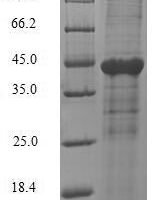
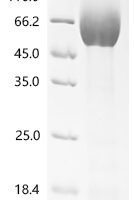
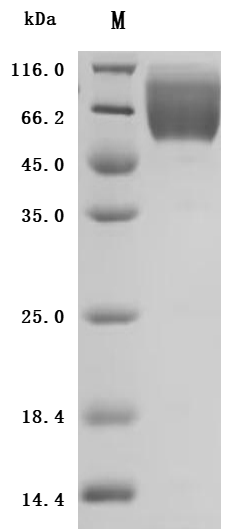
PurityGreater than 95% as determined by SDS-PAGE.
Expression SystemMammalian cell
Expression Region35-428aa
SpeciesHomo sapiens (Human)
Tag InfoC-terminal 10xHis-Avi-tagged
Molecular weight48.2kDa
ActivityPlease contact us to obtain bioactivity data.
BufferIf the delivery form is liquid, the default storage buffer is Tris/PBS-based buffer, 5%-50% glycerol. If the delivery form is lyophilized powder, the buffer before lyophilization is Tris/PBS-based buffer, 6% Trehalose.
StorageStore at -20°C/-80°C upon receipt, aliquoting is necessary for mutiple use. Avoid repeated freeze-thaw cycles.
Research AreasCancer

Function

Cell adhesion protein that mediates homophilic cell adhesion in a calcium-independent manner. Promotes populations of T cells regulating IgA production and secretion associated with control of the commensal microbiota and resistance to enteropathogens.

Biological Context

Subcellular Location: Cell projection, microvillus membrane (Single-pass type I membrane protein); Apical cell membrane (Single-pass type I membrane protein)
Tissue Specificity: Expressed in columnar epithelial cells of the colon (at protein level). The predominant forms expressed by T cells are those containing a long cytoplasmic domain. Expressed in granulocytes and lymphocytes. Leukocytes only express isoforms 6 and isoform 1

Product Specifications

Recombinant Human Carcinoembryonic antigen-related cell adhesion molecule 1 (CEACAM1), partial, Biotinylated (Active) is a recombinant protein from Homo sapiens (Human), expressed in Mammalian cell, covering amino acids 35-428aa, with C-terminal 10xHis-Avi-tagged tag, molecular weight 48.2kDa, purity Greater than 95% as determined by SDS-PAGE.. Suitable for ELISA and Western Blot applications.

SDS-PAGE: Single band at expected molecular weight confirming purity.

ELISA: Suitable as coating antigen or detection standard.

Western Blot: Compatible with standard Western Blot protocols.

Protein Interaction: Validated for SPR (Surface Plasmon Resonance) and BLI (Bio-Layer Interferometry) studies.

Shipping: Shipped at ambient temperature. Lyophilized protein is stable during transit.

Storage: Store lyophilized protein at -20°C to -80°C. Reconstituted protein should be aliquoted and stored at -80°C. Avoid repeated freeze-thaw cycles.

Shelf Life: 12 months from date of receipt when stored as recommended.

Shipping Time: Orders placed before 2 PM EST ship same day. International orders typically deliver within 5-10 business days.

Protein Biology

Function

Cell adhesion protein that mediates homophilic cell adhesion in a calcium-independent manner (By similarity). Promotes populations of T cells regulating IgA production and secretion associated with control of the commensal microbiota and resistance to enteropathogens (By similarity)

Subcellular Location

Cell projection, microvillus membrane (Single-pass type I membrane protein); Apical cell membrane (Single-pass type I membrane protein)

Tissue Specificity

Expressed in columnar epithelial cells of the colon (at protein level) (PubMed:10436421). The predominant forms expressed by T cells are those containing a long cytoplasmic domain (PubMed:18424730). Expressed in granulocytes and lymphocytes. Leukocytes only express isoforms 6 and isoform 1 (PubMed:11994468)

Subunit

Monomer. Oligomer. Heterodimer. Homodimer (PubMed:26483485). Cis-dimer/oligomer (via Ig-like C2-type and/or via cytoplasmic domains); induced by trans-homophilic cell adhesion through an allosteric mechanism transmitted by the Ig-like V-type domain, and is regulated by intracellular calcium and calmodulin. Interacts (via cytoplasmic domain) with calmodulin in a calcium dependent manner; reduces homophilic cell adhesion through dissociation of dimer (By similarity). Isoform 1 interacts (via cytoplasmic domain) with PTPN11 (preferentially) and PTPN6; cis-homodimer form is preferred; this interaction is decreased by formation of Isoform 1 /Isoform 8 cis-heterodimers and is dependent on the monomer/dimer equilibrium; this interaction is phosphorylation-dependent (PubMed:23696226). Isoform 1 interacts with LYN (By similarity). Isoform 1 interacts (via cytoplasmic domain) with SRC (via SH2 domain); this interaction is regulated by trans-homophilic cell adhesion (PubMed:7478590). Isoform 1 interacts (via cytoplasmic domain) with LCK; mediates phosphorylation at Tyr-493 and Tyr-520 resulting in PTPN6 association. Isoform 1 interacts with PTPN6; this interaction is phosphorylation-dependent and causes a profound decrease in TCR stimulation-induced CD247 and ZAP70 phosphorylation. Isoform 1 interacts with TCR/CD3 complex through TCR beta chain and CD3E; colocalizes at the cell surface and upon stimulation of the TCR/CD3 complex recruits PTPN6 in the TCR/CD3 complex, resulting in dephosphorylation of CD247 and ZAP70 (PubMed:18424730). Isoform 1 interacts (via cytoplasmic domain) with SHC1 (via SH2 domain); SHC1 mediates interaction with INSR or EGFR in a Ser-508 phosphorylation-dependent manner (By similarity). Isoform 1 interacts with EGFR; the interaction is indirect (PubMed:15467833). Isoform 1 interacts with CSF3R; down-regulates the CSF3R-STAT3 pathway through recruitment of PTPN6 that dephosphorylates CSF3R (By similarity). Isoform 1 (phosphorylated form) interacts with TLR4 and SYK; recruits PTPN6 that dephosphorylates SYK, reducing the production of reactive oxygen species (ROS) and lysosome disruption, leading to a reduction of the inflammasome activity (By similarity). Isoform 1 interacts with FLNA; inhibits cell migration and cell scattering by interfering with the interaction of FLNA with RALA (PubMed:16291724). Isoform 1 interacts (via cytoplasmic domain) with PXN; the interaction is phosphotyrosyl-dependent (PubMed:11035932). Isoform 1 interacts with KLRK1; recruits PTPN6 that dephosphorylates VAV1 (PubMed:23696226). Isoform 1 interacts with CEACAM8 (PubMed:11994468). Isoform 1 interacts with FASN; this interaction is insulin and phosphorylation-dependent; reduces fatty-acid synthase activity (By similarity). Interacts (via Ig-like V-type) with HAVCR2 (via Ig-like V-type); facilitates the maturation and cell surface expression of HAVCR2 thereby regulating T cell tolerance induction (PubMed:25363763). Isoform 8 interacts (via the cytoplasmic domain) with ANXA2; this interaction is regulated by phosphorylation and appears in the AIIt complex (PubMed:14522961). Interacts (via Lewis X moieties) with CD209 (via C-type lectin domain); this interaction is regulated by the glycosylation pattern of CEACAM1 on cell types and regulates contact between dendritic cells and neutrophils (PubMed:16246332)

Gene: CEACAM1  |  Organism: Homo sapiens  |  Synonyms: Biliary glycoprotein 1; Carcinoembryonic antigen-related cell adhesion molecule 1
Key Publications

Frequently Asked Questions

How do I order or inquire about this product?

Fill out the Online Inquiry form with your required quantity and specifications. You can also email sales@biocrestsci.com. Our team typically responds within 4 business hours with a quote and availability confirmation.

What is the shipping and delivery time?

Orders placed before 2 PM EST ship the same day. Domestic (US) delivery typically takes 2-3 business days. International orders deliver within 5-10 business days. All products are shipped at ambient temperature with appropriate packaging to ensure stability.

How should I store this recombinant protein?

Lyophilized proteins should be stored at -20°C to -80°C upon receipt. After reconstitution, aliquot and store at -80°C. Avoid repeated freeze-thaw cycles. Shelf life is 12 months from date of receipt when stored as recommended.

What quality controls are performed on your products?

Each product undergoes SDS-PAGE purity analysis (typically >85-95%), endotoxin testing, and bioactivity validation. Products are validated for ELISA, Western Blot, and SPR/BLI applications as specified on this product page. A Certificate of Analysis (CoA) is available upon request.

Shopping Cart
Scroll to Top