, ,

Recombinant Human Carcinoembryonic antigen-related cell adhesion molecule 1(CEACAM1),partial,Biotinylated (Active)

Recombinant Human Carcinoembryonic antigen-related cell adhesion molecule 1(CEACAM1),partial,Biotinylated (Active) — Cell adhesion protein that mediates homophilic cell adhesion in a calcium-independent manner. Purity >95%.

SKU: BCACP-000282 Categories: , ,
Product SKUBCACP-000282
Product DescriptionRecombinant Human Carcinoembryonic antigen-related cell adhesion molecule 1(CEACAM1), Biotinylated protein is expressed from Mammalian cell with C-terminal 10xHis-Avi-tagged. It contains 35-428aa. [Accession | P13688].
Uniprot No.P13688
Gene NamesCEACAM1
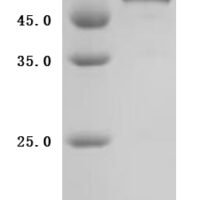
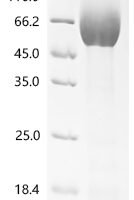
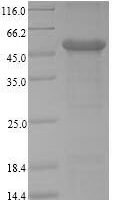
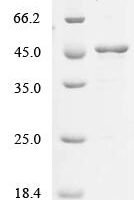
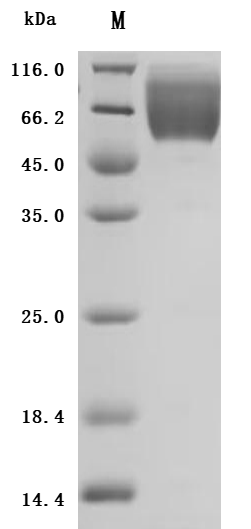
PurityGreater than 95% as determined by SDS-PAGE.Greater than 95% as determined by SEC-HPLC.
Expression SystemMammalian cell
Expression Region35-428aa
SpeciesHomo sapiens (Human)
Tag InfoC-terminal 10xHis-Avi-tagged
Molecular weight48.2 kDa
ActivityMeasured by its binding ability in a functional ELISA. Immobilized Human KAAG1 at 2 μg/mL can bind Anti-KAAG1 recombinant antibody. The EC50 is 4.924-6.034 ng/mL.
BufferLyophilized from a 0.2 μm filtered 20 mM Tris-HCl, 0.5 M NaCl, 6% Trehalose, pH 8.0
StorageStore at -20°C/-80°C upon receipt, aliquoting is necessary for mutiple use. Avoid repeated freeze-thaw cycles.
Alternative NamesBGP, BGP1

Function

Cell adhesion protein that mediates homophilic cell adhesion in a calcium-independent manner. Promotes populations of T cells regulating IgA production and secretion associated with control of the commensal microbiota and resistance to enteropathogens.

Biological Context

Subcellular Location: Cell projection, microvillus membrane (Single-pass type I membrane protein); Apical cell membrane (Single-pass type I membrane protein)
Tissue Specificity: Expressed in columnar epithelial cells of the colon (at protein level). The predominant forms expressed by T cells are those containing a long cytoplasmic domain. Expressed in granulocytes and lymphocytes. Leukocytes only express isoforms 6 and isoform 1

Product Specifications

Recombinant Human Carcinoembryonic antigen-related cell adhesion molecule 1(CEACAM1),partial,Biotinylated (Active) is a recombinant protein from Homo sapiens (Human), expressed in Mammalian cell, covering amino acids 35-428aa, with C-terminal 10xHis-Avi-tagged tag, molecular weight 48.2 kDa, purity Greater than 95% as determined by SDS-PAGE.Greater than 95% as determined by SEC-HPLC.. Suitable for ELISA and Western Blot applications.

Recommended applications depend on the target, product format, and product-specific validation data. Refer to the product datasheet or Certificate of Analysis (CoA), or contact BioCrest Sci for application guidance.

Biological Activity: Measured by its binding ability in a functional ELISA. Immobilized Human KAAG1 at 2 μg/mL can bind Anti-KAAG1 recombinant antibody. The EC50 is 4.924-6.034 ng/mL.

Storage: Store at -20°C/-80°C upon receipt, aliquoting is necessary for mutiple use. Avoid repeated freeze-thaw cycles.

Shipping & Lead Time: Availability, shipping conditions, and estimated lead time are confirmed in the formal quotation or order confirmation based on the product format, destination, and order requirements.

Protein Biology

Function

Cell adhesion protein that mediates homophilic cell adhesion in a calcium-independent manner (By similarity). Promotes populations of T cells regulating IgA production and secretion associated with control of the commensal microbiota and resistance to enteropathogens (By similarity)

Subcellular Location

Cell projection, microvillus membrane (Single-pass type I membrane protein); Apical cell membrane (Single-pass type I membrane protein)

Tissue Specificity

Expressed in columnar epithelial cells of the colon (at protein level) (PubMed:10436421). The predominant forms expressed by T cells are those containing a long cytoplasmic domain (PubMed:18424730). Expressed in granulocytes and lymphocytes. Leukocytes only express isoforms 6 and isoform 1 (PubMed:11994468)

Subunit

Monomer. Oligomer. Heterodimer. Homodimer (PubMed:26483485). Cis-dimer/oligomer (via Ig-like C2-type and/or via cytoplasmic domains); induced by trans-homophilic cell adhesion through an allosteric mechanism transmitted by the Ig-like V-type domain, and is regulated by intracellular calcium and calmodulin. Interacts (via cytoplasmic domain) with calmodulin in a calcium dependent manner; reduces homophilic cell adhesion through dissociation of dimer (By similarity). Isoform 1 interacts (via cytoplasmic domain) with PTPN11 (preferentially) and PTPN6; cis-homodimer form is preferred; this interaction is decreased by formation of Isoform 1 /Isoform 8 cis-heterodimers and is dependent on the monomer/dimer equilibrium; this interaction is phosphorylation-dependent (PubMed:23696226). Isoform 1 interacts with LYN (By similarity). Isoform 1 interacts (via cytoplasmic domain) with SRC (via SH2 domain); this interaction is regulated by trans-homophilic cell adhesion (PubMed:7478590). Isoform 1 interacts (via cytoplasmic domain) with LCK; mediates phosphorylation at Tyr-493 and Tyr-520 resulting in PTPN6 association. Isoform 1 interacts with PTPN6; this interaction is phosphorylation-dependent and causes a profound decrease in TCR stimulation-induced CD247 and ZAP70 phosphorylation. Isoform 1 interacts with TCR/CD3 complex through TCR beta chain and CD3E; colocalizes at the cell surface and upon stimulation of the TCR/CD3 complex recruits PTPN6 in the TCR/CD3 complex, resulting in dephosphorylation of CD247 and ZAP70 (PubMed:18424730). Isoform 1 interacts (via cytoplasmic domain) with SHC1 (via SH2 domain); SHC1 mediates interaction with INSR or EGFR in a Ser-508 phosphorylation-dependent manner (By similarity). Isoform 1 interacts with EGFR; the interaction is indirect (PubMed:15467833). Isoform 1 interacts with CSF3R; down-regulates the CSF3R-STAT3 pathway through recruitment of PTPN6 that dephosphorylates CSF3R (By similarity). Isoform 1 (phosphorylated form) interacts with TLR4 and SYK; recruits PTPN6 that dephosphorylates SYK, reducing the production of reactive oxygen species (ROS) and lysosome disruption, leading to a reduction of the inflammasome activity (By similarity). Isoform 1 interacts with FLNA; inhibits cell migration and cell scattering by interfering with the interaction of FLNA with RALA (PubMed:16291724). Isoform 1 interacts (via cytoplasmic domain) with PXN; the interaction is phosphotyrosyl-dependent (PubMed:11035932). Isoform 1 interacts with KLRK1; recruits PTPN6 that dephosphorylates VAV1 (PubMed:23696226). Isoform 1 interacts with CEACAM8 (PubMed:11994468). Isoform 1 interacts with FASN; this interaction is insulin and phosphorylation-dependent; reduces fatty-acid synthase activity (By similarity). Interacts (via Ig-like V-type) with HAVCR2 (via Ig-like V-type); facilitates the maturation and cell surface expression of HAVCR2 thereby regulating T cell tolerance induction (PubMed:25363763). Isoform 8 interacts (via the cytoplasmic domain) with ANXA2; this interaction is regulated by phosphorylation and appears in the AIIt complex (PubMed:14522961). Interacts (via Lewis X moieties) with CD209 (via C-type lectin domain); this interaction is regulated by the glycosylation pattern of CEACAM1 on cell types and regulates contact between dendritic cells and neutrophils (PubMed:16246332)

Gene: CEACAM1  |  Organism: Homo sapiens  |  Synonyms: Biliary glycoprotein 1; Carcinoembryonic antigen-related cell adhesion molecule 1
Key Publications

Frequently Asked Questions

How do I order or inquire about this product?

Submit the Online Inquiry form with your required quantity and specifications, or email sales@biocrestsci.com. Available sizes, pricing, stock status, documentation, and estimated lead time are confirmed in the formal quotation.

What is the shipping and delivery time?

Availability, dispatch timing, shipping conditions, and delivery estimates depend on the product format, destination, and order requirements. These details are confirmed in the formal quotation or order confirmation.

How should this product be stored?

Follow the storage and handling instructions in the product-specific datasheet and Certificate of Analysis (CoA). Requirements may vary by product form and formulation; contact BioCrest Sci if product-specific guidance is needed.

What quality controls are performed on your products?

Quality-control data such as identity, purity, endotoxin level, or biological activity are provided only when specified on this product page, the datasheet, or Certificate of Analysis (CoA). Biological activity is not implied unless explicitly stated.

Shopping Cart
Scroll to Top