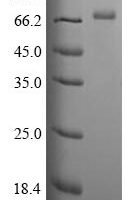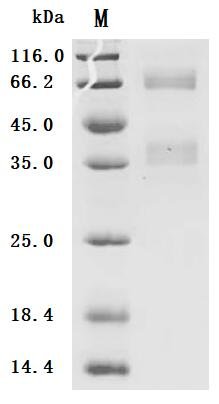
Recombinant Human Clusterin (CLU) (Active)

Recombinant Human Clusterin (CLU) (Active) — Does not affect caspase or BAX-mediated intrinsic apoptosis and TNF-induced NF-kappa-B-activity. Purity >95%.

SKU: BCACP-000576 Category:
Product SKUBCACP-000576
Product DescriptionRecombinant Human Clusterin (CLU) protein is expressed from Mammalian cell with C-terminal 10xHis-tagged. It contains 23-449aa. [Accession | P10909].
Uniprot No.P10909
Gene NamesCLU
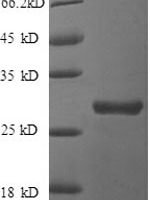
PurityGreater than 95% as determined by SDS-PAGE.
Expression SystemMammalian cell
Expression Region23-449aa
SpeciesHomo sapiens (Human)
Tag InfoC-terminal 10xHis-tagged
Molecular weight51.7 kDa
ActivityMeasured by its binding ability in a functional ELISA. Immobilized Human KIT at 2 μg/mL can bind Human KITLG . The EC50 is 0.6921-0.8551 ng/mL.;Measured by its binding ability in a functional ELISA. Immobilized Human KIT at 2 μg/mL can bind Anti-KIT recombinant antibody. The EC50 is 2.196-2.634 ng/mL.
BufferLyophilized from a 0.2 μm filtered 20 mM Tris-HCl, 0.5 M NaCl, 6% Trehalose, pH 8.0
StorageStore at -20°C/-80°C upon receipt, aliquoting is necessary for mutiple use. Avoid repeated freeze-thaw cycles.
Alternative NamesClusterin; Aging-associated gene 4 protein; Apolipoprotein J; Apo-J; Complement cytolysis inhibitor; CLI; Complement-associated protein SP-40,40; Ku70-binding protein 1; NA1/NA2; Sulfated glycoprotein 2; SGP-2; Testosterone-repressed prostate message 2; TRPM-2 [Cleaved into: Clusterin beta chain; ApoJalpha; Complement cytolysis inhibitor a chain; SP-40,40 beta-chain; Clusterin alpha chain; ApoJbeta; Complement cytolysis inhibitor b chain; SP-40,40 alpha-chain]

Function

Does not affect caspase or BAX-mediated intrinsic apoptosis and TNF-induced NF-kappa-B-activity. Promotes cell death through interaction with BCL2L1 that releases and activates BAX.

Biological Context

Subcellular Location: Nucleus; Cytoplasm; Mitochondrion membrane (Peripheral membrane protein); Cytoplasm, cytosol; Microsome; Endoplasmic reticulum; Mitochondrion; Mitochondrion membrane; Cytoplasm, perinuclear region; Cytoplasmic vesicle, secretory vesicle, chromaffin granule
Tissue Specificity: Detected in blood plasma, cerebrospinal fluid, milk, seminal plasma and colon mucosa. Detected in the germinal center of colon lymphoid nodules and in colon parasympathetic ganglia of the Auerbach plexus (at protein level). Ubiquitous. Detected in brain, testis, ovary, liver and pancreas, and at lower levels in kidney, heart, spleen and lung

Product Specifications

Recombinant Human Clusterin (CLU) (Active) is a recombinant protein from Homo sapiens (Human), expressed in Mammalian cell, covering amino acids 23-449aa, with C-terminal 10xHis-tagged tag, molecular weight 51.7 kDa, purity Greater than 95% as determined by SDS-PAGE.. Suitable for ELISA and Western Blot applications.

Recommended applications depend on the target, product format, and product-specific validation data. Refer to the product datasheet or Certificate of Analysis (CoA), or contact BioCrest Sci for application guidance.

Biological Activity: Measured by its binding ability in a functional ELISA. Immobilized Human KIT at 2 μg/mL can bind Human KITLG . The EC50 is 0.6921-0.8551 ng/mL.;Measured by its binding ability in a functional ELISA. Immobilized Human KIT at 2 μg/mL can bind Anti-KIT recombinant antibody. The EC50 is 2.196-2.634 ng/mL.

Storage: Store at -20°C/-80°C upon receipt, aliquoting is necessary for mutiple use. Avoid repeated freeze-thaw cycles.

Shipping & Lead Time: Availability, shipping conditions, and estimated lead time are confirmed in the formal quotation or order confirmation based on the product format, destination, and order requirements.

Protein Biology

Function

Does not affect caspase or BAX-mediated intrinsic apoptosis and TNF-induced NF-kappa-B-activity (PubMed:24073260). Promotes cell death through interaction with BCL2L1 that releases and activates BAX (PubMed:21567405)

Subcellular Location

Nucleus; Cytoplasm; Mitochondrion membrane (Peripheral membrane protein); Cytoplasm, cytosol; Microsome; Endoplasmic reticulum; Mitochondrion; Mitochondrion membrane; Cytoplasm, perinuclear region; Cytoplasmic vesicle, secretory vesicle, chromaffin granule

Tissue Specificity

Detected in blood plasma, cerebrospinal fluid, milk, seminal plasma and colon mucosa. Detected in the germinal center of colon lymphoid nodules and in colon parasympathetic ganglia of the Auerbach plexus (at protein level). Ubiquitous. Detected in brain, testis, ovary, liver and pancreas, and at lower levels in kidney, heart, spleen and lung

Subunit

Antiparallel disulfide-linked heterodimer of an alpha chain and a beta chain (PubMed:12047389, PubMed:1491011, PubMed:1551440, PubMed:2387851, PubMed:2780565, PubMed:8328966). Self-associates and forms higher oligomers (PubMed:1903064). Interacts with a broad range of misfolded proteins, including APP, APOC2 and LYZ (PubMed:17407782, PubMed:17412999, PubMed:8328966). Slightly acidic pH promotes interaction with misfolded proteins (PubMed:12176985). Forms high-molecular weight oligomers upon interaction with misfolded proteins (PubMed:19535339). Interacts with APOA1, LRP2, CLUAP1 and PON1 (PubMed:15480429, PubMed:17260971, PubMed:1742316, PubMed:1903064, PubMed:8292612). Interacts with the complement membrane attack complex (PubMed:2601725, PubMed:9200695, PubMed:34667172). Interacts (via alpha chain) with XRCC6 (By similarity). Interacts with SYVN1, COMMD1, BTRC, CUL1 and with ubiquitin and SCF (SKP1-CUL1-F-box protein) E3 ubiquitin-protein ligase complexes (PubMed:17451556, PubMed:20068069). Interacts (via alpha chain) with BAX in stressed cells, where BAX undergoes a conformation change leading to association with the mitochondrial membrane (PubMed:16113678). Does not interact with BAX in unstressed cells (PubMed:16113678). Found in a complex with LTF, CLU, EPPIN and SEMG1 (PubMed:17567961). Interacts (immaturely glycosylated pre-secreted form) with HSPA5; this interaction promotes CLU stability and facilitates stress-induced CLU retrotranslocation from the secretory pathway to the mitochondria, thereby reducing stress-induced apoptosis by stabilizing mitochondrial membrane integrity (PubMed:22689054). Interacts (isoform 4) with BCL2L1; this interaction releases and activates BAX and promotes cell death (PubMed:21567405). Interacts with TGFBR2 and ACVR1 (PubMed:8555189). Interacts (secreted form) with STMN3; this interaction may act as an important modulator during neuronal differentiation (By similarity). Interacts with VLDLR and LRP8 (PubMed:24381170)

Gene: CLU  |  Organism: Homo sapiens  |  Synonyms: Aging-associated gene 4 protein; Apolipoprotein J; Complement cytolysis inhibitor; Complement-associated protein SP-40,40; Ku70-binding protein 1; NA1/NA2; Sulfated glycoprotein 2; Testosterone-repressed prostate message 2
Key Publications

Frequently Asked Questions

How do I order or inquire about this product?

Submit the Online Inquiry form with your required quantity and specifications, or email sales@biocrestsci.com. Available sizes, pricing, stock status, documentation, and estimated lead time are confirmed in the formal quotation.

What is the shipping and delivery time?

Availability, dispatch timing, shipping conditions, and delivery estimates depend on the product format, destination, and order requirements. These details are confirmed in the formal quotation or order confirmation.

How should this product be stored?

Follow the storage and handling instructions in the product-specific datasheet and Certificate of Analysis (CoA). Requirements may vary by product form and formulation; contact BioCrest Sci if product-specific guidance is needed.

What quality controls are performed on your products?

Quality-control data such as identity, purity, endotoxin level, or biological activity are provided only when specified on this product page, the datasheet, or Certificate of Analysis (CoA). Biological activity is not implied unless explicitly stated.

Shopping Cart
Scroll to Top