Recombinant Human Coagulation factor V (F5), partial

Recombinant Human Coagulation factor V (F5), partial — Central regulator of hemostasis. Purity >90%.

SKU: BCRECP-000620 Category:

Product Specifications

Product SkuBCRECP-000620
Product DescriptionRecombinant Human Coagulation factor V (F5) Protein is expressed from E.coli with N-terminal 6xHis-SUMO-tagged. It contains 1490-1614aa. [Accession | P12259].
Uniprot No.P12259
Gene NamesF5
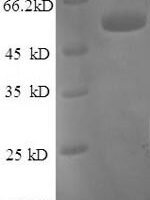
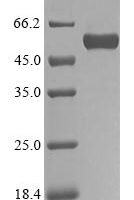
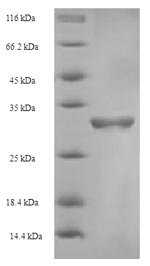
PurityGreater than 90% as determined by SDS-PAGE.
Expression SystemE.coli
Expression Region1490-1614aa
SpeciesHomo sapiens (Human)
Tag InfoN-terminal 6xHis-SUMO-tagged
Molecular weight30.4kDa
ActivityPlease contact us to obtain bioactivity data.
BufferIf the delivery form is liquid, the default storage buffer is Tris/PBS-based buffer, 5%-50% glycerol. If the delivery form is lyophilized powder, the buffer before lyophilization is Tris/PBS-based buffer, 6% Trehalose.
StorageStore at -20°C/-80°C upon receipt, aliquoting is necessary for mutiple use. Avoid repeated freeze-thaw cycles.
Research AreasCardiovascular

Function

Central regulator of hemostasis. It serves as a critical cofactor for the prothrombinase activity of factor Xa that results in the activation of prothrombin to thrombin.

Biological Context

Subcellular Location: Secreted
Tissue Specificity: Plasma
Disease Association: Factor V deficiency (FA5D) : A blood coagulation disorder leading to a hemorrhagic diathesis known as parahemophilia. [The disease is caused by variants affecting the gene represented in this entry] | Thrombophilia due to activated protein C resistance (THPH2) : A hemostatic disorder due to defective degradation of factor V by activated protein C. It is characterized by a poor anticoagulant response to activated protein C resulting in tendency to thrombosis. [The disease is caused by variants affecting the gene represented in this entry] | Budd-Chiari syndrome (BDCHS) : A syndrome caused by obstruction of hepatic venous outflow involving either the hepatic veins or the terminal segment of the inferior vena cava. Obstructions are generally caused by thrombosis and lead to hepatic congestion and ischemic necrosis. Clinical manifestations observed in the majority of patients include hepatomegaly, right upper quadrant pain and abdominal ascites. Budd-Chiari syndrome is associated with a combination of disease states including primary myeloproliferative syndromes and thrombophilia due to factor V Leiden, protein C deficiency and antithrombin III deficiency. Budd-Chiari syndrome is a rare but typical complication in patients with polycythemia vera. [Disease susceptibility is associated with variants affecting the gene represented in this entry] | Ischemic stroke (ISCHSTR) : A stroke is an acute neurologic event leading to death of neural tissue of the brain and resulting in loss of motor, sensory and/or cognitive function. Ischemic strokes, resulting from vascular occlusion, is considered to be a highly complex disease consisting of a group of heterogeneous disorders with multiple genetic and environmental risk factors. [Disease susceptibility is associated with variants affecting the gene represented in this entry] | Pregnancy loss, recurrent, 1 (RPRGL1) : A common complication of pregnancy, resulting in spontaneous abortion before the fetus has reached viability. The term includes all miscarriages from the time of conception until 24 weeks of gestation. Recurrent pregnancy loss is defined as 3 or more consecutive spontaneous abortions. [Disease susceptibility is associated with variants affecting the gene represented in this entry]

Product Specifications

Recombinant Human Coagulation factor V (F5), partial is a recombinant protein from Homo sapiens (Human), expressed in E.coli, covering amino acids 1490-1614aa, with N-terminal 6xHis-SUMO-tagged tag, molecular weight 30.4kDa, purity Greater than 90% as determined by SDS-PAGE.. Suitable for ELISA and Western Blot applications.
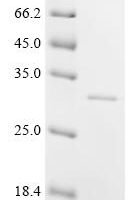
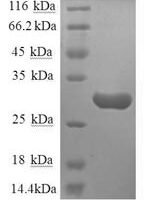
SDS-PAGE: Single band at expected molecular weight confirming purity.

ELISA: Suitable as coating antigen or detection standard.

Western Blot: Compatible with standard Western Blot protocols.

Protein Interaction: Validated for SPR (Surface Plasmon Resonance) and BLI (Bio-Layer Interferometry) studies.

Shipping: Shipped at ambient temperature. Lyophilized protein is stable during transit.

Storage: Store lyophilized protein at -20°C to -80°C. Reconstituted protein should be aliquoted and stored at -80°C. Avoid repeated freeze-thaw cycles.

Shelf Life: 12 months from date of receipt when stored as recommended.

Shipping Time: Orders placed before 2 PM EST ship same day. International orders typically deliver within 5-10 business days.

Protein Biology

Function

Central regulator of hemostasis. It serves as a critical cofactor for the prothrombinase activity of factor Xa that results in the activation of prothrombin to thrombin

Subcellular Location

Secreted

Disease Association

Factor V deficiency (FA5D) : A blood coagulation disorder leading to a hemorrhagic diathesis known as parahemophilia. [The disease is caused by variants affecting the gene represented in this entry] | Thrombophilia due to activated protein C resistance (THPH2) : A hemostatic disorder due to defective degradation of factor V by activated protein C. It is characterized by a poor anticoagulant response to activated protein C resulting in tendency to thrombosis. [The disease is caused by variants affecting the gene represented in this entry] | Budd-Chiari syndrome (BDCHS) : A syndrome caused by obstruction of hepatic venous outflow involving either the hepatic veins or the terminal segment of the inferior vena cava. Obstructions are generally caused by thrombosis and lead to hepatic congestion and ischemic necrosis. Clinical manifestations observed in the majority of patients include hepatomegaly, right upper quadrant pain and abdominal ascites. Budd-Chiari syndrome is associated with a combination of disease states including primary myeloproliferative syndromes and thrombophilia due to factor V Leiden, protein C deficiency and antithrombin III deficiency. Budd-Chiari syndrome is a rare but typical complication in patients with polycythemia vera. [Disease susceptibility is associated with variants affecting the gene represented in this entry] | Ischemic stroke (ISCHSTR) : A stroke is an acute neurologic event leading to death of neural tissue of the brain and resulting in loss of motor, sensory and/or cognitive function. Ischemic strokes, resulting from vascular occlusion, is considered to be a highly complex disease consisting of a group of heterogeneous disorders with multiple genetic and environmental risk factors. [Disease susceptibility is associated with variants affecting the gene represented in this entry] | Pregnancy loss, recurrent, 1 (RPRGL1) : A common complication of pregnancy, resulting in spontaneous abortion before the fetus has reached viability. The term includes all miscarriages from the time of conception until 24 weeks of gestation. Recurrent pregnancy loss is defined as 3 or more consecutive spontaneous abortions. [Disease susceptibility is associated with variants affecting the gene represented in this entry]

Tissue Specificity

Plasma

Subunit

Factor Va, the activated form of factor V, is composed of a heavy chain and a light chain, non-covalently bound. The interaction between the two chains is calcium-dependent. Forms heterodimer with SERPINA5

Gene: F5  |  Organism: Homo sapiens  |  Synonyms: Activated protein C cofactor; Proaccelerin, labile factor
Key Publications

Frequently Asked Questions

How do I order or inquire about this product?

Fill out the Online Inquiry form with your required quantity and specifications. You can also email sales@biocrestsci.com. Our team typically responds within 4 business hours with a quote and availability confirmation.

What is the shipping and delivery time?

Orders placed before 2 PM EST ship the same day. Domestic (US) delivery typically takes 2-3 business days. International orders deliver within 5-10 business days. All products are shipped at ambient temperature with appropriate packaging to ensure stability.

How should I store this recombinant protein?

Lyophilized proteins should be stored at -20°C to -80°C upon receipt. After reconstitution, aliquot and store at -80°C. Avoid repeated freeze-thaw cycles. Shelf life is 12 months from date of receipt when stored as recommended.

What quality controls are performed on your products?

Each product undergoes SDS-PAGE purity analysis (typically >85-95%), endotoxin testing, and bioactivity validation. Products are validated for ELISA, Western Blot, and SPR/BLI applications as specified on this product page. A Certificate of Analysis (CoA) is available upon request.

Shopping Cart
Scroll to Top