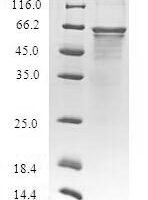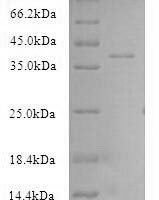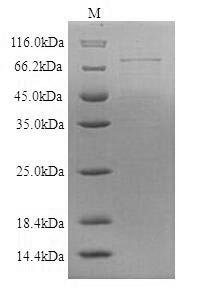
Recombinant Human Desmoglein-1 (DSG1), partial Protein

Recombinant Human Desmoglein-1 (DSG1), partial Protein — A component of desmosome cell-cell junctions which are required for positive regulation of cellular adhesion. Purity >90%.

SKU: BCRECP-00687TM Category:

Product Specifications

Uniprot No.Q02413
Gene NamesDSG1
PurityGreater than 90% as determined by SDS-PAGE.
Expression Systemin vitro E.coli expression system
Expression Region50-548aa
SpeciesHomo sapiens(Human)
Tag InfoN-terminal 10xHis-SUMO-tagged and C-terminal Myc-tagged
Molecular weight75.4kDa
BufferIf the delivery form is liquid, the default storage buffer is Tris/PBS-based buffer, 5%-50% glycerol.If the delivery form is lyophilized powder, the buffer before lyophilization is Tris/PBS-based buffer, 6% Trehalose.
StorageStore at -20°C/-80°C upon receipt, aliquoting is necessary for mutiple use. Avoid repeated freeze-thaw cycles.

Function

A component of desmosome cell-cell junctions which are required for positive regulation of cellular adhesion. Promotes differentiation of keratinocytes via interaction with ERBIN. Reduces activation of RAS/ERK signaling pathways in keratinocytes via promoting ERBIN localization to the cell membrane and its interaction with SHOC2, this competitively reduces the formation of RAS-SHOC2 ERK-activating complexes.

Biological Context

Subcellular Location: Cell membrane (Single-pass type I membrane protein); Cell junction, desmosome; Cytoplasm; Nucleus
Tissue Specificity: Expressed in all suprabasal layers of the epidermis, with the highest expression seen in the granular layer (at protein level). Expressed in the suprabasal esophageal epithelium (at protein level)
Disease Association: Palmoplantar keratoderma 1, striate, focal, or diffuse (PPKS1) : A dermatological disorder characterized by thickening of the skin on the palms and soles, and longitudinal hyperkeratotic lesions on the palms, running the length of each finger. [The disease is caused by variants affecting the gene represented in this entry] | Erythroderma, congenital, with palmoplantar keratoderma, hypotrichosis, and hyper IgE (EPKHE) : A syndrome characterized by severe dermatitis, multiple allergies and metabolic wasting. Clinical features include erythroderma, yellowish papules and plaques arranged at the periphery of the palms, along the fingers and over weight-bearing areas of the feet, skin erosions and scaling, and hypotrichosis. Additionally, patients manifest severe food allergies, elevated immunoglobulin E (IgE) levels and recurrent infections with marked metabolic wasting. [The disease is caused by variants affecting the gene represented in this entry]

Product Specifications

Recombinant Human Desmoglein-1 (DSG1), partial Protein is a recombinant protein from Homo sapiens(Human), expressed in in vitro E.coli expression system, covering amino acids 50-548aa, with N-terminal 10xHis-SUMO-tagged and C-terminal Myc-tagged tag, molecular weight 75.4kDa, purity Greater than 90% as determined by SDS-PAGE.. Suitable for ELISA and Western Blot applications.
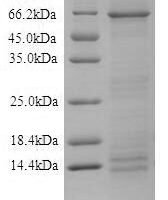
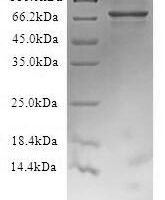
SDS-PAGE: Single band at expected molecular weight confirming purity.

ELISA: Suitable as coating antigen or detection standard.

Western Blot: Compatible with standard Western Blot protocols.

Protein Interaction: Validated for SPR (Surface Plasmon Resonance) and BLI (Bio-Layer Interferometry) studies.

Shipping: Shipped at ambient temperature. Lyophilized protein is stable during transit.

Storage: Store lyophilized protein at -20°C to -80°C. Reconstituted protein should be aliquoted and stored at -80°C. Avoid repeated freeze-thaw cycles.

Shelf Life: 12 months from date of receipt when stored as recommended.

Shipping Time: Orders placed before 2 PM EST ship same day. International orders typically deliver within 5-10 business days.

Protein Biology

Function

A component of desmosome cell-cell junctions which are required for positive regulation of cellular adhesion (PubMed:19717567). Promotes differentiation of keratinocytes via interaction with ERBIN. Reduces activation of RAS/ERK signaling pathways in keratinocytes via promoting ERBIN localization to the cell membrane and its interaction with SHOC2, this competitively reduces the formation of RAS-SHOC2 ERK-activating complexes (PubMed:23524970). Mediates the interaction between the desmosome and COP9 signalosome complex (CSN) protein complex (PubMed:28891468). As a result of this interaction, promotes keratinocyte differentiation via deneddylation of EGFR resulting in a reduction in EGFR protein stabilization and translocation away from the cell membrane (PubMed:28891468). Critical for epidermal integrity and barrier function of the skin (By similarity). Required for esophageal epithelial barrier integrity and correct intercellular spacing in differentiated esophageal epithelium (PubMed:24220297). Required for recovery of epidermal architecture and correct expression of differentiation markers following UVB exposure (PubMed:24594668). May also be required for OCLN involvement in tight junctions (By similarity)

Subcellular Location

Cell membrane (Single-pass type I membrane protein); Cell junction, desmosome; Cytoplasm; Nucleus

Disease Association

Palmoplantar keratoderma 1, striate, focal, or diffuse (PPKS1) : A dermatological disorder characterized by thickening of the skin on the palms and soles, and longitudinal hyperkeratotic lesions on the palms, running the length of each finger. [The disease is caused by variants affecting the gene represented in this entry] | Erythroderma, congenital, with palmoplantar keratoderma, hypotrichosis, and hyper IgE (EPKHE) : A syndrome characterized by severe dermatitis, multiple allergies and metabolic wasting. Clinical features include erythroderma, yellowish papules and plaques arranged at the periphery of the palms, along the fingers and over weight-bearing areas of the feet, skin erosions and scaling, and hypotrichosis. Additionally, patients manifest severe food allergies, elevated immunoglobulin E (IgE) levels and recurrent infections with marked metabolic wasting. [The disease is caused by variants affecting the gene represented in this entry]

Tissue Specificity

Expressed in all suprabasal layers of the epidermis, with the highest expression seen in the granular layer (at protein level). Expressed in the suprabasal esophageal epithelium (at protein level) (PubMed:24220297)

Subunit

(Microbial infection) Interacts with Staphylococcus aureus protein SdrD; this interaction increases S.aureus adherence to keratinocytes

Gene: DSG1  |  Organism: Homo sapiens  |  Synonyms: Cadherin family member 4; Desmosomal glycoprotein 1; Pemphigus foliaceus antigen
Key Publications

Frequently Asked Questions

How do I order or inquire about this product?

Fill out the Online Inquiry form with your required quantity and specifications. You can also email sales@biocrestsci.com. Our team typically responds within 4 business hours with a quote and availability confirmation.

What is the shipping and delivery time?

Orders placed before 2 PM EST ship the same day. Domestic (US) delivery typically takes 2-3 business days. International orders deliver within 5-10 business days. All products are shipped at ambient temperature with appropriate packaging to ensure stability.

How should I store this recombinant protein?

Lyophilized proteins should be stored at -20°C to -80°C upon receipt. After reconstitution, aliquot and store at -80°C. Avoid repeated freeze-thaw cycles. Shelf life is 12 months from date of receipt when stored as recommended.

What quality controls are performed on your products?

Each product undergoes SDS-PAGE purity analysis (typically >85-95%), endotoxin testing, and bioactivity validation. Products are validated for ELISA, Western Blot, and SPR/BLI applications as specified on this product page. A Certificate of Analysis (CoA) is available upon request.

Shopping Cart
Scroll to Top