Recombinant Human DNA-directed RNA polymerase III subunit RPC1 (POLR3A), partial

Recombinant Human DNA-directed RNA polymerase III subunit RPC1 (POLR3A), partial — Catalytic core component of RNA polymerase III (Pol III), a DNA-dependent RNA polymerase which synthesizes small non-coding RNAs using the four ribonucleoside triphosphates as substrates. Purity >90%.

SKU: BCRECP-001418 Category:

Product Specifications

Product SkuBCRECP-001418
Product DescriptionRecombinant Human DNA-directed RNA polymerase III subunit RPC1 (POLR3A) Protein is expressed from E.coli with N-terminal 6xHis-tagged. It contains 392-632aa. [Accession | O14802].
Uniprot No.O14802
Gene NamesPOLR3A
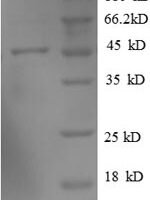
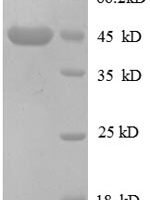
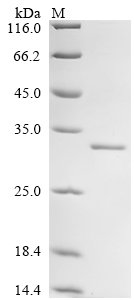
PurityGreater than 90% as determined by SDS-PAGE.
Expression SystemE.coli
Expression Region392-632aa
SpeciesHomo sapiens (Human)
Tag InfoN-terminal 6xHis-tagged
Molecular weight31.4kDa
ActivityPlease contact us to obtain bioactivity data.
BufferIf the delivery form is liquid, the default storage buffer is Tris/PBS-based buffer, 5%-50% glycerol. If the delivery form is lyophilized powder, the buffer before lyophilization is Tris/PBS-based buffer, 6% Trehalose.
StorageStore at -20°C/-80°C upon receipt, aliquoting is necessary for mutiple use. Avoid repeated freeze-thaw cycles.
Research AreasEpigenetics and Nuclear Signaling

Function

Catalytic core component of RNA polymerase III (Pol III), a DNA-dependent RNA polymerase which synthesizes small non-coding RNAs using the four ribonucleoside triphosphates as substrates. Synthesizes 5S rRNA, snRNAs, tRNAs and miRNAs from at least 500 distinct genomic loci. Pol III-mediated transcription cycle proceeds through transcription initiation, transcription elongation and transcription termination stages.

Biological Context

Subcellular Location: Nucleus; Cytoplasm, cytosol
Tissue Specificity: Expressed in the brain, in the cortex and the white matter (at protein level)
Disease Association: Leukodystrophy, hypomyelinating, 7, with or without oligodontia and/or hypogonadotropic hypogonadism (HLD7) : An autosomal recessive neurodegenerative disorder characterized by childhood onset of progressive motor decline manifest as spasticity, ataxia, tremor, and cerebellar signs, as well as mild cognitive regression. Other features may include hypodontia or oligodontia and hypogonadotropic hypogonadism. There is considerable inter- and intrafamilial variability. [The disease is caused by variants affecting the gene represented in this entry] | Wiedemann-Rautenstrauch syndrome (WDRTS) : An autosomal recessive, neonatal progeroid disorder characterized by intrauterine growth retardation, failure to thrive, short stature, hypotonia, variable mental impairment, and a progeroid appearance. Clinical features include apparent macrocephaly, sparse hair, prominent scalp veins, entropion, greatly widened anterior fontanelles, malar hypoplasia, and generalized lipoatrophy. Death usually occurs in early childhood but survival to third decade has been reported. [The disease is caused by variants affecting the gene represented in this entry]

Product Specifications

Recombinant Human DNA-directed RNA polymerase III subunit RPC1 (POLR3A), partial is a recombinant protein from Homo sapiens (Human), expressed in E.coli, covering amino acids 392-632aa, with N-terminal 6xHis-tagged tag, molecular weight 31.4kDa, purity Greater than 90% as determined by SDS-PAGE.. Suitable for ELISA and Western Blot applications.
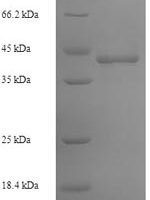
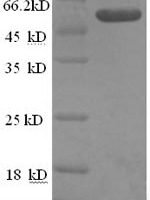
SDS-PAGE: Single band at expected molecular weight confirming purity.

ELISA: Suitable as coating antigen or detection standard.

Western Blot: Compatible with standard Western Blot protocols.

Protein Interaction: Validated for SPR (Surface Plasmon Resonance) and BLI (Bio-Layer Interferometry) studies.

Shipping: Shipped at ambient temperature. Lyophilized protein is stable during transit.

Storage: Store lyophilized protein at -20°C to -80°C. Reconstituted protein should be aliquoted and stored at -80°C. Avoid repeated freeze-thaw cycles.

Shelf Life: 12 months from date of receipt when stored as recommended.

Shipping Time: Orders placed before 2 PM EST ship same day. International orders typically deliver within 5-10 business days.

Protein Biology

Function

Catalytic core component of RNA polymerase III (Pol III), a DNA-dependent RNA polymerase which synthesizes small non-coding RNAs using the four ribonucleoside triphosphates as substrates. Synthesizes 5S rRNA, snRNAs, tRNAs and miRNAs from at least 500 distinct genomic loci (PubMed:19609254, PubMed:19631370, PubMed:20413673, PubMed:33335104, PubMed:33558764, PubMed:33558766, PubMed:34675218, PubMed:35637192, PubMed:9331371). Pol III-mediated transcription cycle proceeds through transcription initiation, transcription elongation and transcription termination stages. During transcription initiation, Pol III is recruited to DNA promoters type I, II or III with the help of general transcription factors and other specific initiation factors. Once the polymerase has escaped from the promoter it enters the elongation phase during which RNA is actively polymerized, based on complementarity with the template DNA strand. Transcription termination involves the release of the RNA transcript and polymerase from the DNA (PubMed:20413673, PubMed:33335104, PubMed:33558764, PubMed:33558766, PubMed:33674783, PubMed:34675218). Forms Pol III active center together with the second largest subunit POLR3B/RPC2. Appends one nucleotide at a time to the 3' end of the nascent RNA, with POLR3A/RPC1 contributing a Mg(2+)-coordinating DxDGD motif, and POLR3B/RPC2 participating in the coordination of a second Mg(2+) ion and providing lysine residues believed to facilitate Watson-Crick base pairing between the incoming nucleotide and template base. Typically, Mg(2+) ions direct a 5' nucleoside triphosphate to form a phosphodiester bond with the 3' hydroxyl of the preceding nucleotide of the nascent RNA, with the elimination of pyrophosphate (PubMed:19609254, PubMed:20413673, PubMed:33335104, PubMed:33558764, PubMed:33674783, PubMed:34675218, PubMed:9331371). Pol III plays a key role in sensing and limiting infection by intracellular bacteria and DNA viruses. Acts as a nuclear and cytosolic DNA sensor involved in innate immune response. Can sense non-self dsDNA that serves as template for transcription into dsRNA. The non-self RNA polymerase III transcripts, such as Epstein-Barr virus-encoded RNAs (EBERs) induce type I interferon and NF-kappa-B through the RIG-I pathway

Subcellular Location

Nucleus; Cytoplasm, cytosol

Disease Association

Leukodystrophy, hypomyelinating, 7, with or without oligodontia and/or hypogonadotropic hypogonadism (HLD7) : An autosomal recessive neurodegenerative disorder characterized by childhood onset of progressive motor decline manifest as spasticity, ataxia, tremor, and cerebellar signs, as well as mild cognitive regression. Other features may include hypodontia or oligodontia and hypogonadotropic hypogonadism. There is considerable inter- and intrafamilial variability. [The disease is caused by variants affecting the gene represented in this entry] | Wiedemann-Rautenstrauch syndrome (WDRTS) : An autosomal recessive, neonatal progeroid disorder characterized by intrauterine growth retardation, failure to thrive, short stature, hypotonia, variable mental impairment, and a progeroid appearance. Clinical features include apparent macrocephaly, sparse hair, prominent scalp veins, entropion, greatly widened anterior fontanelles, malar hypoplasia, and generalized lipoatrophy. Death usually occurs in early childhood but survival to third decade has been reported. [The disease is caused by variants affecting the gene represented in this entry]

Tissue Specificity

Expressed in the brain, in the cortex and the white matter (at protein level)

Subunit

Component of the RNA polymerase III (Pol III) (Pol III) complex consisting of 17 subunits: a ten-subunit catalytic core composed of POLR3A/RPC1, POLR3B/RPC2, POLR1C/RPAC1, POLR1D/RPAC2, POLR3K/RPC10, POLR2E/RPABC1, POLR2F/RPABC2, POLR2H/RPABC3, POLR2K/RPABC4 and POLR2L/RPABC5; a mobile stalk composed of two subunits POLR3H/RPC8 and CRCP/RPC9, protruding from the core and functioning primarily in transcription initiation; and additional subunits homologous to general transcription factors of the RNA polymerase II machinery, POLR3C/RPC3-POLR3F/RPC6-POLR3G/RPC7 heterotrimer required for transcription initiation and POLR3D/RPC4-POLR3E/RPC5 heterodimer involved in both transcription initiation and termination (PubMed:12391170, PubMed:19631370, PubMed:33335104, PubMed:33674783, PubMed:34675218). Pol III exists as two alternative complexes defined by the mutually exclusive incorporation of subunit POLR3G/RPC7alpha or POLR3GL/RPC7beta. The presence of POLR3G/RPC7alpha or POLR3GL/RPC7beta differentially modulates the transcription potential of Pol III, with POLR3G/RPC7alpha specifically associated with transcription of snaR-A non-coding RNAs (PubMed:33558764, PubMed:33558766, PubMed:35637192). As part of the RNA polymerase III complex, interacts with PKP2 (PubMed:11416169)

Gene: POLR3A  |  Organism: Homo sapiens  |  Synonyms: DNA-directed RNA polymerase III largest subunit; DNA-directed RNA polymerase III subunit A; RNA polymerase III 155 kDa subunit; RNA polymerase III subunit C160
Key Publications

Frequently Asked Questions

How do I order or inquire about this product?

Fill out the Online Inquiry form with your required quantity and specifications. You can also email sales@biocrestsci.com. Our team typically responds within 4 business hours with a quote and availability confirmation.

What is the shipping and delivery time?

Orders placed before 2 PM EST ship the same day. Domestic (US) delivery typically takes 2-3 business days. International orders deliver within 5-10 business days. All products are shipped at ambient temperature with appropriate packaging to ensure stability.

How should I store this recombinant protein?

Lyophilized proteins should be stored at -20°C to -80°C upon receipt. After reconstitution, aliquot and store at -80°C. Avoid repeated freeze-thaw cycles. Shelf life is 12 months from date of receipt when stored as recommended.

What quality controls are performed on your products?

Each product undergoes SDS-PAGE purity analysis (typically >85-95%), endotoxin testing, and bioactivity validation. Products are validated for ELISA, Western Blot, and SPR/BLI applications as specified on this product page. A Certificate of Analysis (CoA) is available upon request.

Shopping Cart
Scroll to Top