Function
Component of the MRN complex, which plays a central role in double-strand break (DSB) repair, DNA recombination, maintenance of telomere integrity and meiosis. The MRN complex is involved in the repair of DNA double-strand breaks (DSBs) via homologous recombination (HR), an error-free mechanism which primarily occurs during S and G2 phases. The complex (1) mediates the end resection of damaged DNA, which generates proper single-stranded DNA, a key initial steps in HR, and is (2) required for the recruitment of other repair factors and efficient activation of ATM and ATR upon DNA damage.
Biological Context
Subcellular Location: Nucleus; Chromosome, telomere; Chromosome
Tissue Specificity: Expressed at very low level in most tissues, except in testis where it is expressed at higher level. Expressed in fibroblasts
Disease Association: Nijmegen breakage syndrome-like disorder (NBSLD) : A disorder similar to Nijmegen breakage syndrome and characterized by chromosomal instability, radiation sensitivity, microcephaly, growth retardation, short stature and bird-like face. Immunodeficiency is absent. [The disease is caused by variants affecting the gene represented in this entry]
Product Specifications
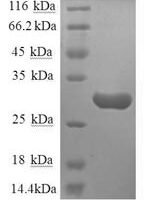
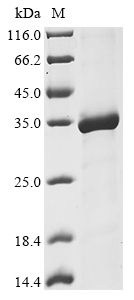
Recombinant Human DNA repair protein RAD50 (RAD50), partial is a recombinant protein from Homo sapiens (Human), expressed in E.coli, covering amino acids 1-235aa, with N-terminal 10xHis-tagged and C-terminal Myc-tagged tag, molecular weight 34.1kDa, purity Greater than 90% as determined by SDS-PAGE.. Suitable for ELISA and Western Blot applications.
![Human Succinate dehydrogenase [ubiquinone] flavoprotein subunit, mitochondrial (SDHA), partial Recombinant Protein, N-GST - BioCrest Sci](https://www.biocrestsci.com/wp-content/uploads/protein/1/BCACP-838381-SDS-150x200.jpg)