, ,

Recombinant Human DnaJ homolog subfamily C member 5 (DNAJC5), Biotinylated

Recombinant Human DnaJ homolog subfamily C member 5 (DNAJC5), Biotinylated — Acts as a general chaperone in regulated exocytosis. Purity >85%.

Product Specifications

Product SkuBCRECP-000522
Product DescriptionRecombinant Human DnaJ homolog subfamily C member 5 (DNAJC5) Protein is expressed from E.coli with N-terminal MBP-tagged and C-terminal 6xHis-Avi-tagged. It contains 1-198aa. [Accession | Q9H3Z4].
Uniprot No.Q9H3Z4
Gene NamesDNAJC5
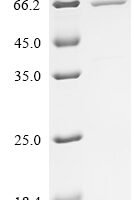
PurityGreater than 85% as determined by SDS-PAGE.
Expression SystemE.coli
Expression Region1-198aa
SpeciesHomo sapiens (Human)
Tag InfoN-terminal MBP-tagged and C-terminal 6xHis-Avi-tagged
Molecular weight69.9kDa
ActivityPlease contact us to obtain bioactivity data.
BufferIf the delivery form is liquid, the default storage buffer is Tris/PBS-based buffer, 5%-50% glycerol. If the delivery form is lyophilized powder, the buffer before lyophilization is Tris/PBS-based buffer, 6% Trehalose.
StorageStore at -20°C/-80°C upon receipt, aliquoting is necessary for mutiple use. Avoid repeated freeze-thaw cycles.
Research AreasNeuroscience

Function

Acts as a general chaperone in regulated exocytosis. Acts as a co-chaperone for the SNARE protein SNAP-25. Involved in the calcium-mediated control of a late stage of exocytosis.

Biological Context

Subcellular Location: Cytoplasm, cytosol; Membrane (Lipid-anchor); Cytoplasmic vesicle, secretory vesicle, chromaffin granule membrane; Melanosome; Cell membrane
Tissue Specificity: Expressed in pancreas, kidney, skeletal muscle, liver, lung, placenta, brain and heart
Disease Association: Ceroid lipofuscinosis, neuronal, 4B (Kufs type), autosomal dominant (CLN4B) : An adult-onset neuronal ceroid lipofuscinosis. Neuronal ceroid lipofuscinoses are progressive neurodegenerative, lysosomal storage diseases characterized by intracellular accumulation of autofluorescent liposomal material, and clinically by seizures, dementia, visual loss, and/or cerebral atrophy. CLN4B has no visual involvement and is characterized by seizures and other neurologic symptoms. [The disease is caused by variants affecting the gene represented in this entry]

Product Specifications

Recombinant Human DnaJ homolog subfamily C member 5 (DNAJC5), Biotinylated is a recombinant protein from Homo sapiens (Human), expressed in E.coli, covering amino acids 1-198aa, with N-terminal MBP-tagged and C-terminal 6xHis-Avi-tagged tag, molecular weight 69.9kDa, purity Greater than 85% as determined by SDS-PAGE.. Suitable for ELISA and Western Blot applications.

Recommended applications depend on the target, product format, and product-specific validation data. Refer to the product datasheet or Certificate of Analysis (CoA), or contact BioCrest Sci for application guidance.

Biological Activity: Please contact us to obtain bioactivity data.

Storage: Store at -20°C/-80°C upon receipt, aliquoting is necessary for mutiple use. Avoid repeated freeze-thaw cycles.

Shipping & Lead Time: Availability, shipping conditions, and estimated lead time are confirmed in the formal quotation or order confirmation based on the product format, destination, and order requirements.

Protein Biology

Function

Acts as a general chaperone in regulated exocytosis (By similarity). Acts as a co-chaperone for the SNARE protein SNAP-25 (By similarity). Involved in the calcium-mediated control of a late stage of exocytosis (By similarity). May have an important role in presynaptic function. May be involved in calcium-dependent neurotransmitter release at nerve endings (By similarity)

Subcellular Location

Cytoplasm, cytosol; Membrane (Lipid-anchor); Cytoplasmic vesicle, secretory vesicle, chromaffin granule membrane; Melanosome; Cell membrane

Disease Association

Ceroid lipofuscinosis, neuronal, 4B (Kufs type), autosomal dominant (CLN4B) : An adult-onset neuronal ceroid lipofuscinosis. Neuronal ceroid lipofuscinoses are progressive neurodegenerative, lysosomal storage diseases characterized by intracellular accumulation of autofluorescent liposomal material, and clinically by seizures, dementia, visual loss, and/or cerebral atrophy. CLN4B has no visual involvement and is characterized by seizures and other neurologic symptoms. [The disease is caused by variants affecting the gene represented in this entry]

Tissue Specificity

Expressed in pancreas, kidney, skeletal muscle, liver, lung, placenta, brain and heart

Subunit

Oligomers (PubMed:27452402). Homodimer (By similarity). Interacts with the chaperone complex consisting of HSC70 and SGTA (By similarity). Interacts with ZDHHC13 (via ANK repeats) (By similarity). Interacts with ZDHHC17 (via ANK repeats) (PubMed:28882895). Interacts with SYT1, SYT5 and SYT7, and with SYT9, forming a complex with SNAP25 (By similarity)

Gene: DNAJC5  |  Organism: Homo sapiens  |  Synonyms: Ceroid-lipofuscinosis neuronal protein 4; Cysteine string protein
Key Publications

Frequently Asked Questions

How do I order or inquire about this product?

Submit the Online Inquiry form with your required quantity and specifications, or email sales@biocrestsci.com. Available sizes, pricing, stock status, documentation, and estimated lead time are confirmed in the formal quotation.

What is the shipping and delivery time?

Availability, dispatch timing, shipping conditions, and delivery estimates depend on the product format, destination, and order requirements. These details are confirmed in the formal quotation or order confirmation.

How should this product be stored?

Follow the storage and handling instructions in the product-specific datasheet and Certificate of Analysis (CoA). Requirements may vary by product form and formulation; contact BioCrest Sci if product-specific guidance is needed.

What quality controls are performed on your products?

Quality-control data such as identity, purity, endotoxin level, or biological activity are provided only when specified on this product page, the datasheet, or Certificate of Analysis (CoA). Biological activity is not implied unless explicitly stated.

Shopping Cart
Scroll to Top