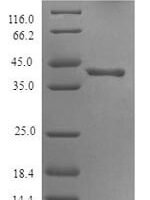
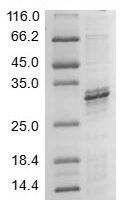
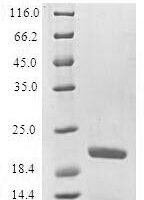
,

Recombinant Human E3 ubiquitin-protein ligase COP1 (COP1) Protein

Recombinant Human E3 ubiquitin-protein ligase COP1 (COP1) Protein — E3 ubiquitin-protein ligase that mediates ubiquitination and subsequent proteasomal degradation of target proteins. Purity >90%.

SKU: BCRECP-00666TM Categories: ,

Product Specifications

Uniprot No.Q8NHY2
Gene NamesRFWD2
PurityGreater than 90% as determined by SDS-PAGE.
Expression Systemin vitro E.coli expression system
Expression Region1-731aa
SpeciesHomo sapiens(Human)
Tag InfoN-terminal 6xHis-tagged
Molecular weight84.5kDa
BufferIf the delivery form is liquid, the default storage buffer is Tris/PBS-based buffer, 5%-50% glycerol.If the delivery form is lyophilized powder, the buffer before lyophilization is Tris/PBS-based buffer, 6% Trehalose.
StorageStore at -20°C/-80°C upon receipt, aliquoting is necessary for mutiple use. Avoid repeated freeze-thaw cycles.

Function

E3 ubiquitin-protein ligase that mediates ubiquitination and subsequent proteasomal degradation of target proteins. E3 ubiquitin ligases accept ubiquitin from an E2 ubiquitin-conjugating enzyme in the form of a thioester and then directly transfers the ubiquitin to targeted substrates. Involved in JUN ubiquitination and degradation.

Biological Context

Subcellular Location: Nucleus speckle; Cytoplasm
Tissue Specificity: Ubiquitously expressed at low level. Expressed at higher level in testis, placenta, skeletal muscle and heart
Pathway: Protein modification; protein ubiquitination

Product Specifications

Recombinant Human E3 ubiquitin-protein ligase COP1 (COP1) Protein is a recombinant protein from Homo sapiens(Human), expressed in in vitro E.coli expression system, covering amino acids 1-731aa, with N-terminal 6xHis-tagged tag, molecular weight 84.5kDa, purity Greater than 90% as determined by SDS-PAGE.. Suitable for ELISA and Western Blot applications.

Recommended applications depend on the target, product format, and product-specific validation data. Refer to the product datasheet or Certificate of Analysis (CoA), or contact BioCrest Sci for application guidance.

Biological Activity: Not implied unless activity data are explicitly listed on this product page, the datasheet, or the CoA.

Storage: Store at -20°C/-80°C upon receipt, aliquoting is necessary for mutiple use. Avoid repeated freeze-thaw cycles.

Shipping & Lead Time: Availability, shipping conditions, and estimated lead time are confirmed in the formal quotation or order confirmation based on the product format, destination, and order requirements.

Protein Biology

Function

E3 ubiquitin-protein ligase that mediates ubiquitination and subsequent proteasomal degradation of target proteins. E3 ubiquitin ligases accept ubiquitin from an E2 ubiquitin-conjugating enzyme in the form of a thioester and then directly transfers the ubiquitin to targeted substrates. Involved in JUN ubiquitination and degradation. Directly involved in p53 (TP53) ubiquitination and degradation, thereby abolishing p53-dependent transcription and apoptosis. Ubiquitinates p53 independently of MDM2 or RCHY1. Probably mediates E3 ubiquitin ligase activity by functioning as the essential RING domain subunit of larger E3 complexes. In contrast, it does not constitute the catalytic RING subunit in the DCX DET1-COP1 complex that negatively regulates JUN, the ubiquitin ligase activity being mediated by RBX1. Involved in 14-3-3 protein sigma/SFN ubiquitination and proteasomal degradation, leading to AKT activation and promotion of cell survival. Ubiquitinates MTA1 leading to its proteasomal degradation. Upon binding to TRIB1, ubiquitinates CEBPA, which lacks a canonical COP1-binding motif (Probable)

Subcellular Location

Nucleus speckle; Cytoplasm

Tissue Specificity

Ubiquitously expressed at low level. Expressed at higher level in testis, placenta, skeletal muscle and heart

Subunit

Homodimer. Homodimerization is mediated by the coiled coil domain. Component of the DCX DET1-COP1 ubiquitin ligase complex at least composed of RBX1, DET1, DDB1, CUL4A and COP1. Isoform 2 does not interact with CUL4A but still binds to RBX1, suggesting that the interaction may be mediated by another cullin protein. Isoform 1 and isoform 2 interact with CUL5 but not with CUL1, CUL2 not CUL3. Interacts with bZIP transcription factors JUN, JUNB and JUND but not with FOS, ATF2 nor XBP1. Interacts with p53 (TP53). Interacts with COPS6; this interaction stabilizes RFWD2 through reducing its auto-ubiquitination and decelerating its turnover rate. Interacts with SFN; this interaction leads to SFN degradation. Isoform 4 forms heterodimers with isoform 1, preventing its association with DET1. Interacts with p53/TP53 and MTA1. Interacts with TRIB1 (via C-terminus) and TRIB2 (PubMed:20410507, PubMed:27041596)

Pathway

Protein modification; protein ubiquitination

Gene: COP1  |  Organism: Homo sapiens  |  Synonyms: Constitutive photomorphogenesis protein 1 homolog; RING finger and WD repeat domain protein 2; RING finger protein 200; RING-type E3 ubiquitin transferase RFWD2
Key Publications

Frequently Asked Questions

How do I order or inquire about this product?

Submit the Online Inquiry form with your required quantity and specifications, or email sales@biocrestsci.com. Available sizes, pricing, stock status, documentation, and estimated lead time are confirmed in the formal quotation.

What is the shipping and delivery time?

Availability, dispatch timing, shipping conditions, and delivery estimates depend on the product format, destination, and order requirements. These details are confirmed in the formal quotation or order confirmation.

How should this product be stored?

Follow the storage and handling instructions in the product-specific datasheet and Certificate of Analysis (CoA). Requirements may vary by product form and formulation; contact BioCrest Sci if product-specific guidance is needed.

What quality controls are performed on your products?

Quality-control data such as identity, purity, endotoxin level, or biological activity are provided only when specified on this product page, the datasheet, or Certificate of Analysis (CoA). Biological activity is not implied unless explicitly stated.

Shopping Cart
Scroll to Top