,

Recombinant Human E3 ubiquitin-protein ligase MYCBP2 (MYCBP2), partial

Recombinant Human E3 ubiquitin-protein ligase MYCBP2 (MYCBP2), partial — Atypical E3 ubiquitin-protein ligase which specifically mediates ubiquitination of threonine and serine residues on target proteins, instead of ubiquitinating lysine residues. Purity >90%.

SKU: BCRECP-001203 Categories: ,

Product Specifications

Product SkuBCRECP-001203
Product DescriptionRecombinant Human E3 ubiquitin-protein ligase MYCBP2 (MYCBP2) Protein is expressed from E.coli with C-terminal 6xHis-tagged. It contains 4417-4676aa. [Accession | O75592].
Uniprot No.O75592
Gene NamesMYCBP2
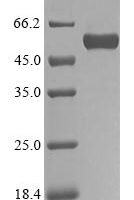
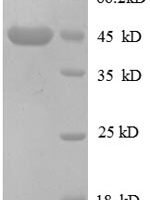
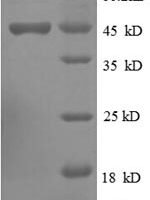
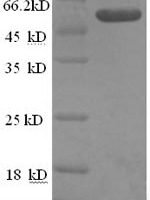
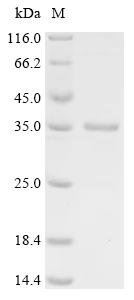
PurityGreater than 90% as determined by SDS-PAGE.
Expression SystemE.coli
Expression Region4417-4676aa
SpeciesHomo sapiens (Human)
Tag InfoC-terminal 6xHis-tagged
Molecular weight36.3kDa
ActivityPlease contact us to obtain bioactivity data.
BufferIf the delivery form is liquid, the default storage buffer is Tris/PBS-based buffer, 5%-50% glycerol. If the delivery form is lyophilized powder, the buffer before lyophilization is Tris/PBS-based buffer, 6% Trehalose.
StorageStore at -20°C/-80°C upon receipt, aliquoting is necessary for mutiple use. Avoid repeated freeze-thaw cycles.
Research AreasCell Biology

Function

Atypical E3 ubiquitin-protein ligase which specifically mediates ubiquitination of threonine and serine residues on target proteins, instead of ubiquitinating lysine residues. Shows esterification activity towards both threonine and serine, with a preference for threonine, and acts via two essential catalytic cysteine residues that relay ubiquitin to its substrate via thioester intermediates. Interacts with the E2 enzymes UBE2D1, UBE2D3, UBE2E1 and UBE2L3.

Biological Context

Subcellular Location: Nucleus; Cell projection, axon; Cytoplasm, cytoskeleton
Tissue Specificity: Expressed in all tissues examined, expression is exceptionally abundant in brain and thymus. Colocalizes with TSC1 and TSC2 along the neurites and in the growth cones. Highly expressed in peripheral and central neurons. Colocalized with TSC1 in one of the filopodial extensions at the tip of a growth cone
Pathway: Protein modification; protein ubiquitination

Product Specifications

Recombinant Human E3 ubiquitin-protein ligase MYCBP2 (MYCBP2), partial is a recombinant protein from Homo sapiens (Human), expressed in E.coli, covering amino acids 4417-4676aa, with C-terminal 6xHis-tagged tag, molecular weight 36.3kDa, purity Greater than 90% as determined by SDS-PAGE.. Suitable for ELISA and Western Blot applications.

SDS-PAGE: Single band at expected molecular weight confirming purity.

ELISA: Suitable as coating antigen or detection standard.

Western Blot: Compatible with standard Western Blot protocols.

Protein Interaction: Validated for SPR (Surface Plasmon Resonance) and BLI (Bio-Layer Interferometry) studies.

Shipping: Shipped at ambient temperature. Lyophilized protein is stable during transit.

Storage: Store lyophilized protein at -20°C to -80°C. Reconstituted protein should be aliquoted and stored at -80°C. Avoid repeated freeze-thaw cycles.

Shelf Life: 12 months from date of receipt when stored as recommended.

Shipping Time: Orders placed before 2 PM EST ship same day. International orders typically deliver within 5-10 business days.

Protein Biology

Function

Atypical E3 ubiquitin-protein ligase which specifically mediates ubiquitination of threonine and serine residues on target proteins, instead of ubiquitinating lysine residues (PubMed:29643511). Shows esterification activity towards both threonine and serine, with a preference for threonine, and acts via two essential catalytic cysteine residues that relay ubiquitin to its substrate via thioester intermediates (PubMed:29643511). Interacts with the E2 enzymes UBE2D1, UBE2D3, UBE2E1 and UBE2L3 (PubMed:18308511, PubMed:29643511). Plays a key role in neural development, probably by mediating ubiquitination of threonine residues on target proteins (Probable). Involved in different processes such as regulation of neurite outgrowth, synaptic growth, synaptogenesis and axon degeneration (By similarity). Required for the formation of major central nervous system axon tracts (By similarity). Required for proper axon growth by regulating axon navigation and axon branching: acts by regulating the subcellular location and stability of MAP3K12/DLK (By similarity). Required for proper localization of retinogeniculate projections but not for eye-specific segregation (By similarity). Regulates axon guidance in the olfactory system (By similarity). Involved in Wallerian axon degeneration, an evolutionarily conserved process that drives the loss of damaged axons: acts by promoting destabilization of NMNAT2, probably via ubiquitination of NMNAT2 (By similarity). Catalyzes ubiquitination of threonine and/or serine residues on NMNAT2, consequences of threonine and/or serine ubiquitination are however unknown (PubMed:29643511). Regulates the internalization of TRPV1 in peripheral sensory neurons (By similarity). Mediates ubiquitination and subsequent proteasomal degradation of TSC2/tuberin (PubMed:18308511, PubMed:27278822). Independently of the E3 ubiquitin-protein ligase activity, also acts as a guanosine exchange factor (GEF) for RAN in neurons of dorsal root ganglia (PubMed:26304119). May function as a facilitator or regulator of transcriptional activation by MYC (PubMed:9689053). Acts in concert with HUWE1 to regulate the circadian clock gene expression by promoting the lithium-induced ubiquitination and degradation of NR1D1 (PubMed:20534529)

Subcellular Location

Nucleus; Cell projection, axon; Cytoplasm, cytoskeleton

Tissue Specificity

Expressed in all tissues examined, expression is exceptionally abundant in brain and thymus. Colocalizes with TSC1 and TSC2 along the neurites and in the growth cones. Highly expressed in peripheral and central neurons. Colocalized with TSC1 in one of the filopodial extensions at the tip of a growth cone

Subunit

Interacts with MYC (PubMed:9689053). Interacts with TSC2 (tuberin) when TSC2 is in complex with TSC1 (hamartin) (PubMed:14559897). Interacts with FBXO45 (PubMed:19398581). Interacts with RAE1 (PubMed:22357847). Interacts with CPNE1 (via VWFA domain) and CPNE4 (via VWFA domain) (By similarity). Interacts with (sumoylated) RANGAP1; interaction with sumoylated RANGAP1 inhibits E3 ubiquitin-protein ligase activity and promotes MYCBP2 translocation to the nucleus (PubMed:26304119). Interacts with RAN (PubMed:26304119). Interacts with ATP13A2; the interaction inhibits the ubiquitination of TSC2 by MYCBP2 (PubMed:27278822). Interacts with USP11 (PubMed:29293652)

Pathway

Protein modification; protein ubiquitination

Gene: MYCBP2  |  Organism: Homo sapiens  |  Synonyms: Myc-binding protein 2; Protein associated with Myc
Key Publications

Frequently Asked Questions

How do I order or inquire about this product?

Fill out the Online Inquiry form with your required quantity and specifications. You can also email sales@biocrestsci.com. Our team typically responds within 4 business hours with a quote and availability confirmation.

What is the shipping and delivery time?

Orders placed before 2 PM EST ship the same day. Domestic (US) delivery typically takes 2-3 business days. International orders deliver within 5-10 business days. All products are shipped at ambient temperature with appropriate packaging to ensure stability.

How should I store this recombinant protein?

Lyophilized proteins should be stored at -20°C to -80°C upon receipt. After reconstitution, aliquot and store at -80°C. Avoid repeated freeze-thaw cycles. Shelf life is 12 months from date of receipt when stored as recommended.

What quality controls are performed on your products?

Each product undergoes SDS-PAGE purity analysis (typically >85-95%), endotoxin testing, and bioactivity validation. Products are validated for ELISA, Western Blot, and SPR/BLI applications as specified on this product page. A Certificate of Analysis (CoA) is available upon request.

Shopping Cart
Scroll to Top