Recombinant Human Ephrin type-A receptor 3 (EPHA3), partial (Active)

Recombinant Human Ephrin type-A receptor 3 (EPHA3), partial (Active) — Receptor tyrosine kinase which binds promiscuously membrane-bound ephrin family ligands residing on adjacent cells, leading to contact-dependent bidirectional signaling into neighboring cells. Purity >95%.

SKU: BCACP-000053 Category:
Product SKUBCACP-000053
Product DescriptionRecombinant Human Ephrin type-A receptor 3 (EPHA3) protein is expressed from Mammalian cell with C-terminal 6xHis-tagged. It contains 21-541aa. [Accession | P29320].
Uniprot No.P29320
Gene NamesEPHA3
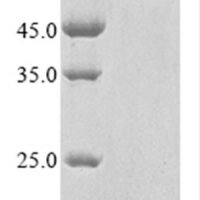
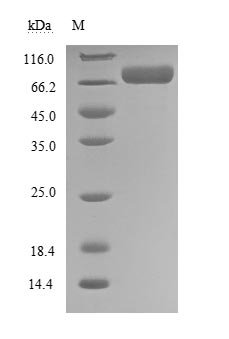
PurityGreater than 95% as determined by SDS-PAGE.Greater than 95% as determined by SEC-HPLC.
Expression SystemMammalian cell
Expression Region21-541aa
SpeciesHomo sapiens (Human)
Tag InfoC-terminal 6xHis-tagged
Molecular weight61.0 kDa
ActivityMeasured by its binding ability in a functional ELISA. Immobilized KLRK1 at 10 μg/ml can bind human ULBP1 , the EC50 of human KLRK1 protein is 222.4-276.0 ng/ml.;Human KLRK1 protein Fc tag captured on COOH chip can bind Human ULBP1 protein Fc/myc tag with an affinity constant of 2.27 nM as detected by LSPR Assay.;Measured by its binding ability in a functional ELISA. Immobilized KLRK1 at 10 μg/ml can bind human Biotinylated ULBP1, the EC50 is 4.254-7.295 ng/ml.
BufferLyophilized from a 0.2 μm filtered 20 mM Tris-HCl, 0.5 M NaCl, 6% Trehalose, pH 8.0
StorageStore at -20°C/-80°C upon receipt, aliquoting is necessary for mutiple use. Avoid repeated freeze-thaw cycles.
Alternative NamesAW492086; Cek4; EC 2.7.10.1; EK4; End3; Eph receptor A3; EPH-like kinase 4; EPH-like tyrosine kinase 1; EPHA3; EPHA3_HUMAN; Ephrin receptor EphA3; Ephrin type-A receptor 3; ETK 1; ETK; ETK1; HEK 4; HEK; HEK4; Human embryo kinase 1; Human embryo kinase; Mek4; MGC109882; Receptor tyrosine kinase HEK; Testicular tissue protein Li 64; Tyro 4; Tyro4; TYRO4 protein tyrosine kinase; Tyrosine protein kinase receptor ETK 1; Tyrosine-protein kinase receptor ETK1; Tyrosine-protein kinase TYRO4

Function

Receptor tyrosine kinase which binds promiscuously membrane-bound ephrin family ligands residing on adjacent cells, leading to contact-dependent bidirectional signaling into neighboring cells. The signaling pathway downstream of the receptor is referred to as forward signaling while the signaling pathway downstream of the ephrin ligand is referred to as reverse signaling. Highly promiscuous for ephrin-A ligands it binds preferentially EFNA5.

Biological Context

Subcellular Location: Secreted
Tissue Specificity: Widely expressed. Highest level in placenta
Disease Association: Colorectal cancer (CRC) : A complex disease characterized by malignant lesions arising from the inner wall of the large intestine (the colon) and the rectum. Genetic alterations are often associated with progression from premalignant lesion (adenoma) to invasive adenocarcinoma. Risk factors for cancer of the colon and rectum include colon polyps, long-standing ulcerative colitis, and genetic family history. [The gene represented in this entry may be involved in disease pathogenesis]

Product Specifications

Recombinant Human Ephrin type-A receptor 3 (EPHA3), partial (Active) is a recombinant protein from Homo sapiens (Human), expressed in Mammalian cell, covering amino acids 21-541aa, with C-terminal 6xHis-tagged tag, molecular weight 61.0 kDa, purity Greater than 95% as determined by SDS-PAGE.Greater than 95% as determined by SEC-HPLC.. Suitable for ELISA and Western Blot applications.
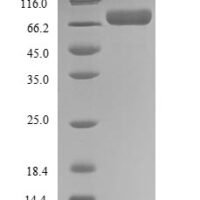
SDS-PAGE: Single band at expected molecular weight confirming purity.

ELISA: Suitable as coating antigen or detection standard.

Western Blot: Compatible with standard Western Blot protocols.

Protein Interaction: Validated for SPR (Surface Plasmon Resonance) and BLI (Bio-Layer Interferometry) studies.

Shipping: Shipped at ambient temperature. Lyophilized protein is stable during transit.

Storage: Store lyophilized protein at -20°C to -80°C. Reconstituted protein should be aliquoted and stored at -80°C. Avoid repeated freeze-thaw cycles.

Shelf Life: 12 months from date of receipt when stored as recommended.

Shipping Time: Orders placed before 2 PM EST ship same day. International orders typically deliver within 5-10 business days.

Protein Biology

Function

Receptor tyrosine kinase which binds promiscuously membrane-bound ephrin family ligands residing on adjacent cells, leading to contact-dependent bidirectional signaling into neighboring cells. The signaling pathway downstream of the receptor is referred to as forward signaling while the signaling pathway downstream of the ephrin ligand is referred to as reverse signaling (PubMed:11870224, PubMed:12794130). Highly promiscuous for ephrin-A ligands it binds preferentially EFNA5 (By similarity). Upon activation by EFNA5 regulates cell-cell adhesion, cytoskeletal organization and cell migration (PubMed:11870224). Also activated by EFNA1, inhibiting epithelial-to-mesenchymal transition of cardiac cells and playing a role in heart development (PubMed:12794130). Involved in the retinotectal mapping of neurons. May also control the segregation but not the guidance of motor and sensory axons during neuromuscular circuit development (By similarity)

Subcellular Location

Secreted

Disease Association

Colorectal cancer (CRC) : A complex disease characterized by malignant lesions arising from the inner wall of the large intestine (the colon) and the rectum. Genetic alterations are often associated with progression from premalignant lesion (adenoma) to invasive adenocarcinoma. Risk factors for cancer of the colon and rectum include colon polyps, long-standing ulcerative colitis, and genetic family history. [The gene represented in this entry may be involved in disease pathogenesis]

Tissue Specificity

Widely expressed. Highest level in placenta

Subunit

Heterotetramer upon binding of the ligand. The heterotetramer is composed of an ephrin dimer and a receptor dimer. Oligomerization is probably required to induce biological responses. Forms a ternary EFNA5-EPHA3-ADAM10 complex mediating EFNA5 extracellular domain shedding by ADAM10 which regulates the EFNA5-EPHA3 complex internalization and function. Interacts with NCK1 (via SH2 domain); mediates EFNA5-EPHA3 signaling (By similarity). Interacts (phosphorylated) with PTPN1; dephosphorylates EPHA3 and may regulate its trafficking and function. Interacts (phosphorylated) with CRK; mediates EFNA5-EPHA3 signaling through RHOA GTPase activation

Gene: EPHA3  |  Organism: Homo sapiens  |  Synonyms: EPH-like kinase 4; HEK; Tyrosine-protein kinase TYRO4; Tyrosine-protein kinase receptor ETK1
Key Publications

Frequently Asked Questions

How do I order or inquire about this product?

Fill out the Online Inquiry form with your required quantity and specifications. You can also email sales@biocrestsci.com. Our team typically responds within 4 business hours with a quote and availability confirmation.

What is the shipping and delivery time?

Orders placed before 2 PM EST ship the same day. Domestic (US) delivery typically takes 2-3 business days. International orders deliver within 5-10 business days. All products are shipped at ambient temperature with appropriate packaging to ensure stability.

How should I store this recombinant protein?

Lyophilized proteins should be stored at -20°C to -80°C upon receipt. After reconstitution, aliquot and store at -80°C. Avoid repeated freeze-thaw cycles. Shelf life is 12 months from date of receipt when stored as recommended.

What quality controls are performed on your products?

Each product undergoes SDS-PAGE purity analysis (typically >85-95%), endotoxin testing, and bioactivity validation. Products are validated for ELISA, Western Blot, and SPR/BLI applications as specified on this product page. A Certificate of Analysis (CoA) is available upon request.

Shopping Cart
Scroll to Top