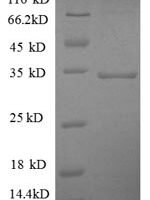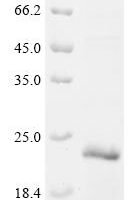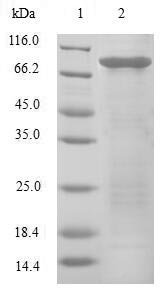
Recombinant Human Eukaryotic translation initiation factor 3 subunit E (EIF3E)

Recombinant Human Eukaryotic translation initiation factor 3 subunit E (EIF3E) — Component of the eukaryotic translation initiation factor 3 (eIF-3) complex, which is required for several steps in the initiation of protein synthesis. Purity >90%.

SKU: BCRECP-000574 Category:

Product Specifications

Product SkuBCRECP-000574
Product DescriptionRecombinant Human Eukaryotic translation initiation factor 3 subunit E (EIF3E) Protein is expressed from E.coli with N-terminal GST-tagged. It contains 1-445aa. [Accession | P60228].
Uniprot No.P60228
Gene NamesEIF3E
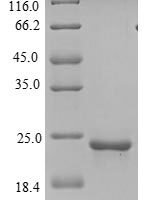
PurityGreater than 90% as determined by SDS-PAGE.
Expression SystemE.coli
Expression Region1-445aa
SpeciesHomo sapiens (Human)
Tag InfoN-terminal GST-tagged
Molecular weight79.1kDa
ActivityPlease contact us to obtain bioactivity data.
BufferIf the delivery form is liquid, the default storage buffer is Tris/PBS-based buffer, 5%-50% glycerol. If the delivery form is lyophilized powder, the buffer before lyophilization is Tris/PBS-based buffer, 6% Trehalose.
StorageStore at -20°C/-80°C upon receipt, aliquoting is necessary for mutiple use. Avoid repeated freeze-thaw cycles.
Research AreasEpigenetics and Nuclear Signaling

Function

Component of the eukaryotic translation initiation factor 3 (eIF-3) complex, which is required for several steps in the initiation of protein synthesis. The eIF-3 complex associates with the 40S ribosome and facilitates the recruitment of eIF-1, eIF-1A, eIF-2:GTP:methionyl-tRNAi and eIF-5 to form the 43S pre-initiation complex (43S PIC). The eIF-3 complex stimulates mRNA recruitment to the 43S PIC and scanning of the mRNA for AUG recognition.

Biological Context

Subcellular Location: Cytoplasm; Nucleus, PML body
Tissue Specificity: Ubiquitously expressed. Expressed at highest levels in appendix, lymph, pancreas, skeletal muscle, spleen and thymus

Product Specifications

Recombinant Human Eukaryotic translation initiation factor 3 subunit E (EIF3E) is a recombinant protein from Homo sapiens (Human), expressed in E.coli, covering amino acids 1-445aa, with N-terminal GST-tagged tag, molecular weight 79.1kDa, purity Greater than 90% as determined by SDS-PAGE.. Suitable for ELISA and Western Blot applications.

Recommended applications depend on the target, product format, and product-specific validation data. Refer to the product datasheet or Certificate of Analysis (CoA), or contact BioCrest Sci for application guidance.

Biological Activity: Please contact us to obtain bioactivity data.

Storage: Store at -20°C/-80°C upon receipt, aliquoting is necessary for mutiple use. Avoid repeated freeze-thaw cycles.

Shipping & Lead Time: Availability, shipping conditions, and estimated lead time are confirmed in the formal quotation or order confirmation based on the product format, destination, and order requirements.

Protein Biology

Function

Component of the eukaryotic translation initiation factor 3 (eIF-3) complex, which is required for several steps in the initiation of protein synthesis (PubMed:17581632, PubMed:25849773, PubMed:27462815). The eIF-3 complex associates with the 40S ribosome and facilitates the recruitment of eIF-1, eIF-1A, eIF-2:GTP:methionyl-tRNAi and eIF-5 to form the 43S pre-initiation complex (43S PIC). The eIF-3 complex stimulates mRNA recruitment to the 43S PIC and scanning of the mRNA for AUG recognition. The eIF-3 complex is also required for disassembly and recycling of post-termination ribosomal complexes and subsequently prevents premature joining of the 40S and 60S ribosomal subunits prior to initiation (PubMed:17581632). The eIF-3 complex specifically targets and initiates translation of a subset of mRNAs involved in cell proliferation, including cell cycling, differentiation and apoptosis, and uses different modes of RNA stem-loop binding to exert either translational activation or repression (PubMed:25849773). Required for nonsense-mediated mRNA decay (NMD); may act in conjunction with UPF2 to divert mRNAs from translation to the NMD pathway (PubMed:17468741). May interact with MCM7 and EPAS1 and regulate the proteasome-mediated degradation of these proteins (PubMed:17310990, PubMed:17324924)

Subcellular Location

Cytoplasm; Nucleus, PML body

Tissue Specificity

Ubiquitously expressed. Expressed at highest levels in appendix, lymph, pancreas, skeletal muscle, spleen and thymus

Subunit

Component of the eukaryotic translation initiation factor 3 (eIF-3) complex, which is composed of 13 subunits: EIF3A, EIF3B, EIF3C, EIF3D, EIF3E, EIF3F, EIF3G, EIF3H, EIF3I, EIF3J, EIF3K, EIF3L and EIF3M. The eIF-3 complex appears to include 3 stable modules: module A is composed of EIF3A, EIF3B, EIF3G and EIF3I; module B is composed of EIF3F, EIF3H, and EIF3M; and module C is composed of EIF3C, EIF3D, EIF3E, EIF3K and EIF3L. EIF3C of module C binds EIF3B of module A and EIF3H of module B, thereby linking the three modules. EIF3J is a labile subunit that binds to the eIF-3 complex via EIF3B. The eIF-3 complex interacts with RPS6KB1 under conditions of nutrient depletion. Mitogenic stimulation leads to binding and activation of a complex composed of MTOR and RPTOR, leading to phosphorylation and release of RPS6KB1 and binding of EIF4B to eIF-3. Interacts with COPS3, COPS6, COPS7 (COPS7A or COPS7B), EIF4G1, EPAS1, MCM7, NCBP1, PSMC6, TRIM27 and UPF2. Interacts with the HTLV-1 protein Tax-1. Interacts with IFIT1 and IFIT2 (PubMed:16023166, PubMed:16973618). Interacts with BZW2/5MP1 (PubMed:21745818)

Gene: EIF3E  |  Organism: Homo sapiens  |  Synonyms: Eukaryotic translation initiation factor 3 subunit 6; Viral integration site protein INT-6 homolog; eIF-3 p48
Key Publications

Frequently Asked Questions

How do I order or inquire about this product?

Submit the Online Inquiry form with your required quantity and specifications, or email sales@biocrestsci.com. Available sizes, pricing, stock status, documentation, and estimated lead time are confirmed in the formal quotation.

What is the shipping and delivery time?

Availability, dispatch timing, shipping conditions, and delivery estimates depend on the product format, destination, and order requirements. These details are confirmed in the formal quotation or order confirmation.

How should this product be stored?

Follow the storage and handling instructions in the product-specific datasheet and Certificate of Analysis (CoA). Requirements may vary by product form and formulation; contact BioCrest Sci if product-specific guidance is needed.

What quality controls are performed on your products?

Quality-control data such as identity, purity, endotoxin level, or biological activity are provided only when specified on this product page, the datasheet, or Certificate of Analysis (CoA). Biological activity is not implied unless explicitly stated.

Shopping Cart
Scroll to Top