Recombinant Human Fibrillin-1 (FBN1), partial

Recombinant Human Fibrillin-1 (FBN1), partial — Adipokine secreted by white adipose tissue that plays an important regulatory role in the glucose metabolism of liver, muscle and pancreas. Purity >90%.

SKU: BCRECP-000637 Category:

Product Specifications

Product SkuBCRECP-000637
Product DescriptionRecombinant Human Fibrillin-1 (FBN1) Protein is expressed from E.coli with N-terminal 10xHis-GST-tagged and C-terminal Myc-tagged. It contains 783-850aa. [Accession | P35555].
Uniprot No.P35555
Gene NamesFBN1
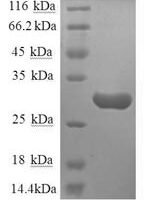
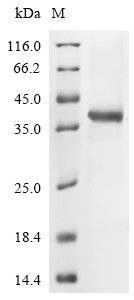
PurityGreater than 90% as determined by SDS-PAGE.
Expression SystemE.coli
Expression Region783-850aa
SpeciesHomo sapiens (Human)
Tag InfoN-terminal 10xHis-GST-tagged and C-terminal Myc-tagged
Molecular weight42.5kDa
ActivityPlease contact us to obtain bioactivity data.
BufferIf the delivery form is liquid, the default storage buffer is Tris/PBS-based buffer, 5%-50% glycerol. If the delivery form is lyophilized powder, the buffer before lyophilization is Tris/PBS-based buffer, 6% Trehalose.
StorageStore at -20°C/-80°C upon receipt, aliquoting is necessary for mutiple use. Avoid repeated freeze-thaw cycles.
Research AreasSignal Transduction

Function

Adipokine secreted by white adipose tissue that plays an important regulatory role in the glucose metabolism of liver, muscle and pancreas. Hormone that targets the liver in response to fasting to increase plasma glucose levels. Binds the olfactory receptor OR4M1 at the surface of hepatocytes and promotes hepatocyte glucose release by activating the protein kinase A activity in the liver, resulting in rapid glucose release into the circulation.

Biological Context

Subcellular Location: Secreted
Disease Association: Marfan syndrome (MFS) : A hereditary disorder of connective tissue that affects the skeletal, ocular, and cardiovascular systems. A wide variety of skeletal abnormalities occurs with Marfan syndrome, including scoliosis, chest wall deformity, tall stature, abnormal joint mobility. Ectopia lentis occurs in most of the patients and is almost always bilateral. The leading cause of premature death is progressive dilation of the aortic root and ascending aorta, causing aortic incompetence and dissection. Neonatal Marfan syndrome is the most severe form resulting in death from cardiorespiratory failure in the first few years of life. [The disease is caused by variants affecting the gene represented in this entry. The majority of the more than a thousand mutations in FBN1 currently known are point mutations, the rest are frameshifts and splice site mutations. Marfan syndrome has been suggested in at least 2 historical figures, Abraham Lincoln and Paganini] | Ectopia lentis 1, isolated, autosomal dominant (ECTOL1) : An ocular abnormality characterized by partial or complete displacement of the lens from its space resulting from defective zonule formation. [The disease is caused by variants affecting the gene represented in this entry] | Weill-Marchesani syndrome 2 (WMS2) : A rare connective tissue disorder characterized by short stature, brachydactyly, joint stiffness, and eye abnormalities including microspherophakia, ectopia lentis, severe myopia and glaucoma. [The disease is caused by variants affecting the gene represented in this entry] | Overlap connective tissue disease (OCTD) : Heritable disorder of connective tissue characterized by involvement of the mitral valve, aorta, skeleton, and skin. MASS syndrome is closely resembling both the Marfan syndrome and the Barlow syndrome. However, no dislocation of the lenses or aneurysmal changes occur in the aorta, and the mitral valve prolapse is by no means invariable. [The disease is caused by variants affecting the gene represented in this entry] | Stiff skin syndrome (SSKS) : A syndrome characterized by hard, thick skin, usually over the entire body, which limits joint mobility and causes flexion contractures. Other occasional findings include lipodystrophy and muscle weakness. [The disease is caused by variants affecting the gene represented in this entry] | Geleophysic dysplasia 2 (GPHYSD2) : An autosomal dominant disorder characterized by severe short stature, short hands and feet, joint limitations, and skin thickening. Radiologic features include delayed bone age, cone-shaped epiphyses, shortened long tubular bones, and ovoid vertebral bodies. Affected individuals have characteristic facial features including a 'happy' face with full cheeks, shortened nose, hypertelorism, long and flat philtrum, and thin upper lip. Other distinctive features include progressive cardiac valvular thickening often leading to an early death, toe walking, tracheal stenosis, respiratory insufficiency, and lysosomal-like storage vacuoles in various tissues. [The disease is caused by variants affecting the gene represented in this entry] | Acromicric dysplasia (ACMICD) : An autosomal dominant disorder characterized by severe short stature, short hands and feet, joint limitations, and skin thickening. Radiologic features include delayed bone age, cone-shaped epiphyses, shortened long tubular bones, and ovoid vertebral bodies. Affected individuals have distinct facial features, including round face, well-defined eyebrows, long eyelashes, bulbous nose with anteverted nostrils, long and prominent philtrum, and thick lips with a small mouth. Other characteristic features include hoarse voice and pseudomuscular build, and there are distinct skeletal features as well, including an internal notch of the femoral head, internal notch of the second metacarpal, and external notch of the fifth metacarpal. [The disease is caused by variants affecting the gene represented in this entry] | Marfanoid-progeroid-lipodystrophy syndrome (MFLS) : An autosomal dominant syndrome characterized by congenital lipodystrophy, a progeroid facial appearance due to lack of subcutaneous fat, and variable signs of Marfan syndrome. Clinical features include premature birth with an accelerated linear growth disproportionate to the weight gain, ectopia lentis, aortic dilatation, dural ectasia, and arachnodactyly. Mental and motor development are within normal limits. [The disease is caused by variants affecting the gene represented in this entry]

Product Specifications

Recombinant Human Fibrillin-1 (FBN1), partial is a recombinant protein from Homo sapiens (Human), expressed in E.coli, covering amino acids 783-850aa, with N-terminal 10xHis-GST-tagged and C-terminal Myc-tagged tag, molecular weight 42.5kDa, purity Greater than 90% as determined by SDS-PAGE.. Suitable for ELISA and Western Blot applications.
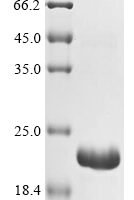
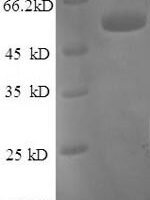
SDS-PAGE: Single band at expected molecular weight confirming purity.

ELISA: Suitable as coating antigen or detection standard.

Western Blot: Compatible with standard Western Blot protocols.

Protein Interaction: Validated for SPR (Surface Plasmon Resonance) and BLI (Bio-Layer Interferometry) studies.

Shipping: Shipped at ambient temperature. Lyophilized protein is stable during transit.

Storage: Store lyophilized protein at -20°C to -80°C. Reconstituted protein should be aliquoted and stored at -80°C. Avoid repeated freeze-thaw cycles.

Shelf Life: 12 months from date of receipt when stored as recommended.

Shipping Time: Orders placed before 2 PM EST ship same day. International orders typically deliver within 5-10 business days.

Protein Biology

Function

Adipokine secreted by white adipose tissue that plays an important regulatory role in the glucose metabolism of liver, muscle and pancreas (PubMed:27087445, PubMed:30853600). Hormone that targets the liver in response to fasting to increase plasma glucose levels (PubMed:27087445). Binds the olfactory receptor OR4M1 at the surface of hepatocytes and promotes hepatocyte glucose release by activating the protein kinase A activity in the liver, resulting in rapid glucose release into the circulation (PubMed:27087445, PubMed:31230984). May act as a regulator of adaptive thermogenesis by inhibiting browning and energy consumption, while increasing lipid deposition in white adipose tissue (By similarity). Also acts as an orexigenic hormone that increases appetite: crosses the blood brain barrier and exerts effects on the hypothalamus (By similarity). In the arcuate nucleus of the hypothalamus, asprosin directly activates orexigenic AgRP neurons and indirectly inhibits anorexigenic POMC neurons, resulting in appetite stimulation (By similarity). Activates orexigenic AgRP neurons via binding to the olfactory receptor OR4M1 (By similarity). May also play a role in sperm motility in testis via interaction with OR4M1 receptor (By similarity)

Subcellular Location

Secreted

Disease Association

Marfan syndrome (MFS) : A hereditary disorder of connective tissue that affects the skeletal, ocular, and cardiovascular systems. A wide variety of skeletal abnormalities occurs with Marfan syndrome, including scoliosis, chest wall deformity, tall stature, abnormal joint mobility. Ectopia lentis occurs in most of the patients and is almost always bilateral. The leading cause of premature death is progressive dilation of the aortic root and ascending aorta, causing aortic incompetence and dissection. Neonatal Marfan syndrome is the most severe form resulting in death from cardiorespiratory failure in the first few years of life. [The disease is caused by variants affecting the gene represented in this entry. The majority of the more than a thousand mutations in FBN1 currently known are point mutations, the rest are frameshifts and splice site mutations. Marfan syndrome has been suggested in at least 2 historical figures, Abraham Lincoln and Paganini] | Ectopia lentis 1, isolated, autosomal dominant (ECTOL1) : An ocular abnormality characterized by partial or complete displacement of the lens from its space resulting from defective zonule formation. [The disease is caused by variants affecting the gene represented in this entry] | Weill-Marchesani syndrome 2 (WMS2) : A rare connective tissue disorder characterized by short stature, brachydactyly, joint stiffness, and eye abnormalities including microspherophakia, ectopia lentis, severe myopia and glaucoma. [The disease is caused by variants affecting the gene represented in this entry] | Overlap connective tissue disease (OCTD) : Heritable disorder of connective tissue characterized by involvement of the mitral valve, aorta, skeleton, and skin. MASS syndrome is closely resembling both the Marfan syndrome and the Barlow syndrome. However, no dislocation of the lenses or aneurysmal changes occur in the aorta, and the mitral valve prolapse is by no means invariable. [The disease is caused by variants affecting the gene represented in this entry] | Stiff skin syndrome (SSKS) : A syndrome characterized by hard, thick skin, usually over the entire body, which limits joint mobility and causes flexion contractures. Other occasional findings include lipodystrophy and muscle weakness. [The disease is caused by variants affecting the gene represented in this entry] | Geleophysic dysplasia 2 (GPHYSD2) : An autosomal dominant disorder characterized by severe short stature, short hands and feet, joint limitations, and skin thickening. Radiologic features include delayed bone age, cone-shaped epiphyses, shortened long tubular bones, and ovoid vertebral bodies. Affected individuals have characteristic facial features including a 'happy' face with full cheeks, shortened nose, hypertelorism, long and flat philtrum, and thin upper lip. Other distinctive features include progressive cardiac valvular thickening often leading to an early death, toe walking, tracheal stenosis, respiratory insufficiency, and lysosomal-like storage vacuoles in various tissues. [The disease is caused by variants affecting the gene represented in this entry] | Acromicric dysplasia (ACMICD) : An autosomal dominant disorder characterized by severe short stature, short hands and feet, joint limitations, and skin thickening. Radiologic features include delayed bone age, cone-shaped epiphyses, shortened long tubular bones, and ovoid vertebral bodies. Affected individuals have distinct facial features, including round face, well-defined eyebrows, long eyelashes, bulbous nose with anteverted nostrils, long and prominent philtrum, and thick lips with a small mouth. Other characteristic features include hoarse voice and pseudomuscular build, and there are distinct skeletal features as well, including an internal notch of the femoral head, internal notch of the second metacarpal, and external notch of the fifth metacarpal. [The disease is caused by variants affecting the gene represented in this entry] | Marfanoid-progeroid-lipodystrophy syndrome (MFLS) : An autosomal dominant syndrome characterized by congenital lipodystrophy, a progeroid facial appearance due to lack of subcutaneous fat, and variable signs of Marfan syndrome. Clinical features include premature birth with an accelerated linear growth disproportionate to the weight gain, ectopia lentis, aortic dilatation, dural ectasia, and arachnodactyly. Mental and motor development are within normal limits. [The disease is caused by variants affecting the gene represented in this entry]

Subunit

Interacts with COL16A1 (PubMed:15165854). Interacts with integrin alpha-V/beta-3 (PubMed:15062093). Interacts with ADAMTS10; this interaction promotes microfibril assembly (PubMed:21402694). Interacts with THSD4; this interaction promotes fibril formation (By similarity). Interacts (via N-terminal domain) with FBLN2 and FBLN5 (PubMed:15790312, PubMed:17255108). Interacts with ELN (PubMed:15790312). Forms a ternary complex with ELN and FBLN2 or FBLN5 and a significant interaction with ELN seen only in the presence of FBLN2 or FBLN5 (PubMed:17255108). Interacts (via N-terminal domain) with LTBP2 (via C-terminal domain) in a Ca(+2)-dependent manner (PubMed:17293099). Interacts (via N-terminal domain) with LTBP1 (via C-terminal domain) (PubMed:17293099). Interacts with integrins ITGA5:ITGB1, ITGAV:ITGB3 and ITGAV:ITGB6 (PubMed:12807887, PubMed:17158881). Interacts (via N-terminal domain) with BMP2, BMP4, BMP7, BMP10 and GDF5 (PubMed:18339631). Interacts (via N-terminal domain) with MFAP2 and MFAP5 (PubMed:15131124). Interacts with ADAMTSL5 (PubMed:23010571). Interacts with MFAP4 (PubMed:26601954). Interacts (via N-terminal domain) with TNFSF11 in a Ca(+2)-dependent manner (PubMed:24039232). Interacts (via N-terminal domain) with EFEMP2; this interaction inhibits EFEMP2 binding to LOX and ELN (PubMed:17255108, PubMed:19349279, PubMed:19570982)

Gene: FBN1  |  Organism: Homo sapiens
Key Publications

Frequently Asked Questions

How do I order or inquire about this product?

Fill out the Online Inquiry form with your required quantity and specifications. You can also email sales@biocrestsci.com. Our team typically responds within 4 business hours with a quote and availability confirmation.

What is the shipping and delivery time?

Orders placed before 2 PM EST ship the same day. Domestic (US) delivery typically takes 2-3 business days. International orders deliver within 5-10 business days. All products are shipped at ambient temperature with appropriate packaging to ensure stability.

How should I store this recombinant protein?

Lyophilized proteins should be stored at -20°C to -80°C upon receipt. After reconstitution, aliquot and store at -80°C. Avoid repeated freeze-thaw cycles. Shelf life is 12 months from date of receipt when stored as recommended.

What quality controls are performed on your products?

Each product undergoes SDS-PAGE purity analysis (typically >85-95%), endotoxin testing, and bioactivity validation. Products are validated for ELISA, Western Blot, and SPR/BLI applications as specified on this product page. A Certificate of Analysis (CoA) is available upon request.

Shopping Cart
Scroll to Top