Recombinant Human Fragile X mental retardation syndrome-related protein 1 (FXR1)

Recombinant Human Fragile X mental retardation syndrome-related protein 1 (FXR1) — mRNA-binding protein that acts as a regulator of mRNAs translation and/or stability, and which is required for various processes, such as neurogenesis, muscle development and spermatogenesis. Purity >90%.

SKU: BCRECP-000703 Category:

Product Specifications

Product SkuBCRECP-000703
Product DescriptionRecombinant Human Fragile X mental retardation syndrome-related protein 1 (FXR1) Protein is expressed from E.coli with N-terminal GFP-tagged and C-terminal 6xHis-tagged. It contains 1-621aa. [Accession | P51114].
Uniprot No.P51114
Gene NamesFXR1
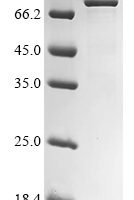
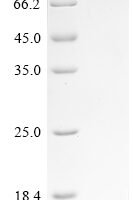
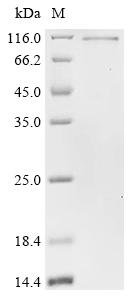
PurityGreater than 90% as determined by SDS-PAGE.
Expression SystemE.coli
Expression Region1-621aa
SpeciesHomo sapiens (Human)
Tag InfoN-terminal GFP-tagged and C-terminal 6xHis-tagged
Molecular weight97.7kDa
ActivityPlease contact us to obtain bioactivity data.
BufferIf the delivery form is liquid, the default storage buffer is Tris/PBS-based buffer, 5%-50% glycerol. If the delivery form is lyophilized powder, the buffer before lyophilization is Tris/PBS-based buffer, 6% Trehalose.
StorageStore at -20°C/-80°C upon receipt, aliquoting is necessary for mutiple use. Avoid repeated freeze-thaw cycles.
Research AreasEpigenetics and Nuclear Signaling

Function

mRNA-binding protein that acts as a regulator of mRNAs translation and/or stability, and which is required for various processes, such as neurogenesis, muscle development and spermatogenesis. Specifically binds to AU-rich elements (AREs) in the 3'-UTR of target mRNAs. Promotes formation of some phase-separated membraneless compartment by undergoing liquid-liquid phase separation upon binding to AREs-containing mRNAs, leading to assemble mRNAs into cytoplasmic ribonucleoprotein granules that concentrate mRNAs with associated regulatory factors.

Biological Context

Subcellular Location: Cytoplasm, Cytoplasmic ribonucleoprotein granule; Cytoplasm, Stress granule; Cytoplasm; Cell projection, dendrite; Cell projection, dendritic spine; Cell projection, axon; Nucleus envelope; Postsynapse
Tissue Specificity: Expressed in all tissues examined including heart, brain, kidney and testis. In brain, present at high level in neurons and especially in the Purkinje cells at the interface between the granular layer and the molecular layer (at protein level)
Disease Association: Congenital myopathy 9A (CMYO9A) : An autosomal recessive muscular disorder characterized by severe hypotonia apparent at birth, poor feeding, ulnar deviation of the hands, laterally deviated feet, fractures of the long bones, respiratory insufficiency due to muscle weakness, and death in infancy. [The disease is caused by variants affecting the gene represented in this entry] | Congenital myopathy 9B, proximal, with minicore lesions (CMYO9B) : An autosomal recessive, slowly progressive muscular disorder characterized by primarily proximal muscle weakness, neonatal hypotonia leading to delayed motor development, mildly delayed walking in childhood, and difficulty running or climbing. Cardiac function is unaffected, but most patients have obstructive sleep apnea. Muscle biopsy shows type 1 fiber predominance with disorganized Z-lines and minicores that disrupt the myofibrillar striation pattern. [The disease is caused by variants affecting the gene represented in this entry]

Product Specifications

Recombinant Human Fragile X mental retardation syndrome-related protein 1 (FXR1) is a recombinant protein from Homo sapiens (Human), expressed in E.coli, covering amino acids 1-621aa, with N-terminal GFP-tagged and C-terminal 6xHis-tagged tag, molecular weight 97.7kDa, purity Greater than 90% as determined by SDS-PAGE.. Suitable for ELISA and Western Blot applications.
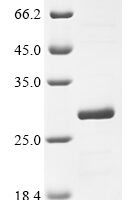
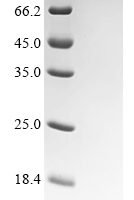
SDS-PAGE: Single band at expected molecular weight confirming purity.

ELISA: Suitable as coating antigen or detection standard.

Western Blot: Compatible with standard Western Blot protocols.

Protein Interaction: Validated for SPR (Surface Plasmon Resonance) and BLI (Bio-Layer Interferometry) studies.

Shipping: Shipped at ambient temperature. Lyophilized protein is stable during transit.

Storage: Store lyophilized protein at -20°C to -80°C. Reconstituted protein should be aliquoted and stored at -80°C. Avoid repeated freeze-thaw cycles.

Shelf Life: 12 months from date of receipt when stored as recommended.

Shipping Time: Orders placed before 2 PM EST ship same day. International orders typically deliver within 5-10 business days.

Protein Biology

Function

mRNA-binding protein that acts as a regulator of mRNAs translation and/or stability, and which is required for various processes, such as neurogenesis, muscle development and spermatogenesis (PubMed:17382880, PubMed:20417602, PubMed:30067974, PubMed:34731628, PubMed:35989368, PubMed:36306353). Specifically binds to AU-rich elements (AREs) in the 3'-UTR of target mRNAs (PubMed:17382880, PubMed:34731628). Promotes formation of some phase-separated membraneless compartment by undergoing liquid-liquid phase separation upon binding to AREs-containing mRNAs, leading to assemble mRNAs into cytoplasmic ribonucleoprotein granules that concentrate mRNAs with associated regulatory factors (By similarity). Required to activate translation of stored mRNAs during late spermatogenesis: acts by undergoing liquid-liquid phase separation to assemble target mRNAs into cytoplasmic ribonucleoprotein granules that recruit translation initiation factor EIF4G3 to activate translation of stored mRNAs in late spermatids (By similarity). Promotes translation of MYC transcripts by recruiting the eIF4F complex to the translation start site (PubMed:34731628). Acts as a negative regulator of inflammation in response to IL19 by promoting destabilization of pro-inflammatory transcripts (PubMed:30067974). Also acts as an inhibitor of inflammation by binding to TNF mRNA, decreasing TNF protein production (By similarity). Acts as a negative regulator of AMPA receptor GRIA2/GluA2 synthesis during long-lasting synaptic potentiation of hippocampal neurons by binding to GRIA2/GluA2 mRNA, thereby inhibiting its translation (By similarity). Regulates proliferation of adult neural stem cells by binding to CDKN1A mRNA and promoting its expression (By similarity). Acts as a regulator of sleep and synaptic homeostasis by regulating translation of transcripts in neurons (By similarity). Required for embryonic and postnatal development of muscle tissue by undergoing liquid-liquid phase separation to assemble target mRNAs into cytoplasmic ribonucleoprotein granules (PubMed:30770808). Involved in the nuclear pore complex localization to the nuclear envelope by preventing cytoplasmic aggregation of nucleoporins: acts by preventing ectopic phase separation of nucleoporins in the cytoplasm via a microtubule-dependent mechanism (PubMed:32706158). Plays a role in the stabilization of PKP2 mRNA and therefore protein abundance, via its interaction with PKP3 (PubMed:25225333). May also do the same for PKP2, PKP3 and DSP via its interaction with PKP1 (PubMed:25225333). Forms a cytoplasmic messenger ribonucleoprotein (mRNP) network by packaging long mRNAs, serving as a scaffold that recruits proteins and signaling molecules. This network facilitates signaling reactions by maintaining proximity between kinases and substrates, crucial for processes like actomyosin reorganization (PubMed:39106863)

Subcellular Location

Cytoplasm, Cytoplasmic ribonucleoprotein granule; Cytoplasm, Stress granule; Cytoplasm; Cell projection, dendrite; Cell projection, dendritic spine; Cell projection, axon; Nucleus envelope; Postsynapse

Disease Association

Congenital myopathy 9A (CMYO9A) : An autosomal recessive muscular disorder characterized by severe hypotonia apparent at birth, poor feeding, ulnar deviation of the hands, laterally deviated feet, fractures of the long bones, respiratory insufficiency due to muscle weakness, and death in infancy. [The disease is caused by variants affecting the gene represented in this entry] | Congenital myopathy 9B, proximal, with minicore lesions (CMYO9B) : An autosomal recessive, slowly progressive muscular disorder characterized by primarily proximal muscle weakness, neonatal hypotonia leading to delayed motor development, mildly delayed walking in childhood, and difficulty running or climbing. Cardiac function is unaffected, but most patients have obstructive sleep apnea. Muscle biopsy shows type 1 fiber predominance with disorganized Z-lines and minicores that disrupt the myofibrillar striation pattern. [The disease is caused by variants affecting the gene represented in this entry]

Tissue Specificity

Expressed in all tissues examined including heart, brain, kidney and testis (PubMed:7781595, PubMed:9259278). In brain, present at high level in neurons and especially in the Purkinje cells at the interface between the granular layer and the molecular layer (at protein level) (PubMed:9259278)

Subunit

(Microbial infection) Interacts with Sindbis virus non-structural protein 3 (via C-terminus); this interaction inhibits the formation of host stress granules on viral mRNAs and the nsp3-FXR1 complexes bind viral RNAs and probably orchestrate the assembly of viral replication complexes

Gene: FXR1  |  Organism: Homo sapiens  |  Synonyms: FMR1 autosomal homolog 1; hFXR1p
Key Publications

Frequently Asked Questions

How do I order or inquire about this product?

Fill out the Online Inquiry form with your required quantity and specifications. You can also email sales@biocrestsci.com. Our team typically responds within 4 business hours with a quote and availability confirmation.

What is the shipping and delivery time?

Orders placed before 2 PM EST ship the same day. Domestic (US) delivery typically takes 2-3 business days. International orders deliver within 5-10 business days. All products are shipped at ambient temperature with appropriate packaging to ensure stability.

How should I store this recombinant protein?

Lyophilized proteins should be stored at -20°C to -80°C upon receipt. After reconstitution, aliquot and store at -80°C. Avoid repeated freeze-thaw cycles. Shelf life is 12 months from date of receipt when stored as recommended.

What quality controls are performed on your products?

Each product undergoes SDS-PAGE purity analysis (typically >85-95%), endotoxin testing, and bioactivity validation. Products are validated for ELISA, Western Blot, and SPR/BLI applications as specified on this product page. A Certificate of Analysis (CoA) is available upon request.

Shopping Cart
Scroll to Top