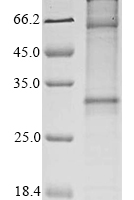
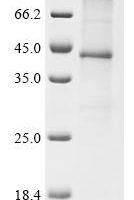
Recombinant Human G-protein coupled receptor 35 (GPR35) Protein

Recombinant Human G-protein coupled receptor 35 (GPR35) Protein — G protein-coupled receptor that binds to several ligands including the tryptophan metabolite kynurenic acid (KYNA), lysophosphatidic acid (LPA) or 5-hydroxyindoleacetic acid (5-HIAA) with high affi… Purity >90%.

SKU: BCRECP-00187TM Category:

Product Specifications

Uniprot No.Q9HC97
Gene NamesGPR35
PurityGreater than 90% as determined by SDS-PAGE.
Expression Systemin vitro E.coli expression system
Expression Region1-309aa
SpeciesHomo sapiens (Human)
Tag InfoN-terminal 10xHis-tagged
Molecular weight36.9kDa
BufferIf the delivery form is liquid, the default storage buffer is Tris/PBS-based buffer, 5%-50% glycerol.If the delivery form is lyophilized powder, the buffer before lyophilization is Tris/PBS-based buffer, 6% Trehalose.
StorageStore at -20°C/-80°C upon receipt, aliquoting is necessary for mutiple use. Avoid repeated freeze-thaw cycles.

Function

G protein-coupled receptor that binds to several ligands including the tryptophan metabolite kynurenic acid (KYNA), lysophosphatidic acid (LPA) or 5-hydroxyindoleacetic acid (5-HIAA) with high affinity, leading to rapid and transient activation of numerous intracellular signaling pathways. Ligand binding causes a conformation change that triggers signaling via guanine nucleotide-binding proteins (G proteins) and modulates the activity of downstream effectors, such as adenylate cyclase. GPR35 can couple with G(i)/G(o)- or G(12)/G(13) classes of G alpha proteins depending on the context, mediating the inhibition of adenylate cyclase or activation Rho small GTPases, respectively.

Biological Context

Subcellular Location: Cell membrane (Multi-pass membrane protein); Mitochondrion outer membrane (Multi-pass membrane protein)
Tissue Specificity: Predominantly expressed in immune and gastrointestinal tissues

Product Specifications

Recombinant Human G-protein coupled receptor 35 (GPR35) Protein is a recombinant protein from Homo sapiens (Human), expressed in in vitro E.coli expression system, covering amino acids 1-309aa, with N-terminal 10xHis-tagged tag, molecular weight 36.9kDa, purity Greater than 90% as determined by SDS-PAGE.. Suitable for ELISA and Western Blot applications.
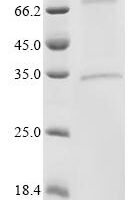
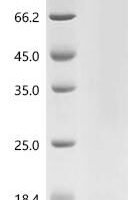
Recommended applications depend on the target, product format, and product-specific validation data. Refer to the product datasheet or Certificate of Analysis (CoA), or contact BioCrest Sci for application guidance.

Biological Activity: Not implied unless activity data are explicitly listed on this product page, the datasheet, or the CoA.

Storage: Store at -20°C/-80°C upon receipt, aliquoting is necessary for mutiple use. Avoid repeated freeze-thaw cycles.

Shipping & Lead Time: Availability, shipping conditions, and estimated lead time are confirmed in the formal quotation or order confirmation based on the product format, destination, and order requirements.

Protein Biology

Function

G protein-coupled receptor that binds to several ligands including the tryptophan metabolite kynurenic acid (KYNA), lysophosphatidic acid (LPA) or 5-hydroxyindoleacetic acid (5-HIAA) with high affinity, leading to rapid and transient activation of numerous intracellular signaling pathways (PubMed:16754668, PubMed:19473985, PubMed:20361937, PubMed:24347166, PubMed:35148838, PubMed:35926043). Ligand binding causes a conformation change that triggers signaling via guanine nucleotide-binding proteins (G proteins) and modulates the activity of downstream effectors, such as adenylate cyclase (PubMed:19473985, PubMed:35926043). GPR35 can couple with G(i)/G(o)- or G(12)/G(13) classes of G alpha proteins depending on the context, mediating the inhibition of adenylate cyclase or activation Rho small GTPases, respectively (PubMed:19473985, PubMed:35926043, PubMed:36543774). KYNA-binding promotes monocyte adhesion to vascular endothelium under flow conditions, leading to G(i)/GNAI1 activation and inhibition of adenylate cyclase (PubMed:19473985). Involved in cardioprotection during ischemia by promoting mitochondrial remodeling: following KYNA-binding and G(i)/GNAI1 activation, GPR35 is internalized to the outer mitochondrial membrane, where it inhibits mitochondrial adenylate cyclase (ADCY10), allowing ATPIF1 to repress ATP synthase activity (PubMed:35926043). Stimulates lipid metabolism, thermogenic and anti-inflammatory gene expression in adipose tissue once activated by KYNA (By similarity). Plays a role in neutrophil recruitment to sites of inflammation and bacterial clearance through the major serotonin metabolite 5-HIAA that acts as a physiological ligand (PubMed:35148838). In macrophages, activation by lysophosphatidic acid promotes GPR35-induced signaling with a distinct transcriptional profile characterized by TNF production associated with ERK and NF-kappa-B activation (By similarity). In turn, induces chemotaxis of macrophages (By similarity)

Subcellular Location

Cell membrane (Multi-pass membrane protein); Mitochondrion outer membrane (Multi-pass membrane protein)

Tissue Specificity

Predominantly expressed in immune and gastrointestinal tissues

Subunit

Interacts with ARRB2 (PubMed:35101446, PubMed:37660910)

Gene: GPR35  |  Organism: Homo sapiens  |  Synonyms: Kynurenic acid receptor
Key Publications

Frequently Asked Questions

How do I order or inquire about this product?

Submit the Online Inquiry form with your required quantity and specifications, or email sales@biocrestsci.com. Available sizes, pricing, stock status, documentation, and estimated lead time are confirmed in the formal quotation.

What is the shipping and delivery time?

Availability, dispatch timing, shipping conditions, and delivery estimates depend on the product format, destination, and order requirements. These details are confirmed in the formal quotation or order confirmation.

How should this product be stored?

Follow the storage and handling instructions in the product-specific datasheet and Certificate of Analysis (CoA). Requirements may vary by product form and formulation; contact BioCrest Sci if product-specific guidance is needed.

What quality controls are performed on your products?

Quality-control data such as identity, purity, endotoxin level, or biological activity are provided only when specified on this product page, the datasheet, or Certificate of Analysis (CoA). Biological activity is not implied unless explicitly stated.

Shopping Cart
Scroll to Top