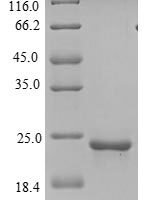
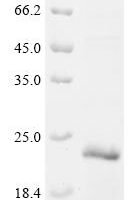
Recombinant Human Glycine receptor subunit alpha-1 (GLRA1), partial

Recombinant Human Glycine receptor subunit alpha-1 (GLRA1), partial — Subunit of heteromeric glycine-gated chloride channels. Purity >90%.

SKU: BCRECP-000760 Category:

Product Specifications

Product SkuBCRECP-000760
Product DescriptionRecombinant Human Glycine receptor subunit alpha-1 (GLRA1) Protein is expressed from E.coli with N-terminal 10xHis-tagged and C-terminal Myc-tagged. It contains 29-250aa. [Accession | P23415].
Uniprot No.P23415
Gene NamesGLRA1
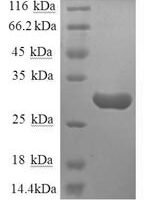
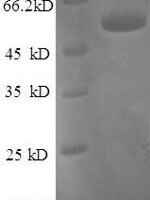
PurityGreater than 90% as determined by SDS-PAGE.
Expression SystemE.coli
Expression Region29-250aa
SpeciesHomo sapiens (Human)
Tag InfoN-terminal 10xHis-tagged and C-terminal Myc-tagged
Molecular weight33.1 kDa
ActivityPlease contact us to obtain bioactivity data.
BufferIf the delivery form is liquid, the default storage buffer is Tris/PBS-based buffer, 5%-50% glycerol. If the delivery form is lyophilized powder, the buffer before lyophilization is Tris/PBS-based buffer, 6% Trehalose.
StorageStore at -20°C/-80°C upon receipt, aliquoting is necessary for mutiple use. Avoid repeated freeze-thaw cycles.
Research AreasOthers

Function

Subunit of heteromeric glycine-gated chloride channels. Plays an important role in the down-regulation of neuronal excitability. Contributes to the generation of inhibitory postsynaptic currents.

Biological Context

Subcellular Location: Postsynaptic cell membrane (Multi-pass membrane protein); Synapse; Perikaryon; Cell projection, dendrite; Cell membrane (Multi-pass membrane protein)
Disease Association: Hyperekplexia 1 (HKPX1) : A neurologic disorder characterized by muscular rigidity of central nervous system origin, particularly in the neonatal period, and by an exaggerated startle response to unexpected acoustic or tactile stimuli. [The disease is caused by variants affecting the gene represented in this entry]

Product Specifications

Recombinant Human Glycine receptor subunit alpha-1 (GLRA1), partial is a recombinant protein from Homo sapiens (Human), expressed in E.coli, covering amino acids 29-250aa, with N-terminal 10xHis-tagged and C-terminal Myc-tagged tag, molecular weight 33.1 kDa, purity Greater than 90% as determined by SDS-PAGE.. Suitable for ELISA and Western Blot applications.
Recommended applications depend on the target, product format, and product-specific validation data. Refer to the product datasheet or Certificate of Analysis (CoA), or contact BioCrest Sci for application guidance.

Biological Activity: Please contact us to obtain bioactivity data.

Storage: Store at -20°C/-80°C upon receipt, aliquoting is necessary for mutiple use. Avoid repeated freeze-thaw cycles.

Shipping & Lead Time: Availability, shipping conditions, and estimated lead time are confirmed in the formal quotation or order confirmation based on the product format, destination, and order requirements.

Protein Biology

Function

Subunit of heteromeric glycine-gated chloride channels (PubMed:14551753, PubMed:23994010, PubMed:25730860, PubMed:37821459). Plays an important role in the down-regulation of neuronal excitability (PubMed:8298642, PubMed:9009272). Contributes to the generation of inhibitory postsynaptic currents (PubMed:25445488). Channel activity is potentiated by ethanol (PubMed:25973519). Potentiation of channel activity by intoxicating levels of ethanol contribute to the sedative effects of ethanol (By similarity)

Subcellular Location

Postsynaptic cell membrane (Multi-pass membrane protein); Synapse; Perikaryon; Cell projection, dendrite; Cell membrane (Multi-pass membrane protein)

Disease Association

Hyperekplexia 1 (HKPX1) : A neurologic disorder characterized by muscular rigidity of central nervous system origin, particularly in the neonatal period, and by an exaggerated startle response to unexpected acoustic or tactile stimuli. [The disease is caused by variants affecting the gene represented in this entry]

Subunit

Interacts with GLRB to form heteropentameric channels; this is probably the predominant form in vivo (PubMed:22715885, PubMed:22973015, PubMed:25445488, PubMed:35526563, PubMed:37821459). Heteropentamer composed of four GLRA1 subunits and one GLRB subunit (PubMed:37821459). Heteropentamer composed of two GLRA1 and three GLRB (PubMed:22715885). Heteropentamer composed of three GLRA1 and two GLRB (PubMed:22973015). Homopentamer (in vitro) (PubMed:22715885, PubMed:22973015, PubMed:23994010, PubMed:25730860). Both homopentamers and heteropentamers form functional ion channels, but their characteristics are subtly different (PubMed:14551753, PubMed:22715885, PubMed:22973015, PubMed:23994010, PubMed:25445488, PubMed:25730860)

Gene: GLRA1  |  Organism: Homo sapiens  |  Synonyms: Glycine receptor 48 kDa subunit; Glycine receptor strychnine-binding subunit
Key Publications

Frequently Asked Questions

How do I order or inquire about this product?

Submit the Online Inquiry form with your required quantity and specifications, or email sales@biocrestsci.com. Available sizes, pricing, stock status, documentation, and estimated lead time are confirmed in the formal quotation.

What is the shipping and delivery time?

Availability, dispatch timing, shipping conditions, and delivery estimates depend on the product format, destination, and order requirements. These details are confirmed in the formal quotation or order confirmation.

How should this product be stored?

Follow the storage and handling instructions in the product-specific datasheet and Certificate of Analysis (CoA). Requirements may vary by product form and formulation; contact BioCrest Sci if product-specific guidance is needed.

What quality controls are performed on your products?

Quality-control data such as identity, purity, endotoxin level, or biological activity are provided only when specified on this product page, the datasheet, or Certificate of Analysis (CoA). Biological activity is not implied unless explicitly stated.

Shopping Cart
Scroll to Top