,

Recombinant Human ICOS ligand (ICOSLG), partial (Active)

Recombinant Human ICOS ligand (ICOSLG), partial (Active) — Ligand for the T-cell-specific cell surface receptor ICOS. Purity >95%.

SKU: BCACP-000069 Categories: ,
Product SKUBCACP-000069
Product DescriptionRecombinant Human ICOS ligand (ICOSLG) protein is expressed from Mammalian cell with C-terminal 6xHis-tagged. It contains 19-258aa. [Accession | O75144].
Uniprot No.O75144
Gene NamesICOSLG
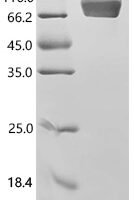
PurityGreater than 95% as determined by SDS-PAGE.
Expression SystemMammalian cell
Expression Region19-258aa
SpeciesHomo sapiens (Human)
Tag InfoC-terminal 6xHis-tagged
Molecular weight28.9 kDa
ActivityMeasured by its binding ability in a functional ELISA. Immobilized PD-1 at 2 μg/ml can bind Anti-PD-1 recombinant antibody, the EC50 of human PD-1 protein is 6.087-7.854 ng/ml.;Measured by its binding ability in a functional ELISA. Immobilized PD-1 at 2 μg/ml can bind Nivolumab, the EC50 of human PD-1 protein is 9.713-12.39 ng/ml.
BufferLyophilized from a 0.2 μm filtered 20 mM Tris-HCl, 0.5 M NaCl, 6% Trehalose, pH 8.0
StorageStore at -20°C/-80°C upon receipt, aliquoting is necessary for mutiple use. Avoid repeated freeze-thaw cycles.
Alternative NamesICOSLG; B7H2; B7RP1; ICOSL; KIAA0653; ICOS ligand; B7 homolog 2; B7-H2; B7-like protein Gl50; B7-related protein 1; B7RP-1; CD antigen CD275

Function

Ligand for the T-cell-specific cell surface receptor ICOS. Acts as a costimulatory signal for T-cell proliferation and cytokine secretion. Also induces B-cell proliferation and differentiation into plasma cells.

Biological Context

Subcellular Location: Cell membrane
Tissue Specificity: Detected only in lymph nodes, leukocytes and spleen. Expressed on activated monocytes and dendritic cells
Disease Association: Immunodeficiency 119 (IMD119) : An autosomal recessive immunologic disorder characterized by childhood-onset of recurrent respiratory tract infections, susceptibility to chronic DNA-based viral infections, hypogammaglobulinemia, and panlymphopenia. [The disease may be caused by variants affecting the gene represented in this entry]

Product Specifications

Recombinant Human ICOS ligand (ICOSLG), partial (Active) is a recombinant protein from Homo sapiens (Human), expressed in Mammalian cell, covering amino acids 19-258aa, with C-terminal 6xHis-tagged tag, molecular weight 28.9 kDa, purity Greater than 95% as determined by SDS-PAGE.. Suitable for ELISA and Western Blot applications.

Recommended applications depend on the target, product format, and product-specific validation data. Refer to the product datasheet or Certificate of Analysis (CoA), or contact BioCrest Sci for application guidance.

Biological Activity: Measured by its binding ability in a functional ELISA. Immobilized PD-1 at 2 μg/ml can bind Anti-PD-1 recombinant antibody, the EC50 of human PD-1 protein is 6.087-7.854 ng/ml.;Measured by its binding ability in a functional ELISA. Immobilized PD-1 at 2 μg/ml can bind Nivolumab, the EC50 of human PD-1 protein is 9.713-12.39 ng/ml.

Storage: Store at -20°C/-80°C upon receipt, aliquoting is necessary for mutiple use. Avoid repeated freeze-thaw cycles.

Shipping & Lead Time: Availability, shipping conditions, and estimated lead time are confirmed in the formal quotation or order confirmation based on the product format, destination, and order requirements.

Protein Biology

Function

Ligand for the T-cell-specific cell surface receptor ICOS. Acts as a costimulatory signal for T-cell proliferation and cytokine secretion (PubMed:11007762, PubMed:11023515, PubMed:30498080). Also induces B-cell proliferation and differentiation into plasma cells. Could play an important role in mediating local tissue responses to inflammatory conditions, as well as in modulating the secondary immune response by co-stimulating memory T-cell function (By similarity). In endothelial cells, required for proper neutrophil transmigration in response to chemoattractants, such as CXCL8/IL8 or N-formyl-methionyl peptides (fMLP) (PubMed:30498080)

Subcellular Location

Cell membrane

Disease Association

Immunodeficiency 119 (IMD119) : An autosomal recessive immunologic disorder characterized by childhood-onset of recurrent respiratory tract infections, susceptibility to chronic DNA-based viral infections, hypogammaglobulinemia, and panlymphopenia. [The disease may be caused by variants affecting the gene represented in this entry]

Tissue Specificity

Detected only in lymph nodes, leukocytes and spleen. Expressed on activated monocytes and dendritic cells

Subunit

Interacts with CTLA4 (in vitro)

Gene: ICOSLG  |  Organism: Homo sapiens  |  Synonyms: B7 homolog 2; B7-like protein Gl50; B7-related protein 1
Key Publications

Frequently Asked Questions

How do I order or inquire about this product?

Submit the Online Inquiry form with your required quantity and specifications, or email sales@biocrestsci.com. Available sizes, pricing, stock status, documentation, and estimated lead time are confirmed in the formal quotation.

What is the shipping and delivery time?

Availability, dispatch timing, shipping conditions, and delivery estimates depend on the product format, destination, and order requirements. These details are confirmed in the formal quotation or order confirmation.

How should this product be stored?

Follow the storage and handling instructions in the product-specific datasheet and Certificate of Analysis (CoA). Requirements may vary by product form and formulation; contact BioCrest Sci if product-specific guidance is needed.

What quality controls are performed on your products?

Quality-control data such as identity, purity, endotoxin level, or biological activity are provided only when specified on this product page, the datasheet, or Certificate of Analysis (CoA). Biological activity is not implied unless explicitly stated.

Shopping Cart
Scroll to Top