Recombinant Human Indian hedgehog protein (IHH), partial (Active)

Recombinant Human Indian hedgehog protein (IHH), partial (Active) — The dually lipidated indian hedgehog protein N-product is a morphogen that activates the smoothened signaling pathway, and which is essential for bone and cartilage development. Purity >96%.

SKU: BCACP-000868 Category:
Product SKUBCACP-000868
Product DescriptionRecombinant Human Indian hedgehog protein (IHH) protein is expressed from E.Coli with Tag-Free. It contains 29-202aa. [Accession | Q14623].
Uniprot No.Q14623
Gene NamesIHH
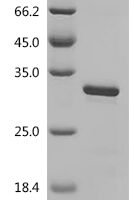
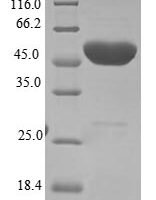
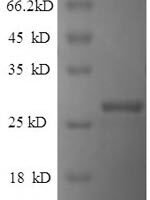
Purity>96% as determined by SDS-PAGE.
Expression SystemE.Coli
Expression Region29-202aa
SpeciesHomo sapiens (Human)
Tag InfoTag-Free
Molecular weight19.8 kDa
ActivityFully biologically active when compared to standard. The ED50 as determined by a cell proliferation assay using human A375 cell line is less than 5 μg/ml, corresponding to a specific activity of >200 IU/mg.
BufferLyophilized from a 0.2 μm filtered 20 mM Tris-HCl, 0.5 M NaCl, 6% Trehalose, pH 8.0
StorageStore at -20°C/-80°C upon receipt, aliquoting is necessary for mutiple use. Avoid repeated freeze-thaw cycles.
Alternative NamesBDA1; HHG-2; HHG2; IHH; IHH_HUMAN; Indian Hedgehog; Indian hedgehog homolog; Indian hedgehog protein; Indian hedgehog protein C-product; Indian hedgehog protein N-product

Function

The dually lipidated indian hedgehog protein N-product is a morphogen that activates the smoothened signaling pathway, and which is essential for bone and cartilage development. Acts by binding to the patched receptor (PTCH1 or PTCH2), relieving smoothened (SMO) inhibition by patched, activating the smoothened signaling pathway and transcription of target genes. In the absence of IHH, patched represses the constitutive signaling activity of SMO.

Biological Context

Subcellular Location: Secreted; Cell membrane (Lipid-anchor)
Tissue Specificity: Expressed in embryonic lung, and in adult kidney and liver
Disease Association: Brachydactyly A1 (BDA1) : An autosomal dominant form of brachydactyly, a group of inherited malformations characterized by shortening of the digits due to abnormal development of the phalanges and/or the metacarpals. Brachydactyly type A1 is characterized by middle phalanges of all the digits rudimentary or fused with the terminal phalanges. The proximal phalanges of the thumbs and big toes are short. Some BDA1 affected individuals exhibit short stature. [The disease is caused by variants affecting the gene represented in this entry] | Acrocapitofemoral dysplasia (ACFD) : An autosomal recessive disorder characterized by short stature of variable severity with postnatal onset. The most constant radiographic abnormalities are observed in the tubular bones of the hands and in the proximal part of the femur. Cone-shaped epiphyses or a similar epiphyseal configuration with premature epimetaphyseal fusion result in shortening of the skeletal components involved. Cone-shaped epiphyses are also present to a variable extent at the shoulders, knees and ankles. [The disease is caused by variants affecting the gene represented in this entry]

Product Specifications

Recombinant Human Indian hedgehog protein (IHH), partial (Active) is a recombinant protein from Homo sapiens (Human), expressed in E.Coli, covering amino acids 29-202aa, with Tag-Free tag, molecular weight 19.8 kDa, purity >96% as determined by SDS-PAGE.. Suitable for ELISA and Western Blot applications.
Recommended applications depend on the target, product format, and product-specific validation data. Refer to the product datasheet or Certificate of Analysis (CoA), or contact BioCrest Sci for application guidance.

Biological Activity: Fully biologically active when compared to standard. The ED50 as determined by a cell proliferation assay using human A375 cell line is less than 5 μg/ml, corresponding to a specific activity of >200 IU/mg.

Storage: Store at -20°C/-80°C upon receipt, aliquoting is necessary for mutiple use. Avoid repeated freeze-thaw cycles.

Shipping & Lead Time: Availability, shipping conditions, and estimated lead time are confirmed in the formal quotation or order confirmation based on the product format, destination, and order requirements.

Protein Biology

Function

The dually lipidated indian hedgehog protein N-product is a morphogen that activates the smoothened signaling pathway, and which is essential for bone and cartilage development (By similarity). Acts by binding to the patched receptor (PTCH1 or PTCH2), relieving smoothened (SMO) inhibition by patched, activating the smoothened signaling pathway and transcription of target genes (By similarity). In the absence of IHH, patched represses the constitutive signaling activity of SMO (By similarity). Plays a role in morphogenesis of the skeleton by coordinating growth and differentiation of the endochondral skeleton (By similarity). Positively regulates PTHLH expression during endochondral bone formation preventing chondrocyte hypertrophy (By similarity). In contrast, participates in normal chondrocyte proliferation in a PTHLH-independent pathway (By similarity). Involved in the development of retinal pigment epithelium (RPE), photoreceptors and periocular tissues (By similarity). Plays a role in hedgehog paracrine signaling (PubMed:24342078). Associated with the very-low-density lipoprotein (VLDL) particles to function as a circulating morphogen for endothelial cell integrity maintenance (PubMed:20839884)

Subcellular Location

Secreted; Cell membrane (Lipid-anchor)

Disease Association

Brachydactyly A1 (BDA1) : An autosomal dominant form of brachydactyly, a group of inherited malformations characterized by shortening of the digits due to abnormal development of the phalanges and/or the metacarpals. Brachydactyly type A1 is characterized by middle phalanges of all the digits rudimentary or fused with the terminal phalanges. The proximal phalanges of the thumbs and big toes are short. Some BDA1 affected individuals exhibit short stature. [The disease is caused by variants affecting the gene represented in this entry] | Acrocapitofemoral dysplasia (ACFD) : An autosomal recessive disorder characterized by short stature of variable severity with postnatal onset. The most constant radiographic abnormalities are observed in the tubular bones of the hands and in the proximal part of the femur. Cone-shaped epiphyses or a similar epiphyseal configuration with premature epimetaphyseal fusion result in shortening of the skeletal components involved. Cone-shaped epiphyses are also present to a variable extent at the shoulders, knees and ankles. [The disease is caused by variants affecting the gene represented in this entry]

Tissue Specificity

Expressed in embryonic lung, and in adult kidney and liver

Subunit

Interacts with BOC and CDON (PubMed:20519495). Interacts with PTCH1 (PubMed:21537345). Interacts with glypican GPC3 (By similarity)

Gene: IHH  |  Organism: Homo sapiens  |  Synonyms: HHG-2
Key Publications

Frequently Asked Questions

How do I order or inquire about this product?

Submit the Online Inquiry form with your required quantity and specifications, or email sales@biocrestsci.com. Available sizes, pricing, stock status, documentation, and estimated lead time are confirmed in the formal quotation.

What is the shipping and delivery time?

Availability, dispatch timing, shipping conditions, and delivery estimates depend on the product format, destination, and order requirements. These details are confirmed in the formal quotation or order confirmation.

How should this product be stored?

Follow the storage and handling instructions in the product-specific datasheet and Certificate of Analysis (CoA). Requirements may vary by product form and formulation; contact BioCrest Sci if product-specific guidance is needed.

What quality controls are performed on your products?

Quality-control data such as identity, purity, endotoxin level, or biological activity are provided only when specified on this product page, the datasheet, or Certificate of Analysis (CoA). Biological activity is not implied unless explicitly stated.

Shopping Cart
Scroll to Top