Recombinant Human Melanocortin receptor 4 (MC4R) Protein

Recombinant Human Melanocortin receptor 4 (MC4R) Protein — G protein-coupled receptor that binds melanocyte-stimulating hormones (alpha- and beta-MSH) and corticotropin/ACTH, which are peptide products of the POMC precursor. Purity >85%.

SKU: BCRECP-00298TM Category:

Product Specifications

Uniprot No.P32245
Gene NamesMC4R
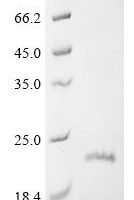
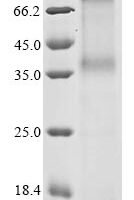
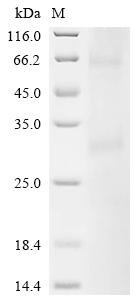
PurityGreater than 85% as determined by SDS-PAGE.
Expression Systemin vitro E.coli expression system
Expression Region1-332aa
SpeciesHomo sapiens (Human)
Tag InfoC-terminal 10xHis-tagged
Molecular weight38.3kDa
ActivityNot Test
BufferIf the delivery form is liquid, the default storage buffer is Tris/PBS-based buffer, 5%-50% glycerol.If the delivery form is lyophilized powder, the buffer before lyophilization is Tris/PBS-based buffer, 6% Trehalose.
StorageStore at -20°C/-80°C upon receipt, aliquoting is necessary for mutiple use. Avoid repeated freeze-thaw cycles.

Function

G protein-coupled receptor that binds melanocyte-stimulating hormones (alpha- and beta-MSH) and corticotropin/ACTH, which are peptide products of the POMC precursor. Functions as a central component of the leptin-melanocortin pathway, which is essential for maintaining energy homeostasis. Upon activation, couples to G(s) protein, stimulating adenylate cyclase and the cAMP-dependent signaling pathway, which promotes anorexogenic signaling in the hypothalamus and contributes to a negative energy balance.

Biological Context

Subcellular Location: Cell membrane (Multi-pass membrane protein); Cell projection, cilium membrane (Multi-pass membrane protein)
Tissue Specificity: Brain, placental, and gut tissues
Disease Association: Obesity (OBESITY) : A condition characterized by an increase of body weight beyond the limitation of skeletal and physical requirements, as the result of excessive accumulation of body fat. [Disease susceptibility is associated with variants affecting the gene represented in this entry. Obesity due to MC4R deficiency is associated with reduced total cholesterol, low-density lipoprotein-cholesterol, triglycerides and hypertension, and relative protection from cardiovascular disease]

Product Specifications

Recombinant Human Melanocortin receptor 4 (MC4R) Protein is a recombinant protein from Homo sapiens (Human), expressed in in vitro E.coli expression system, covering amino acids 1-332aa, with C-terminal 10xHis-tagged tag, molecular weight 38.3kDa, purity Greater than 85% as determined by SDS-PAGE.. Suitable for ELISA and Western Blot applications.
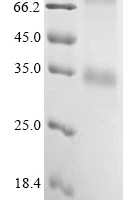
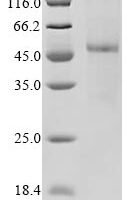
SDS-PAGE: Single band at expected molecular weight confirming purity.

ELISA: Suitable as coating antigen or detection standard.

Western Blot: Compatible with standard Western Blot protocols.

Protein Interaction: Validated for SPR (Surface Plasmon Resonance) and BLI (Bio-Layer Interferometry) studies.

Shipping: Shipped at ambient temperature. Lyophilized protein is stable during transit.

Storage: Store lyophilized protein at -20°C to -80°C. Reconstituted protein should be aliquoted and stored at -80°C. Avoid repeated freeze-thaw cycles.

Shelf Life: 12 months from date of receipt when stored as recommended.

Shipping Time: Orders placed before 2 PM EST ship same day. International orders typically deliver within 5-10 business days.

Protein Biology

Function

G protein-coupled receptor that binds melanocyte-stimulating hormones (alpha- and beta-MSH) and corticotropin/ACTH, which are peptide products of the POMC precursor (PubMed:12646665, PubMed:14764818, PubMed:25163632, PubMed:32327598, PubMed:33858992, PubMed:8392067). Functions as a central component of the leptin-melanocortin pathway, which is essential for maintaining energy homeostasis (PubMed:32327598, PubMed:33858992). Upon activation, couples to G(s) protein, stimulating adenylate cyclase and the cAMP-dependent signaling pathway, which promotes anorexogenic signaling in the hypothalamus and contributes to a negative energy balance (PubMed:12588803, PubMed:14764818, PubMed:25163632, PubMed:33858992). Regulates food intake: activation by agonists suppresses appetite, whereas the antagonist Agouti-related protein/AGRP precludes agonist-induced signaling, thereby stimulating appetite (PubMed:9311920, PubMed:29311635). Modulates the firing activity of neurons in paraventricular nucleus (PVN) of the hypothalamus via alpha-MSH and AGRP regulation of inwardly rectifying potassium channel KCNJ13 closure, independently of G(s) signaling (PubMed:32327598). In the PVN, also interacts with opsin 3/OPN3, which couples to G(i/o) proteins to inhibit MC4R-mediated cAMP signaling, thereby promoting food intake (PubMed:39951488). In intestinal epithelial cells, contributes to inhibition of hepatic glucose production via nesfatin-1/NUCB2, leading to increased cAMP levels and glucagon-like peptide 1 (GLP-1) secretion (PubMed:39562740). Interaction with MGRN1 displaces the G(s) protein, further decreasing MC4R signaling activity (PubMed:19737927). Also activated by gamma-MSH, though with low potency (PubMed:8392067)

Subcellular Location

Cell membrane (Multi-pass membrane protein); Cell projection, cilium membrane (Multi-pass membrane protein)

Disease Association

Obesity (OBESITY) : A condition characterized by an increase of body weight beyond the limitation of skeletal and physical requirements, as the result of excessive accumulation of body fat. [Disease susceptibility is associated with variants affecting the gene represented in this entry. Obesity due to MC4R deficiency is associated with reduced total cholesterol, low-density lipoprotein-cholesterol, triglycerides and hypertension, and relative protection from cardiovascular disease]

Tissue Specificity

Brain, placental, and gut tissues

Subunit

Homodimer; disulfide-linked, also forms higher order oligomers. Interacts with GNAS (PubMed:33858992). Interacts with ATRNL1 (By similarity). Interacts with MGRN1; this interaction competes with GNAS-binding and thus inhibits agonist-induced cAMP production. Interacts with MRAP and MRAP2; these associated factors increase ligand-sensitivity and generation of cAMP. Forms a complex with OPN3 and KCNJ13; interaction with OPN3 inhibits MC4R-mediated signaling (PubMed:39951488)

Gene: MC4R  |  Organism: Homo sapiens
Key Publications

Frequently Asked Questions

How do I order or inquire about this product?

Fill out the Online Inquiry form with your required quantity and specifications. You can also email sales@biocrestsci.com. Our team typically responds within 4 business hours with a quote and availability confirmation.

What is the shipping and delivery time?

Orders placed before 2 PM EST ship the same day. Domestic (US) delivery typically takes 2-3 business days. International orders deliver within 5-10 business days. All products are shipped at ambient temperature with appropriate packaging to ensure stability.

How should I store this recombinant protein?

Lyophilized proteins should be stored at -20°C to -80°C upon receipt. After reconstitution, aliquot and store at -80°C. Avoid repeated freeze-thaw cycles. Shelf life is 12 months from date of receipt when stored as recommended.

What quality controls are performed on your products?

Each product undergoes SDS-PAGE purity analysis (typically >85-95%), endotoxin testing, and bioactivity validation. Products are validated for ELISA, Western Blot, and SPR/BLI applications as specified on this product page. A Certificate of Analysis (CoA) is available upon request.

Shopping Cart
Scroll to Top